Tarot card meanings are best understood as a structured language rather than a fixed list of predictions. Readers commonly begin with established symbolism, numerology, suits, and the visual system of a chosen deck, then develop interpretations through study, context, journaling, and practice. Intuition can contribute, but it works most reliably alongside knowledge and reasoning.
That distinction matters because tarot has no single universal interpretive system. A Rider-Waite-Smith reading may organize cards differently from a Tarot de Marseille reading, while reversals, astrological correspondences, and birth-card calculations belong to particular traditions or modern practices rather than to tarot as a whole.
Start with the card before adding more cards
A common beginner’s habit is to avoid an unclear card by drawing numerous clarifiers. That can produce more material without producing more meaning. A stronger first step is to study the original card carefully and ask what it contributes to the question and spread position.
Readers developing their own meanings often work through each card individually. Useful areas of study include:
- the card’s imagery and symbols;
- its number or rank;
- its suit, where applicable;
- its position in the spread;
- its relationship to surrounding cards;
- the reader’s response to the image; and
- the card’s established meanings in the deck’s tradition.
This approach does not require choosing between book meanings and intuition. A reader can learn the symbolic vocabulary first, then notice which part of that vocabulary is most relevant in a particular reading. Experienced practitioners in the discussion emphasized that intuition alone is not a substitute for substantial study and practice.
Use the deck’s tradition as a framework
Tarot decks do not all communicate in the same way. The Rider-Waite-Smith system gives the numbered minor cards detailed scenes, making visual interpretation especially accessible. Readers may also work with Tarot de Marseille, whose minors traditionally rely more heavily on patterns, suit symbols, numbers, and the reader’s system of interpretation.
Even within the Rider-Waite-Smith family, editions can differ in coloring, borders, line work, and visual emphasis. Those changes may affect a reader’s personal connection with the cards, but they do not automatically create a new system of meanings. Choosing a deck is therefore partly a practical and aesthetic decision: the images should be clear enough to study and compelling enough to support sustained practice.
Historical study can help prevent modern assumptions from being treated as timeless rules. Readers in the discussion recommended reading tarot history alongside card-by-card guides, noting that broader cultural and philosophical connections may be missed when books are used only as quick references.
Read the four suits as patterns of emphasis
The suits can help identify the kind of concern dominating a reading. They are not rigid categories, and their meaning depends on the deck, the question, and the position of each card. Still, a concentration of one suit may point to a recurring area of attention.
- Wands: often invite consideration of action, drive, creative effort, ambition, or conflict.
- Cups: may emphasize feelings, relationships, emotional experience, or receptivity.
- Swords: can bring attention to thought, language, decisions, tension, or mental disturbance.
- Pentacles: commonly direct attention toward material circumstances, practical matters, the body, work, resources, and grounding.
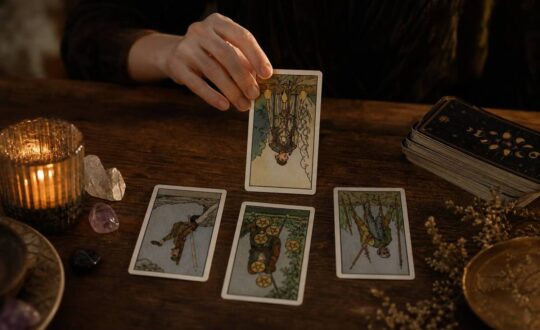
An all-Pentacles spread, for example, may suggest that practical or material conditions deserve more attention than emotional drama or abstract possibility. It may also point toward sustainability, patience, and the question of whether something can exist in everyday life over time. Another reader might simply treat the concentration as an overabundance of one type of energy and let the individual cards and positions determine whether it is helpful or restrictive.
There is no universal rule that an unusually concentrated spread is invalid. Some readers interpret the suit concentration directly; others focus only on the cards as dealt. The important practice is to recognize the pattern without allowing it to override the actual spread.
Let numbers connect cards within a suit
Numbered cards can be read at two levels: the meaning of the individual image and the developmental pattern suggested by its number. The sequence may help explain why a card appears where it does.
The Six of Wands illustrates this principle. It is often associated with victory, recognition, and success, but its place after the Five of Wands can add a sense of having survived or moved beyond struggle. In a reading about grief, recognition may not mean public fame. It could describe a personal victory, the ability to continue after hardship, or the hope of achieving a meaningful connection. The spread position and the reader’s question determine which possibility is most useful.
A difficult reaction to a card is also information, though not proof that the card is negative. If a reader strongly resists the Six of Wands, that response might prompt questions about attitudes toward praise, success, visibility, or the victories of other people. Personal discomfort can reveal an interpretive blind spot, but it should be examined rather than treated as the card’s definitive meaning.
Interpret reversals as a choice, not a requirement
A reversed card is one that appears upside down. Some readers use reversals routinely; others read every card upright and handle difficult or blocked expressions through context. Neither approach is inherently mandatory.
When reversals are used, they can indicate several different conditions depending on the reader’s method:
- an internal or less visible expression of the card;
- delay, blockage, or resistance;
- an excess or deficiency of the card’s quality;
- a complication of the upright meaning; or
- an emphasis that differs from the surrounding cards.
The reversed Six of Swords, for instance, might be read as difficulty moving on, emotional disturbance, a disrupted transition, or an inability to leave a troubling situation behind. A reported reading before a regretted trip connected that card with disturbance in an already difficult situation, while the Tower was understood as shock and the revelation of delusions. That account is one reader’s retrospective interpretation, not a universal prediction that those cards guarantee a bad journey.
Reversals should therefore be interpreted in relation to the question and spread position. Drawing additional cards to force certainty can make a reading harder to evaluate. A clear method applied consistently is generally more useful than repeatedly searching for a reassuring or definitive answer.
Separate traditional correspondences from modern additions
Tarot has been associated with astrology, elemental systems, numerology, and other esoteric frameworks, but those correspondences are not accepted by every reader. The Golden Dawn’s esoteric system, for example, imposed a particular structure of beliefs and correspondences onto the Rider-Waite-Smith tradition. Some practitioners value those links; others read without them.
Astrological and elemental correspondences can be useful when they are part of the reader’s chosen system. They should be presented as a framework rather than as an unavoidable property of every tarot deck. A reader does not need to use astrology or esoteric correspondences to interpret cards effectively.
Understand what birth cards actually represent
Birth cards, sometimes called year cards or personality and soul cards, are a modern numerological practice based on a person’s birth date. They are not an ancient feature of tarot. The discussion identifies Mary K. Greer as a major popularizer of the modern birth-card system through her 1984 book Tarot Constellations: Patterns of Personal Destiny, while also noting that she learned about birth cards from Angeles Arriens.
Birth-card calculations commonly add the numbers of a birth date and reduce the result according to the practitioner’s chosen method, often relating the final number to a Major Arcana card. Because historical tarot decks differed in numbering, ordering, and even the presence of particular cards, the result is not a historically uniform tarot system. Justice and Strength, for example, occupy different numerical positions in Tarot de Marseille and Rider-Waite-Smith traditions.
That history does not make birth cards useless. It clarifies what they are: a modern interpretive tool that some readers find personally meaningful. They should not be confused with a historically continuous tarot practice or with an astrological birth chart, which is based on planetary positions.
Build meanings through a repeatable practice
Personal meanings become more dependable when they are recorded and tested over time. A tarot journal can include the question, card, spread position, initial response, traditional associations, and later observations. One-card-a-day exercises and structured studies of an entire deck can help reveal recurring patterns without requiring the reader to memorize a single rigid definition.
Books can serve different purposes. A reader may work through a comprehensive study from beginning to end to understand its overall philosophy, then return to selected sections as a reference. Both methods appeared in the discussion, along with the view that connections across a whole text can be lost when a book is consulted only one page at a time.
Reading for other people is another stage of practice, but it need not be the first one. Developing a journal and working consistently with one’s own readings can provide a foundation before taking on the added responsibility of interpreting for someone else.
The practical goal is not to eliminate ambiguity. It is to create enough structure that ambiguity can be explored through interactive tarot practice: begin with the deck’s system, study the image and number, note suit patterns, apply reversals only if they belong to the method, and treat birth cards and correspondences as optional modern frameworks. Over time, personal insight can become a disciplined extension of tarot knowledge rather than a replacement for it.