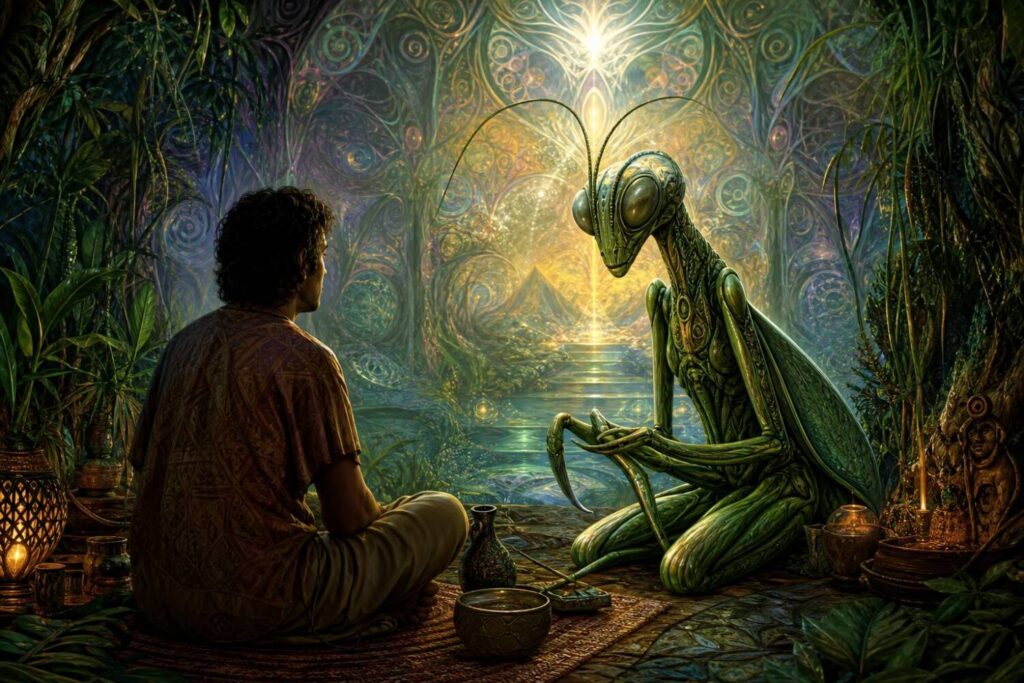
Reports of mantis-like beings appear in accounts of ayahuasca ceremonies, mushroom and salvia experiences, meditation, and other unusual states. People describe them in different ways: as guides, observers, companions, or frightening presences. Some say the beings communicate or perform some kind of work; others are unsure what they saw. The recurrence makes the stories culturally intriguing, but it does not establish that the beings exist outside the people experiencing them.
A useful starting point is to treat each account as a report of a subjective experience. That leaves room to take the person’s feelings seriously without treating their interpretation as verified fact. It also helps separate two questions that often become tangled: what did someone experience, and what caused it?
One experience, several possible meanings
In one account, a person describes an ayahuasca ceremony in Peru in which they felt taken from ordinary reality into another dimension. They encountered tall mantis beings in a void-like space and understood them to be training them in raising their “vibration” and “frequency.” The person also describes an intense feeling of oneness, with no separate sense of identity. This is a vivid personal narrative, and its language gives the experience a spiritual framework. It does not, on its own, establish that another dimension or its inhabitants were objectively present.
Other accounts in the dossier differ in both setting and interpretation. A salvia user describes meeting a mantis being they identify as a guide or companion. A person who had taken mushrooms reports seeing a mantis-like face reflected in a bathroom window and wonders whether it was a hallucination. Another account begins during meditation, with the person feeling dreamlike and “out of it” despite having taken no drugs. These similarities matter as a cultural pattern, but the differences matter too: the setting, emotional tone, and degree of certainty vary.
What might explain the pattern?
Several explanations can be considered without assuming that one answer fits every report. The most direct is that altered or dreamlike states can involve unusual perceptions and a strong sense that an experience is real or meaningful. In the mushroom account, the person explicitly asks whether what they saw could have been a hallucination. A commenter makes a similar point, while another suggests that the mind may give a face to a feeling of communicating with something wholly unfamiliar. These are interpretations, not settled explanations, but they show how participants themselves weigh different possibilities.
A second possibility is that familiar cultural images help people describe experiences that are difficult to put into words. “Mantis” can function as a label for a distinctive insect-like appearance, while “guide,” “visitor,” or “technician” describes the role a person believes the figure played. This does not mean the experience is invented or insincere. It means that perception and interpretation are intertwined: a person can report an intense encounter while remaining uncertain about what it was.
A third possibility is that online discussion shapes how people compare and narrate experiences. In the threads, commenters share similar stories, ask for details, and offer spiritual explanations. Others respond with skepticism or alternative accounts. That exchange can make a recurring image easier to recognize and discuss. It cannot show how common these experiences are in the wider population: a small set of posts and comments is not a representative survey, and engagement scores do not measure prevalence.
Meaning without certainty
For some people, the mantis figure becomes part of a continuing spiritual practice. In the ayahuasca discussion, commenters ask about techniques and describe meditation, prayer, breath work, and time in nature as ways of responding to the experience. In the salvia thread, the original poster says they need time to interpret and incorporate an intense trip, comparing the process to sitting with a powerful dream. These responses show how an encounter can acquire meaning after the event, even when its cause remains unclear.
That distinction is important. A personal experience may feel transformative, comforting, or frightening; its impact is real to the person reporting it. But sincerity and significance are not proof that an external being was present. Mantis-like figures in psychedelic and altered-state reports are best understood as a recurring motif in accounts of unusual perception, one that invites curiosity, careful listening, and humility about what can be concluded.