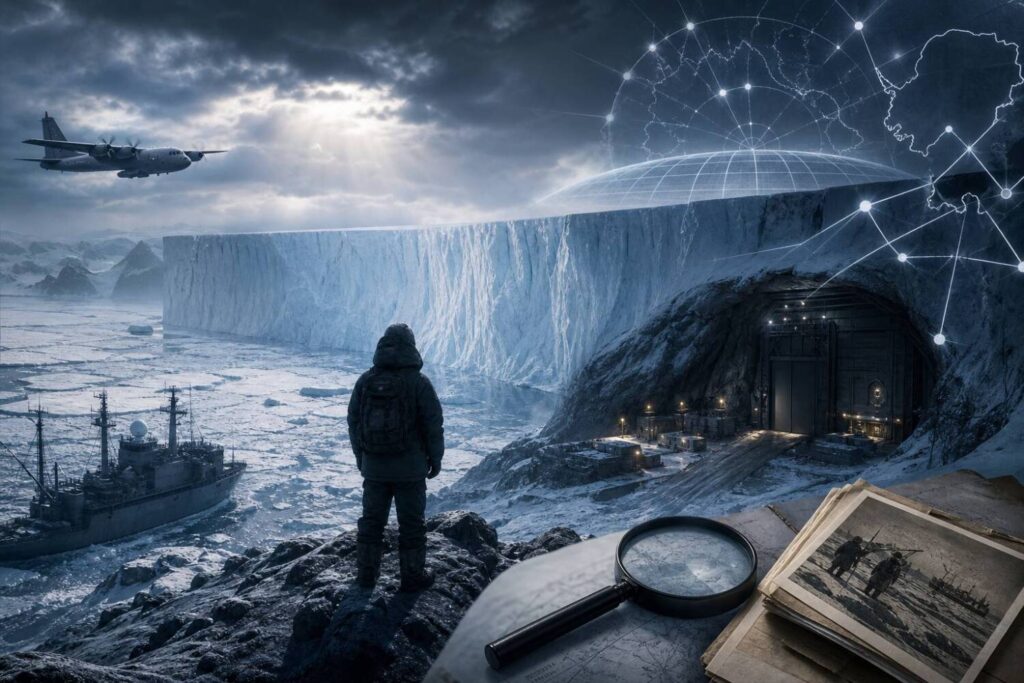
Antarctica’s remoteness, harsh conditions and limited access make it an easy setting for claims about hidden worlds and secret activity. Online discussions range from supposed underground civilizations and concealed bases to a world-encircling ice wall. Some posts also list more specific mysteries, including Lake Vostok, magnetic anomalies, “organism 46B,” blue ice and pyramid-like structures.
These ideas are not all the same kind of claim. Some grow from real features or events, an expedition, a place-name, a research site, and add an unsupported interpretation. Others, such as stories about inner Earth beings or a frozen advanced civilization, are presented in the discussions without verifiable evidence. A useful guide starts by separating the documented point from the story attached to it.
The “ice wall” and the Arctic mix-up
In one discussion, a commenter describes a supposed hidden map with walls of ice at the top and bottom of the world. This reflects a broader conspiracy motif in which Antarctica is imagined not as a continent but as a boundary concealing something beyond it. The supplied discussions do not provide evidence for a hidden wall or concealed geography.
Confusion between the Arctic and Antarctica also appears in the posts. They are not two ends of one ice-covered landmass: as a commenter explains, the Arctic is an ocean surrounded by continents, while Antarctica is a continent surrounded by ocean. That basic distinction matters when assessing claims about maps, access and the shape of the polar regions.
Hidden bases, ancient civilizations and place-names
Some posts speculate about secret bases, extraterrestrial technology, Nazi survival, underground cities or an ancient civilization beneath the ice. Another discussion lists claims involving a pyramid, an octagon-shaped building and unusual organisms. The material supplied here establishes that these claims circulate; it does not substantiate them. Repetition, vivid detail or a confident tone is not evidence that a structure or hidden society exists.
Rothschild Island illustrates how a real fact can be folded into speculation. The island is real, lies off the northwest coast of Alexander Island in West Antarctica, and was first mapped by the French Antarctic Expedition led by Jean Baptiste Charcot between 1908 and 1910. Charcot named it after Édouard Alphonse de Rothschild. The name’s association with a prominent banking family may sound suggestive to conspiracy-minded readers, but the discussion offers no evidence that the island’s name indicates a secret project.
What Operation Highjump does, and does not, show
Admiral Richard E. Byrd is a recurring figure in Antarctica conspiracy stories. He had extensive Antarctic experience, including leading Operation Highjump in 1946, 47, an expedition described in the discussion as involving roughly 4,700 personnel and 13 ships. A 1954 interview quoted Byrd describing an area “as big as the United States” that had never been seen by humans, beyond the pole.
That statement is sometimes used to suggest that Byrd discovered a hidden territory or entered an unexplored world. But the quote, as supplied, does not establish those conclusions. The discussions also refer to a supposed “secret diary”; one reply argues that it was not written by Byrd and instead combined material from his actual journal with fiction. The existence of a dramatic story about an expedition is not the same as evidence that the story is true.
Treaty rules and the idea of a sealed continent
Antarctica’s international arrangements can also feed suspicion. The supplied discussion says that 58 countries signed a treaty in 1959 and that its terms would be revisited in 2048. Some commenters interpret shared rules as proof that governments are hiding something. Others note that research, tourism and expeditions take place there, while environmental rules and restricted areas shape what visitors can do.
The same discussions describe the continent as a place for astronomy, physics, climate and geological-history research. Those activities, along with difficult living conditions and environmental protections, offer ordinary reasons for organized access and regulation. The material does not support the claim that Antarctica is wholly closed to visitors or controlled by a single government.
A practical test for polar claims
When evaluating an Antarctica story, ask what part is independently documented and what part is interpretation. A mapped island, a real expedition or a treaty is a starting point, not proof of hidden bases, ancient technology or an inner world. In the supplied discussions, many extraordinary claims are raised as questions or guesses, while the evidence offered for them is absent. Keeping that distinction in view makes it possible to take Antarctica’s real history and science seriously without treating speculation as fact.