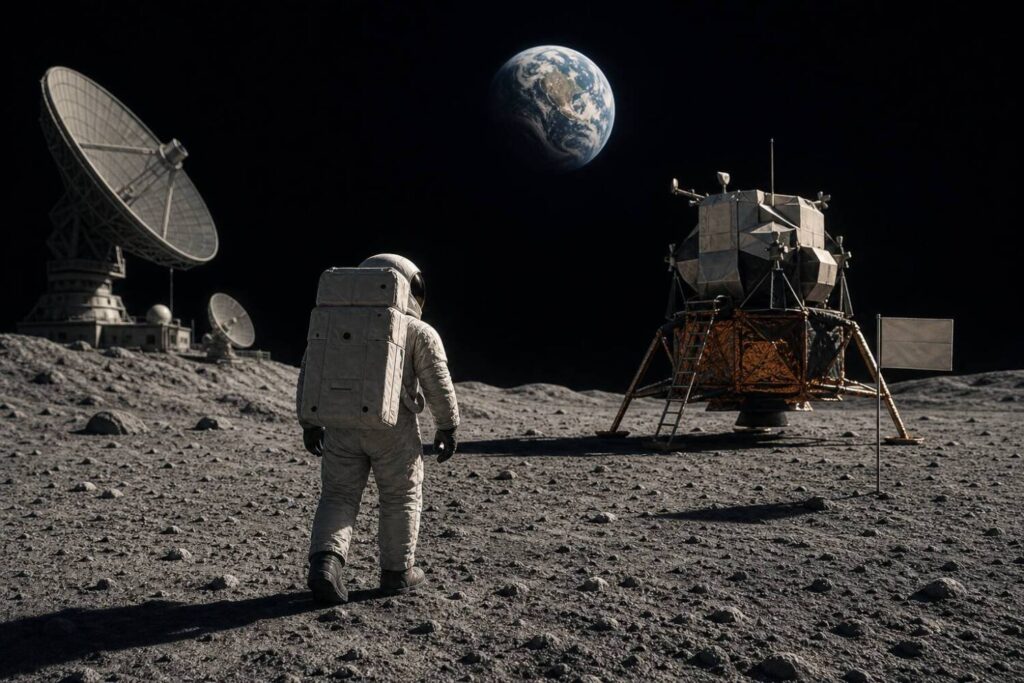
The Apollo Moon landings are often challenged with questions about how the missions were broadcast, why photographs appear to show unusual shadows, and why a rival power would not have exposed a fraud. Those questions can be assessed against the evidence cited in the debate: Apollo missions were televised using technology already in use on Earth, Soviet tracking is reported, and several claims about missing records or “lost” technology have more limited explanations than their online versions suggest.
A television broadcast, not internet-style livestreaming
Calling the 1969 coverage a “livestream” can make it sound more technologically extraordinary than it was. The term is usually associated with internet video today; the Apollo coverage was a televised broadcast. Live television was already common in the 1960s, including for news and sports.
That does not mean transmitting from the Moon was ordinary in every respect. It means the basic idea of sending pictures for a live broadcast was not new. The relevant question is whether the mission’s images and transmission fit the technology and conditions of the time, not whether they resemble a modern online stream.
What photographs can, and cannot, show about shadows
Some hoax claims point to shadows in lunar photographs as evidence that the images were staged. But an impression that a photograph “looks wrong” is not, by itself, proof of a set or studio lighting. The discussion of Apollo imagery points to physics simulations of how images would appear on the Moon, including in a vacuum and with sunlight reflected by lunar soil.
Those conditions matter when judging an image against familiar scenes on Earth. A serious shadow claim needs to explain why the photograph conflicts with the expected lighting conditions, rather than simply treating an unfamiliar appearance as evidence of fakery. The material discussed here does not provide a detailed, photograph-by-photograph analysis of particular shadows, so a specific image should be assessed on its own evidence.
The Soviet Union had reason to scrutinize the missions
Some versions of the theory ask why other countries, especially the United States’ Cold War rival, would have gone along with a fabrication. The Soviet Union, not Russia as a separate country, was the central competitor in the Space Race. A response cited in the debate says the Soviets tracked the Moon missions using deep-space radar and radio telemetry.
That point is significant because a rival power had a strong reason to challenge a false claim of success. It is not, on its own, a complete account of what every country knew or did. China is also raised in online discussions, but the material presented here does not establish what Chinese observers independently verified. The stronger point is the reported Soviet tracking, considered alongside the political incentive to expose a deception.
“Lost technology” and missing tapes are different claims
The claim that the technology to reach the Moon was “lost” often blurs two ideas: losing the ability to recreate the Apollo hardware and losing knowledge of how the missions worked. A response in the discussion argues that Apollo depended on a large network of companies and specialized manufacturing capabilities, many of which no longer exist. It also notes that Apollo hardware was dismantled after the program ended, while pointing to the use of a modified Apollo Guidance Computer in an early military fly-by-wire aircraft.
That explanation does not mean the original equipment can simply be put back into service. It does mean that dismantled hardware and a changed manufacturing base are not the same as proof that the missions never happened.
There is also a narrower, real archival issue: the original raw-format tapes of the Apollo 11 broadcast were lost, according to an account raised in the debate. Television-compatible conversions still exist. The loss of original tapes is worth distinguishing from the claim that all records of the broadcast disappeared; one does not establish the other.
Why six landings matter to the argument
The Apollo program made six successful crewed lunar landings between 1969 and 1972; Apollo 13 was a failed landing attempt. The repeated missions matter because a hoax theory has to account not just for one event, but for a series of missions and the scrutiny they attracted.
Some conspiracy arguments treat the Cold War motive, demonstrating American superiority, as if it were evidence that the landings were fabricated. It is a possible motive to consider, but motive alone does not prove an event was faked. The same competition also gave the Soviet Union reason to investigate and challenge a false claim.
Assess the evidence, not just the suspicion
Questions about broadcasting, shadows, archives and political motives are legitimate starting points for inquiry. They become evidence for a hoax only when they withstand closer examination and explain the full record better than the alternative. In the claims reviewed here, “live streaming” is a modern label for televised broadcasting, the Soviet Union is reported to have tracked the missions, and losses of equipment or original tapes do not amount to evidence that the landings themselves were staged.