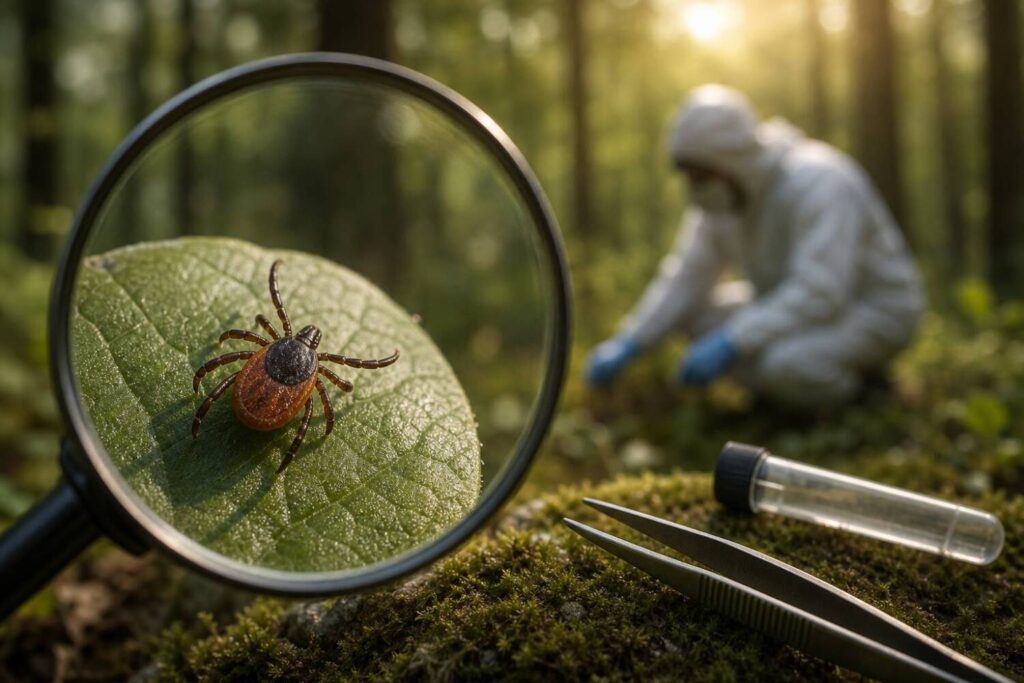
Claims that farmers are finding boxes of ticks dumped on their land have circulated alongside reports of tick bites and concern about tick-borne illnesses. The allegation goes further: that ticks are being deliberately planted to drive demand for Lyme disease vaccines or, in another version, to promote plant-based meat.
The material available here does not substantiate that allegation. It records social-media claims and discussion, but provides no independently verified discovery of a box, confirmed location, or evidence tying any such incident to vaccine demand or food products. That does not prove that no one has ever found a box containing ticks; it means the claim, as presented, has not been demonstrated.
Real health concerns do not confirm the conspiracy
Tick bites and tick-borne conditions are legitimate concerns. The discussion refers to Lyme disease and alpha-gal syndrome, a tick-borne condition that can make people allergic to red meat. People also describe finding ticks on themselves or having personal experience with Lyme disease and alpha-gal. Those accounts may reflect real experiences, but anecdotes do not establish a wider trend or explain its cause.
One discussion post frames reports of tick infestations and growing concern about alpha-gal as occurring while pharmaceutical companies advance new Lyme disease vaccines. Even if both developments are happening at the same time, timing alone does not show that one caused the other. It is not evidence that anyone is releasing ticks to create demand for a vaccine.
What the available evidence does, and does not, show
The dossier records claims that mysterious boxes have been found on farms and in forests, including a social-media account about a helicopter allegedly dropping ticks. It does not provide the original footage, a confirmed site visit, an identified source for the ticks, or independent verification of these accounts.
A separate post says health departments, entomologists and fact-checkers have debunked the rumors, but supplies no reports or findings to assess. That assertion is not a substitute for the underlying evidence. Likewise, replies that dismiss official sources or speculate about how a deliberate release might work do not verify the claim.
The key distinction is between evidence that ticks and tick-borne illnesses are a concern and evidence that people are deliberately planting ticks. The material supports the existence of the concern and the allegation; it does not establish the alleged planting or motive.
What would help verify a reported discovery
- Check the original account: Look for the full video or photographs, when and where they were recorded, and whether the account identifies who found the box.
- Seek independent confirmation: A claim is stronger if the location and discovery can be checked by people who were not involved in spreading the post.
- Separate observation from explanation: Even a confirmed box of ticks would not, on its own, show who placed it there or why.
- Look for evidence of motive: A connection to vaccine demand or plant-based meat requires evidence linking the alleged act to that purpose, not just the coincidence of public discussion or commercial activity.
Until those details are available, the responsible conclusion is limited: the tick-box story is circulating, but the supplied material does not verify it. Concern about tick-borne disease should be treated separately from an unsupported claim of deliberate release.