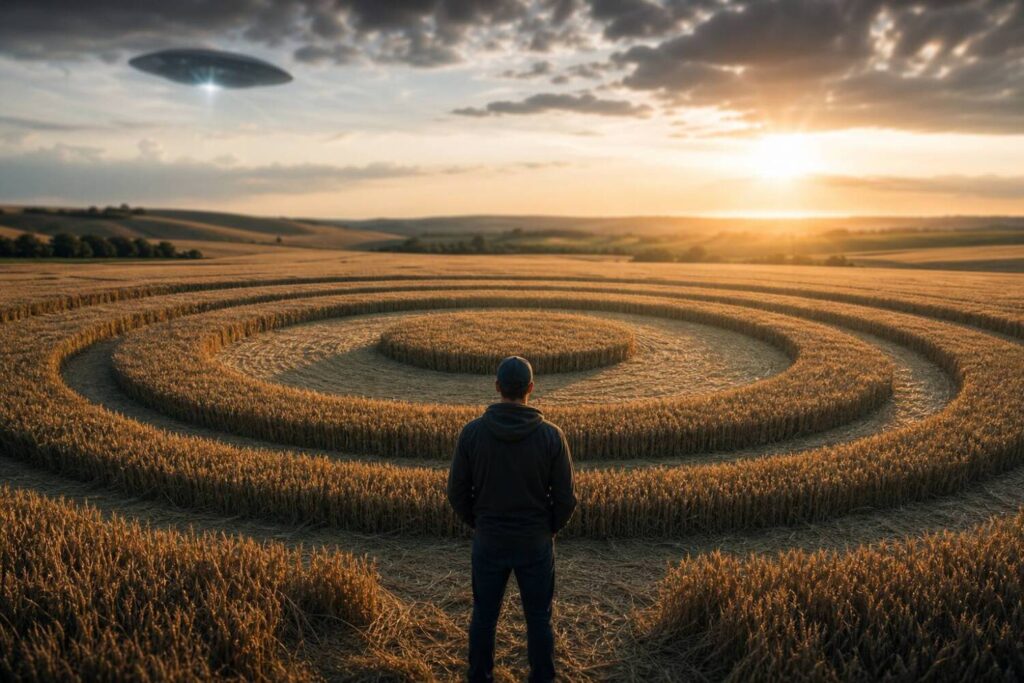
Crop circles have not simply vanished. Reports of new formations still circulate, including in 2026, but the phenomenon no longer commands the attention it once did. The best-supported explanation for many formations is human design: people have made them as pranks or deliberate works, and some have admitted to doing so. Claims that other circles are made by aliens remain speculation, not a conclusion established by the patterns themselves.
From mysterious marks to designed formations
Crop circles are patterns made by flattening crops in fields. Their scale and geometry can make them look difficult to produce from the ground, which has helped fuel theories about unusual forces or extraterrestrial visitors. But an intricate design is not, by itself, evidence of an extraordinary cause. A planned pattern can be laid out using measurements, angles and a design scaled up from a smaller drawing.
Human-made formations are not merely a theoretical possibility. People have been caught making crop circles, and some makers have reportedly confessed. That history means a formation’s appearance alone cannot establish that it has an unexplained origin. It also does not prove that every circle was made by people: each claim needs evidence specific to that formation.
One formation frequently raised in discussions is the Milk Hill design from 2001, described as 780 feet across and containing 409 circles. Its size and complexity are cited as reasons it would have been difficult to make in a short summer night. Those arguments speak to the challenge of the work, but they do not identify who, or what, made it.
Why reports attract less attention
Crop circles are still reported, but comments about their apparent decline offer several possible explanations rather than a settled account. Some people say fewer groups are making hoaxes or that public interest has faded. Others suggest that, in an era of easily altered images, photographs are less persuasive as evidence. These explanations are plausible, but the discussion does not provide figures that would establish how much the number of formations has changed.
Nor does every new report amount to a confirmed mystery. A formation may be real while claims about its maker, its construction or unusual effects remain unverified. Reports of formations in 2026 show that the subject remains active; they do not, on their own, demonstrate an unexplained cause.
What the alien claims do, and do not, show
Some enthusiasts argue that certain designs are too precise or complex for people to have made. Others point to claims about bent or interwoven stalks, radiation, or changes to plants. In the material available here, those are claims made by participants in the debate, not independently established findings. Without reliable measurements, documented observations and a way to rule out ordinary explanations, they cannot serve as proof of an alien origin.
The idea that crop circles are messages from extraterrestrials faces a further problem: a striking pattern does not tell us who made it or what it means. Proposed readings range from diagrams to coded communications, but no interpretation in the discussion is demonstrated. Alien explanations therefore remain speculation, while human authorship has been acknowledged in at least some cases.
What happened to crop circles?
The phenomenon appears less prominent in public conversation, not definitively over. New formations are still reported, and human-made designs remain part of the story. What has changed is how much attention the reports receive, and how difficult it can be to distinguish a documented formation from an unverified claim about its origin.