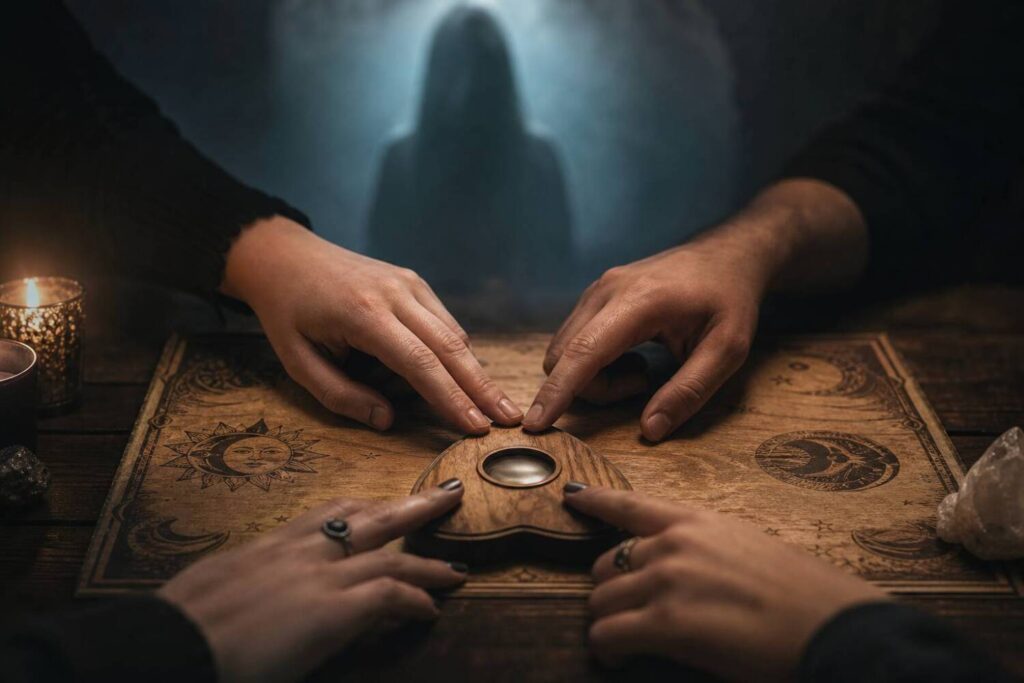
A Ouija planchette can move without any participant consciously deciding to push it. The best-established explanation is the ideomotor effect: expectations and thoughts can produce small, involuntary muscle movements. With several people touching the planchette, those movements can combine into a motion that feels surprising or external. That helps explain why a session can seem uncanny without establishing that a spirit is present.
It does not mean everyone who reports a startling experience is lying, or that every detail of every story has been explained. People interpret what happens in different ways. Some see the board as a tool for spirit communication; others understand it as a game shaped by expectation, group dynamics and a long history of spooky stories. Those interpretations are not equally supported by the movement itself.
How the planchette can seem to move on its own
In the ideomotor effect, a person’s expectations can influence slight movements without conscious awareness. On a Ouija board, participants rest their fingers on a planchette and ask questions, often anticipating that it will travel toward letters or answers. Even if nobody intends to steer it, subtle movements can guide it across the board.
In a group, the effect can be hard to detect. Several people may contribute small movements, while each feels the others’ fingers and the planchette moving. If the result is unexpected, participants may sincerely remember that they did not move it. That experience of lacking conscious control is not, by itself, evidence that the movement came from an outside force.
Expectation can also shape how a session feels. A board associated with ghosts, warnings and “trickster” entities invites participants to look for meaningful patterns. A name, number or phrase that seems to fit a person or situation can feel like a message. Other outcomes may be forgotten, or interpreted as deliberately mysterious.
What personal accounts can, and cannot, show
Online accounts describe a wide range of reactions: fear after a planchette spells a name, amazement at an answer that seems unexpectedly accurate, and disappointment when nothing happens. Some people recount motion they could not explain, while others say their sessions felt like ordinary spooky fun. These are reports of personal experiences, not independent verification that a spirit communicated through the board.
Even a striking answer leaves questions. Participants may know more than they realize, share information without noticing, or recognize a coincidence only after it occurs. A story can be compelling to the people involved without providing a way to determine who, or what, moved the planchette.
Paranormal interpretations remain important to some users. In the discussions reflected in the source material, people describe sessions as contact with spirits, warn about deceptive entities, or recommend rituals for ending a session. Those views express personal beliefs and practices. They are not established explanations for the board’s movement.
A board shaped by both play and folklore
The Ouija board occupies a space between manufactured game and supernatural symbol. Some participants describe using it as a party game or a way to scare friends; others treat it with deep caution or use it as a tool for divination. Stories about frightening sessions can reinforce the board’s reputation, drawing on folklore about cursed objects, while that reputation can make an ordinary movement feel more significant.
The source material also reflects disagreement about the board’s history. One collector describes antique and vintage spirit boards, including examples they say date back to the early 1800s. Other commenters emphasize the modern board as a commercial product. These comments point to a broader distinction between spirit-board traditions and particular products, but they do not establish a complete history or settle the origins of the Ouija board.
That tension helps explain the board’s cultural hold: it can be a plaything, a collectible, a decorative object or a focus for sincere spiritual beliefs. Its meaning depends partly on the stories people bring to it. The ideomotor effect offers a well-established account of how a planchette can move without deliberate pushing; what participants believe that movement means is a separate question.