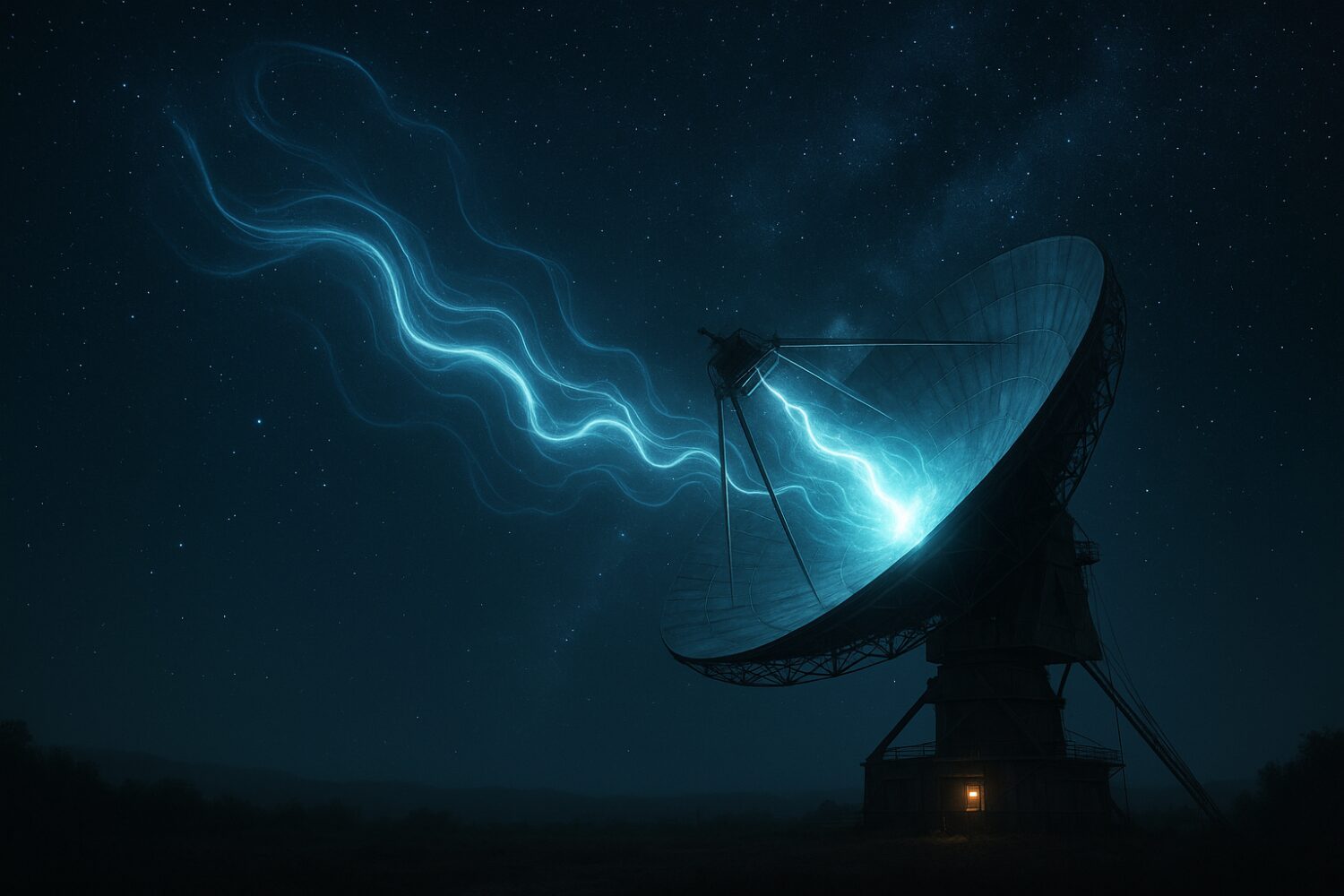
Big Ear’s Wow! Signal attracted attention because it was strong, narrow in frequency and close to the neutral hydrogen line. Its changing strength also resembled the response expected as a compact source passed through the telescope’s beam. Those features make it an interesting event for the search for extraterrestrial intelligence.
Which facts would distinguish a transmitter?
Earth-based transmitters can also produce narrow signals. Natural processes can concentrate radio emissions at particular frequencies. A better test would locate a repeat on the sky and check its frequency structure and movement with independent instruments. Big Ear had a single detection and two possible beam positions. Its six printed intensity values leave the waveform unknown. Ehman’s technical account of the original observation
A possible natural source
A study of archival Arecibo data found fainter narrow features near the hydrogen line and proposed that a short energetic event could brighten a cold hydrogen cloud. That would give a natural source a way to resemble a narrowband candidate. The authors tested related observations and proposed a mechanism for Wow! The 1977 event remains a single detection. Arecibo archival study and proposed mechanism
The case timeline follows the original observation and the attempt to refine where it came from. Its origin remains unresolved.