A strange smell, an unexpected voice or a device that seems to act on its own can be frightening. When several unusual events happen together, it is easy to treat them as one mystery and look for a single dramatic explanation. A safer approach is to assess each event separately, beginning with hazards that could harm someone and ordinary causes that can be checked.
A rotten-egg smell deserves immediate attention. Gas suppliers may add an odorant to natural gas so a leak is easier to notice, and the smell can resemble sulfur or rotten eggs. The odor does not prove there is a leak, but it is not something to investigate casually. If you smell it, leave the area and contact your local emergency service or gas provider from outside. Do not stay indoors trying to locate the source or operate electrical switches or appliances. Follow the instructions of emergency personnel.
Do not let an earlier inspection become a reason to dismiss a new smell. In one account, a resident said maintenance had checked an apartment after a rotten-egg odor appeared in one room and found nothing. That is reassuring only to a point: if the smell returns, changes or becomes stronger, treat the situation as a fresh safety concern and ask qualified personnel to assess it.
Keep other household hazards in view
Not every worrying household event has an odor. Carbon monoxide is a different concern: it has no smell, and exposure can cause symptoms including headaches. A discussion about an old pub included a commenter’s account of a confirmed leak after months of headaches. That anecdote is not a diagnosis, but it illustrates why unusual symptoms should not be attributed to a haunting without checking for environmental risks.
Make sure appropriate alarms are present and functioning, and take any alarm seriously. If anyone feels unwell or a carbon monoxide alarm sounds, move to fresh air and contact emergency services or another appropriate local authority. Do not rely on being able to smell a problem. A building inspection, alarm check or maintenance visit can help investigate a concern, but people should follow professional advice if symptoms or warnings continue.
Physical safety matters too. If a voice or movement seems to come from outside, check that doors and windows are secure when it is safe to do so. A commenter responding to a late-night voice described ordinary possibilities such as someone outside the home; another raised the possibility of a person accessing a crawl space or ceiling in a different case. These are possibilities, not evidence that an intruder is present. If there is a credible sign of entry or immediate danger, leave if you can do so safely and contact local authorities rather than searching the property alone.
Investigate ordinary causes one event at a time
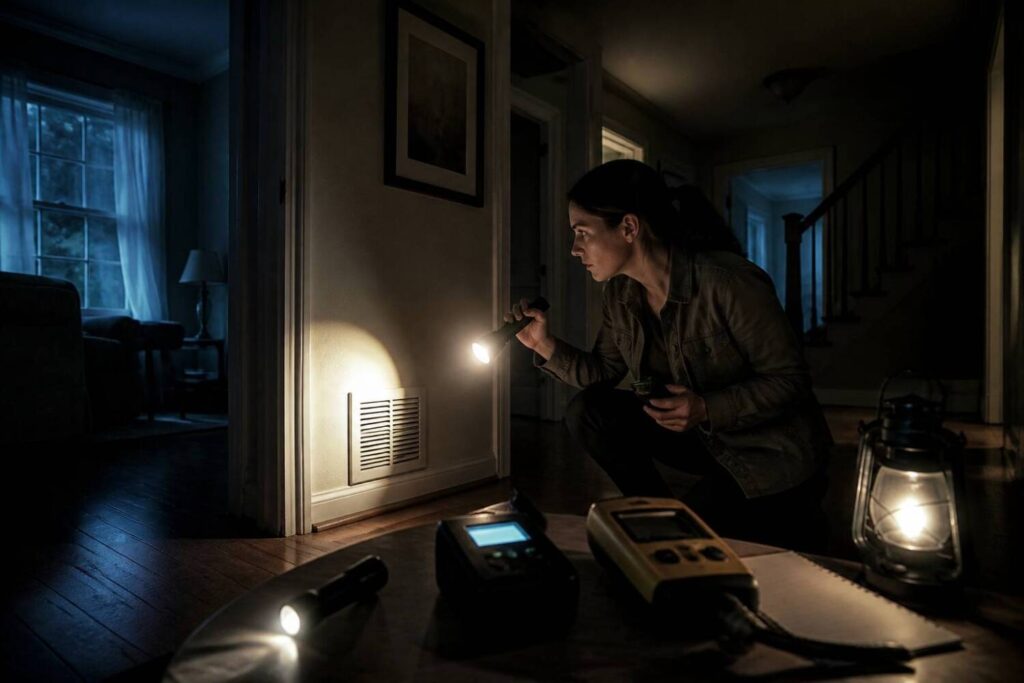
Once immediate hazards are addressed, make a calm record of what happened. Note the time, location, what was observed and who else was present. Separate direct observations from interpretations: “the television opened a video” is more useful than “a spirit used the television.” A simple timeline can show whether events repeat under particular conditions or whether several people independently noticed the same thing.
For unexpected television or phone activity, check the device and its ordinary controls before drawing conclusions. Look at whether a remote, connected device or account could be controlling playback, and review recent settings, downloads or account access. If you suspect someone is deliberately interfering with a device, change relevant passwords from a device you trust and ask a knowledgeable technician or service provider for help. Do not treat a search-bar message or an unusual video as proof of paranormal contact, or as proof of a particular person’s involvement. Secure evidence and seek appropriate technical help rather than confronting someone on the basis of a guess.
For noises, apparent voices or misplaced objects, compare notes with other household members and consider ordinary explanations such as sound carrying through a building, a person speaking nearby, a door or appliance, or a lapse in attention. Older buildings may have quirks, but newer buildings do not rule out environmental or equipment problems. In a discussion about a pub in an old building, one commenter recommended an inspection to help distinguish building issues from other interpretations; the resident said inspections and gas-detector checks were already part of their routine. That is a useful principle: check what can be checked, and be clear about what an inspection did and did not establish.
Take persistent or unusual experiences seriously
Strange perceptions do not mean someone is lying or “making it up.” They do mean that a paranormal explanation should not be the only explanation considered. Sleep disruption, stress, health conditions and medication effects can be relevant to unusual perceptions or memory. If someone repeatedly hears or sees things others do not, feels confused about a familiar place, or has a sudden change in memory or behaviour, arrange medical advice. If the change is urgent or the person may be in danger, seek prompt help.
One discussion about a person who thought a room had appeared in a familiar home included several commenters urging a medical assessment before considering paranormal theories. That is a sensible order of operations. A clinician can assess health-related explanations; a homeowner or qualified inspector can assess the building; a technician can look at devices. These checks do not settle every question, but they can identify issues that have practical solutions.
Keep paranormal interpretations in the realm of speculation
People in online discussions often offer spiritual explanations, cleansing practices or stories of similar experiences. Others suggest pranks, intruders, building acoustics, device problems or coincidence. These comments show how differently people interpret ambiguous events; they do not verify what caused them. A dramatic sequence, such as a reported sighting near a house fire, does not establish that one event caused the other. Timing alone is not evidence of a connection.
If a spiritual practice is personally meaningful and does not create a safety risk, it can be a private source of comfort. It should not replace leaving a home during a possible gas leak, checking a carbon monoxide alarm, seeking medical care or addressing credible security concerns. Be cautious of anyone who urges you to ignore those steps, makes alarming claims with certainty or pressures you into costly services.
A practical order of operations
- Respond to immediate hazards first. Treat a rotten-egg smell as a possible gas warning; leave and call for help from outside. Take carbon monoxide alarms and concerning symptoms seriously.
- Protect people and the home. If there are credible signs of an intruder or immediate danger, get to safety and contact local authorities.
- Record observations without assigning a cause. Write down what happened, when it happened and who witnessed it.
- Check relevant ordinary explanations. Ask qualified maintenance staff, a technician or a clinician for help as appropriate.
- Reassess if events continue. A previous inspection or an initial explanation does not rule out a new or recurring problem.
Curiosity is understandable, especially when experiences feel personal or seem to form a pattern. A safety-first investigation does not require dismissing what someone experienced. It means separating the experience from the explanation, checking urgent and testable causes first, and leaving paranormal conclusions where the evidence leaves them: as speculation.