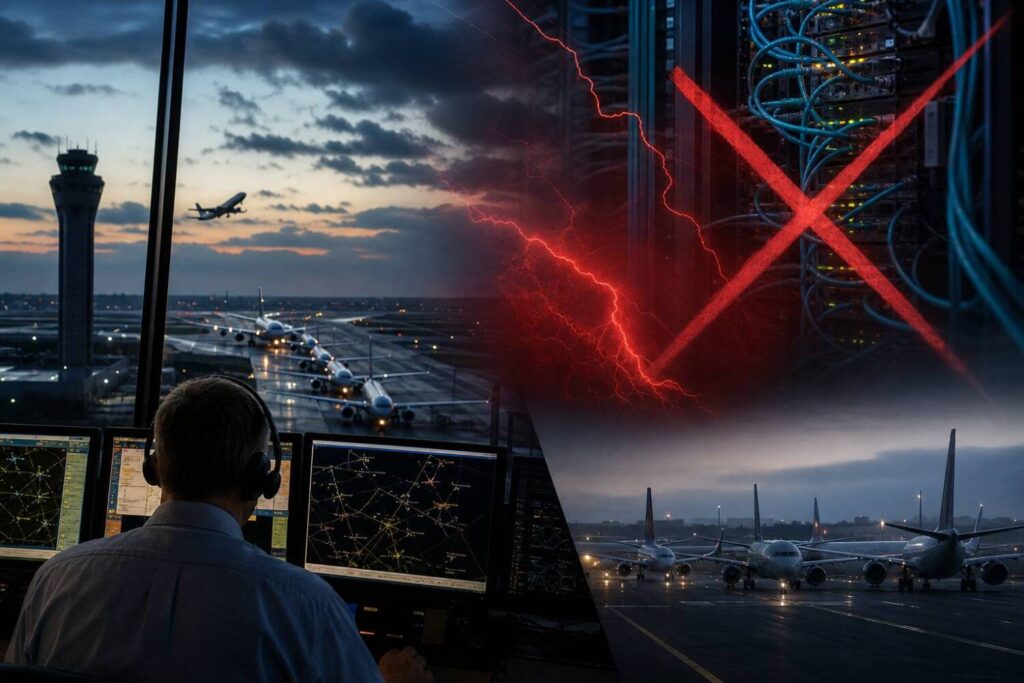
A flight attendant preparing for boarding said the captain had just delivered an unsettling message: a nationwide ground stop was in effect, and the FAA was saying only that it was for safety. The account appeared on Reddit, where passengers and purported aviation workers were trying to determine what had happened.
Other posts described communications disruptions and grounded flights. One commenter said a flight from Raleigh to New York circled before receiving clearance and later landed. Another said they had deplaned before a long-awaited trip. These accounts offer glimpses of disruption, but they do not establish the full scope, timing or cause of an FAA action. The supplied record contains no official FAA notice confirming those details.
A separate claim supplied a possible explanation. A person identifying as a senior telecom advisor wrote that a long-haul network connecting high-altitude radio towers was likely out and that contacts believed a backbone fiber line had been cut. The poster also said the exact cause was uncertain. That distinction matters. A plausible network failure is not evidence that this particular failure occurred.
Why communications can stop departures
Air traffic control depends on reliable communication between controllers and aircraft, as well as the systems and facilities that support the movement of flights. If a communications network fails or its reliability is in doubt, allowing more aircraft to depart into the affected airspace can add traffic faster than controllers can safely manage it.
A ground stop is a way to hold affected departures on the ground while the problem is assessed or capacity is constrained. Its scope depends on the operational problem: a disruption at one facility may have different consequences from a failure affecting connections used across a wider area. A report of a nationwide stop, by itself, does not reveal which equipment failed or whether every aircraft was affected.
Nor does “ground stop” mean that every aircraft already in flight suddenly lands. The commenter who described circling and then landing was reporting a different phase of a flight from the flight attendant preparing for boarding. Both accounts are consistent with disruption, but neither independently establishes the controlling instructions across the aviation system.
Where redundancy can fail
The telecom poster’s theory rests on a basic engineering problem: a backup is useful only if it remains available when the primary connection fails. Communications networks can have redundant routes intended to keep service running after a fault. But two routes that appear separate on a diagram may still share a physical vulnerability.
The poster suggested that fiber routes could run on opposite sides of a road, or be separated by only a limited distance. In that scenario, a directional boring rig or trencher crossing the area could damage both routes. The equipment would not need to strike the same cable twice; it could sever a primary path and a backup where their physical routes come close together.
That is an explanation of how redundancy might be defeated, not a finding about the reported ground stop. The source provides no verified location for a cut, no identified carrier or facility, and no official account of a failed backup. It also does not establish whether a fiber network was involved at all.
Reports converge, but do not establish a cause
Several Reddit posts described a nationwide stop or communications trouble. Their agreement is worth noting, but the posts do not show whether their authors independently received information from aviation personnel, saw the same online reports, or repeated a common claim. One post relayed an unconfirmed report of radar and frequency trouble possibly involving Chicago airports. Another commenter claimed a flight-plan system was affected. Neither claim is substantiated in the supplied record.
The discussion also reached beyond aviation. The original flight attendant post mentioned Microsoft, and other commenters pointed to a recent technology disruption as a reason for suspicion. Some asserted a cyberattack or proposed a connection to an air-traffic AI tool. Those are claims in a discussion, not evidence of a shared cause. Close timing alone cannot establish that separate outages are related, and the supplied material contains no technical findings linking them.
Even a confirmed communications outage would leave several questions open: whether the fault was physical or software-related, which systems were affected, whether backups worked as designed, and how the disruption translated into any departure restrictions. An intentional attack would require evidence beyond the existence of an outage.
What confirmation would resolve
The first firm step would be an official account of the ground stop itself: when it began, where it applied and what operational issue prompted it. A subsequent technical explanation could identify the affected communications service, the role of any redundant paths and whether a physical cable fault occurred.
Until then, the fiber-cut account remains a testable theory, and the proposed links to other technology problems remain speculation. The most precise unanswered question is whether an FAA communications failure prompted the reported ground stop and, if so, which component failed, and why its backup did or did not keep the service available.