

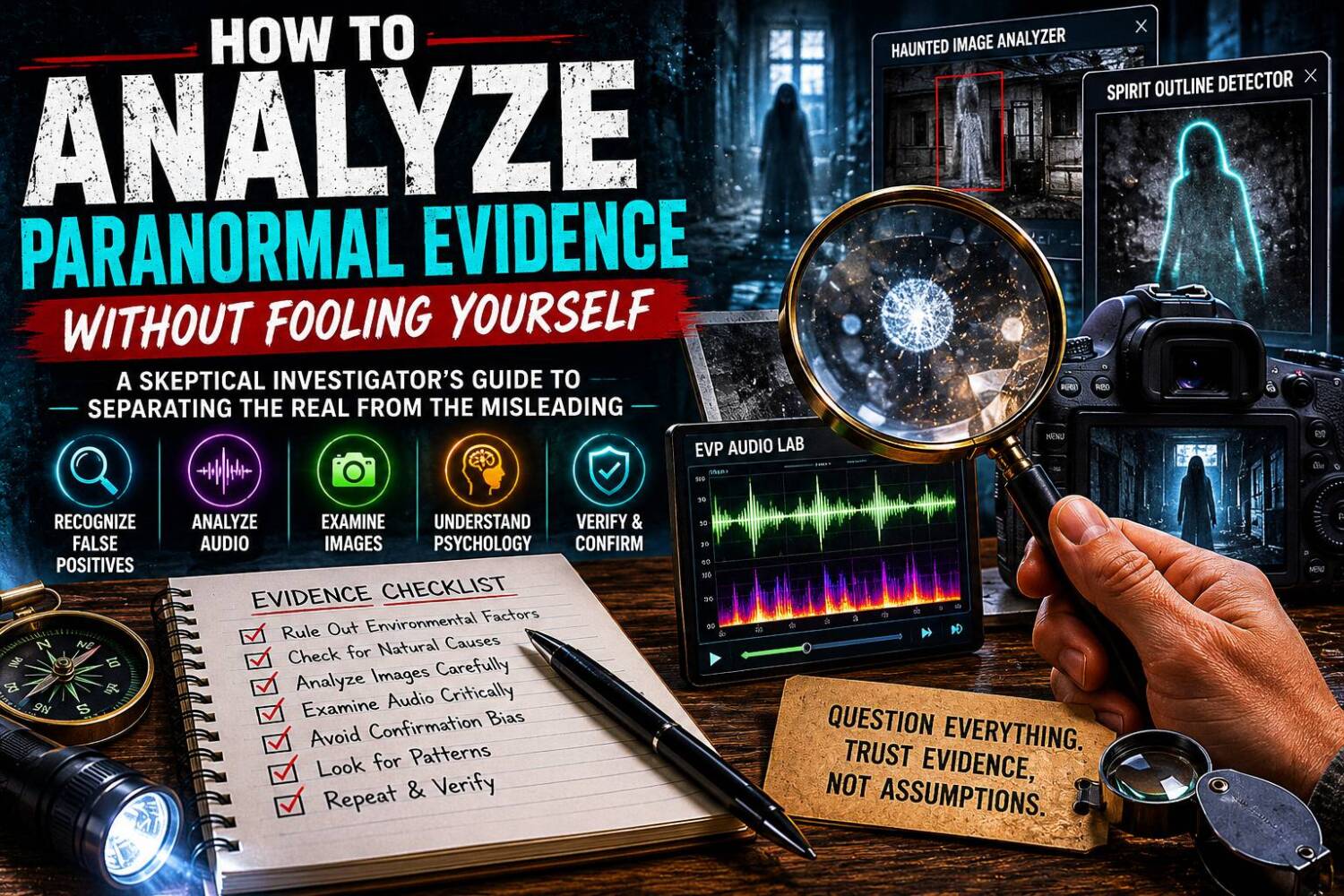

Ghost photos, EVP recordings, shadow figures, and mysterious anomalies can feel convincing in the moment. However, experienced paranormal investigators quickly learn that most evidence eventually receives an ordinary explanation.
Dust reflects infrared light. Audio compression creates phantom whispers. Human perception fills gaps with imagined patterns. Stress, expectation, and low-light environments all increase the likelihood of misinterpretation.
That does not necessarily mean every paranormal experience is fake. It means serious investigators must approach evidence carefully if they want to separate genuinely unusual events from ordinary mistakes.
This guide explains how paranormal investigators critically evaluate evidence without falling into confirmation bias or self-deception.
Step 1: Understand Pareidolia
Pareidolia is the brain’s tendency to find meaningful patterns in random information. Humans naturally see faces in shadows, hear voices in static, and interpret vague shapes as human figures.
This psychological effect explains why many ghost photographs appear convincing at first glance.
Common examples include:
- Faces appearing in wallpaper textures
- Shadow figures formed by uneven lighting
- Voices emerging from random static
- Human shapes created by motion blur
- Reflections mistaken for apparitions
The Spirit Outline Detector can help investigators examine whether apparent figures are consistent edge patterns or simply random visual noise.
Step 2: Analyze Ghost Photos Carefully
Photography is one of the most misunderstood areas of paranormal investigation because cameras capture many effects that the human eye ignores.
Before assuming a photo contains paranormal activity, rule out:
- Lens flare
- Dust or insects near infrared light
- Long-exposure motion blur
- Compression artifacts
- Double exposure
- Reflections in windows or mirrors
- Low-light sensor distortion
The Haunted Image Analyzer can help investigators enhance low-light images, adjust contrast, inspect shadows, and apply infrared-style analysis to suspicious areas.
Investigators should always compare enhanced versions against the untouched original image to avoid creating artificial anomalies during editing.
Step 3: Treat EVP Recordings Skeptically
Electronic Voice Phenomena, or EVP, is one of the most controversial forms of paranormal evidence because the human brain is extremely sensitive to speech patterns.
Random noise often sounds meaningful once listeners are told what they are expected to hear.
Possible non-paranormal explanations include:
- Radio interference
- Distant conversations
- Audio compression artifacts
- Mechanical sounds
- Electronic interference
- Auditory pareidolia
The EVP Audio Lab allows investigators to isolate frequencies, reduce background noise, reverse recordings, and inspect audio spectrograms for unusual patterns.
The Video Whisper Detector can also isolate faint dialogue hidden within noisy video recordings.
A strong EVP review process involves:
- Reviewing audio without suggestion first.
- Comparing interpretations between independent listeners.
- Checking for contamination from investigators.
- Reviewing surrounding environmental sounds.
- Testing whether the same phrase can be heard repeatedly.
Step 4: Understand Environmental Influences
Many sensations associated with hauntings can emerge from environmental conditions rather than supernatural causes.
Known environmental factors include:
- Carbon monoxide exposure
- Mold contamination
- Infrasound vibration
- Sleep deprivation
- Electromagnetic interference
- Temperature fluctuations
- Psychological stress
The Magnetic Field Map Generator can help investigators visualize unusual EMF hotspots that may influence both electronics and human perception.
The Ghost Radar can also help monitor changing audio-energy patterns during environmental sweeps.
Step 5: Watch for Suggestion and Group Psychology
One of the biggest problems in ghost hunting is accidental suggestion.
If one investigator says:
“Did you hear that whisper say ‘help me’?”
other people often begin hearing the same thing even when the sound is ambiguous.
This is why professional investigators prefer blind review whenever possible. Evidence should be analyzed before interpretations are shared publicly.
Group excitement, fear, darkness, and expectation can all amplify ordinary experiences into seemingly paranormal encounters.
Step 6: Look for Repeatability
Strong evidence usually repeats.
Single random anomalies are far less convincing than:
- Repeated sounds in the same location
- Multiple witnesses describing the same event independently
- Consistent audio anomalies under controlled conditions
- Environmental readings correlating with witness experiences
- Patterns recurring over multiple investigations
Repeatability matters because genuine patterns are harder to dismiss as coincidence or contamination.
Step 7: Do Not Force Conclusions
One of the most important habits in paranormal investigation is learning to say:
“I do not know what caused this.”
Unexplained does not automatically mean supernatural.
The strongest investigators remain willing to discard weak evidence, question their assumptions, and revisit conclusions when new information appears.
What Makes Paranormal Evidence Interesting?
Most paranormal claims collapse under careful review. However, certain types of evidence tend to attract serious attention:
- Multiple independent witnesses
- Consistent environmental anomalies
- Repeated audio events captured under controlled conditions
- Clear documentation with timestamps and context
- Evidence supported across different forms of recording
Even then, paranormal interpretation remains controversial.
Critical Thinking Improves Paranormal Investigation
Good paranormal investigation is not about blindly believing or aggressively debunking every claim. It is about careful observation, disciplined testing, and honest analysis.
The more investigators understand psychology, environmental science, photography, and audio analysis, the better equipped they become to identify truly unusual events.
Sometimes the most valuable discovery is not proving a haunting. It is learning how easily human perception can transform uncertainty into certainty.