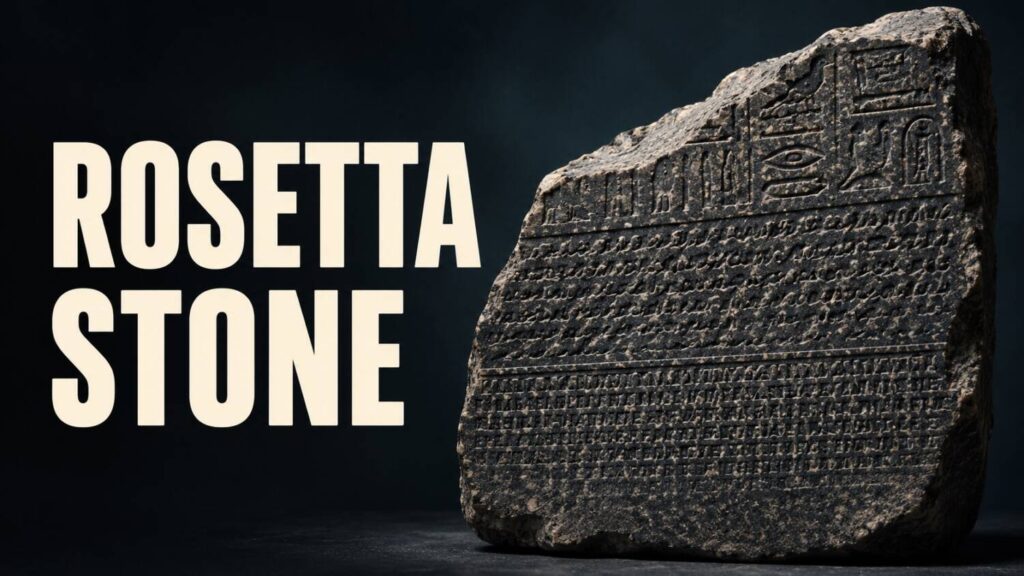
On the Rosetta Stone, the Greek text names King Ptolemy V. In the surviving hieroglyphic portion, a group of signs sits inside an oval reserved for a royal name. The name in Greek gave scholars a reason to look at those particular signs, and an independent clue to the sounds they might represent.
Two languages, three scripts
The stone preserves part of a decree issued in 196 BCE. The priests’ decree was written in Egyptian in hieroglyphs and Demotic, and in ancient Greek. The British Museum’s guide to the decipherment shows how the three versions give readers related passages to compare. Since the slab is broken, each version survives to a different extent.
Greek provided a way into the subject of the decree and supplied names. A cartouche, the oval frame around a royal name, then helped researchers find a small set of signs in the Egyptian section. If the signs recorded sounds, parts of Ptolemy’s name could provide possible values for them. The next question was whether those values still made sense in a different name.
How a reading earns its place
Thomas Young compared the versions and identified phonetic signs in the name Ptolemy. The Philae obelisk provided another inscription with a cartouche linked to Cleopatra. Shared letters in the names gave researchers a way to compare proposed sounds across separate monuments. An assignment made for one name could be kept, revised or discarded in light of the other.
Jean-François Champollion used evidence from other inscriptions and his knowledge of Coptic, a later form of Egyptian. In 1822 he set out findings that extended phonetic readings beyond Greek and Roman royal names. As the work developed, it became possible to explain how Egyptian writing combined signs for sounds with signs that helped indicate meaning.
When a parallel text is hard to use
Even a parallel inscription can leave important words unmatched. An ancient translator may summarize, change the order or write a title differently. Damage may remove the very line a researcher wants to compare. A useful parallel gives a reader enough separate points of contact to check an interpretation across more than one line.
The Indus inscriptions offer a comparison. Many are short, and there is no generally accepted bilingual text that pairs their signs with a readable version. The Rosetta Stone gave scholars somewhere specific to begin and, with other inscriptions, a way to find out where their first readings needed to change.