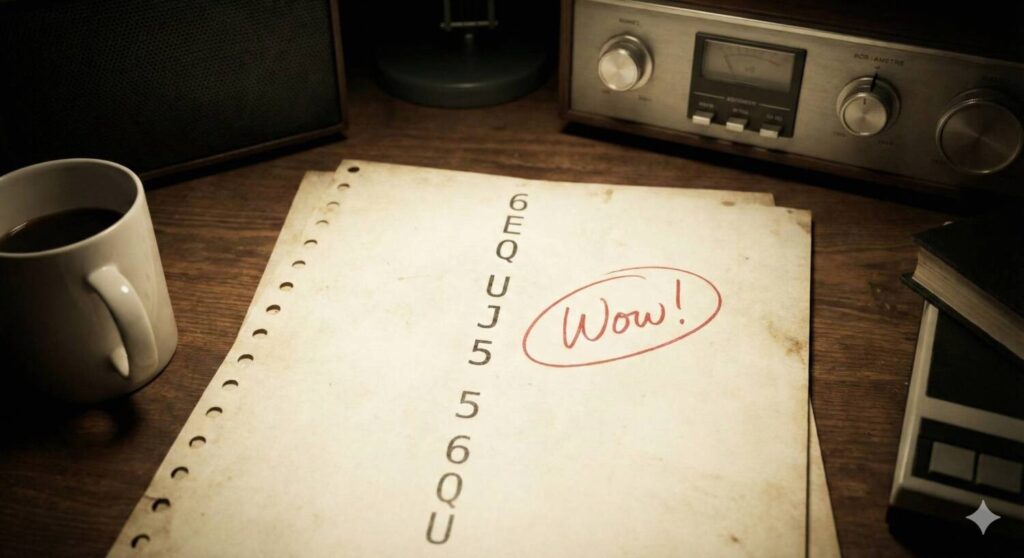
On 15 August 1977, Ohio State University’s Big Ear radio telescope logged six unusually strong readings in a single frequency channel. The numbers and letters rose and fell down the printout. When volunteer astronomer Jerry Ehman reviewed the data later, he circled them and wrote “Wow!” in the margin.
What Big Ear actually recorded
The six characters, 6EQUJ5, recorded successive intensities. Each value describes the signal strength in one channel across a ten-second sampling period, with about two seconds allowed for computer processing. The full sequence spans roughly 72 seconds. That is about how long a fixed source in that part of the sky would take to cross one beam as Earth turned. The recorded span gives researchers a limit on what they could observe. The source’s full duration is unknown. Jerry Ehman’s account of the printout and the observing system
The channel was about 10 kHz wide and near 1,420 MHz, close to the emission frequency of neutral hydrogen. The telescope stored measurements of power. It did not record an audio waveform from the event, and the intensity codes alone cannot establish whether the signal carried information. How to read the six characters on the printout
Why there are two possible positions
Big Ear had two feeds whose beams swept the same part of the sky a few minutes apart. A persistent source would normally be visible in both. The signal appeared once, and the printout did not say which feed picked it up. That left two possible positions near Sagittarius. The rise and fall in strength resembles the expected response to a compact source moving through a beam. It does not provide a precise source location or a second detection.
What researchers have tested since
Follow-up observations have found no confirmed repeat of the original detection. A 2024 study of archival Arecibo data identified weaker narrow features close to the hydrogen line. Its authors proposed that a short, intense event could temporarily amplify emission from a cloud of cold hydrogen. A 2025 archival reanalysis by the same team used Ohio SETI records to revise estimates of the original event’s frequency, brightness, and possible positions. The proposed mechanism would give astronomers a natural way to produce a signal with some of the reported properties. The Arecibo observations concern separate detections, so the proposal remains an interpretation of the 1977 event. Arecibo archival study · Reanalysis of the Ohio SETI archive
The strongest evidence is still the set of six readings in one column. A repeat from the same direction, recorded with enough resolution to examine its spectrum and checked by another instrument, would give researchers a way to distinguish between explanations the 1977 printout leaves open. What the observation can say about an extraterrestrial origin