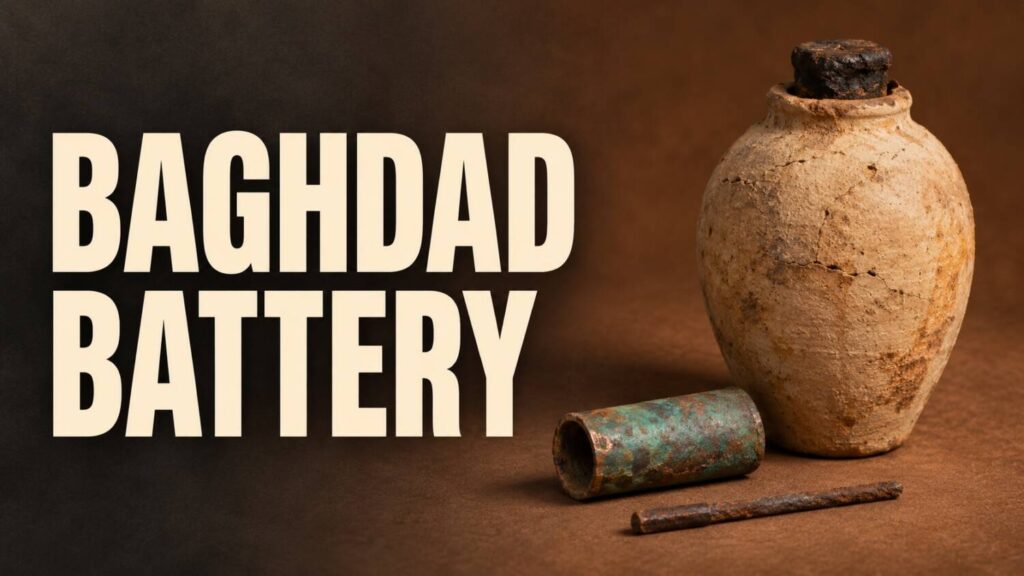
Inside a small earthenware jar was a copper cylinder and an iron rod. The arrangement caught the attention of Wilhelm König, who proposed in 1938 that the find from near Baghdad could have been an electric cell. Rebuilding it makes that idea easy to demonstrate and much harder to settle.
What survived inside the jar
The object is usually associated with Khujut Rabu’a, near Baghdad. In his study of the jar and comparable finds, Paul T. Keyser describes a rolled copper tube and a rod held apart by bitumen, a tar-like material. The archaeological documentation leaves the date and original use less secure than the familiar name “Parthian battery” suggests.
König proposed that it supplied current for electroplating. Keyser considered an electrical use as well, but suggested a different application, pain relief. Both proposals depend on details beyond the arrangement of the metals. In particular, Keyser noted that related copper containers from Ctesiphon were reported to contain papyrus. Their contents leave room for interpretations that have nothing to do with a circuit.
What the meter can measure
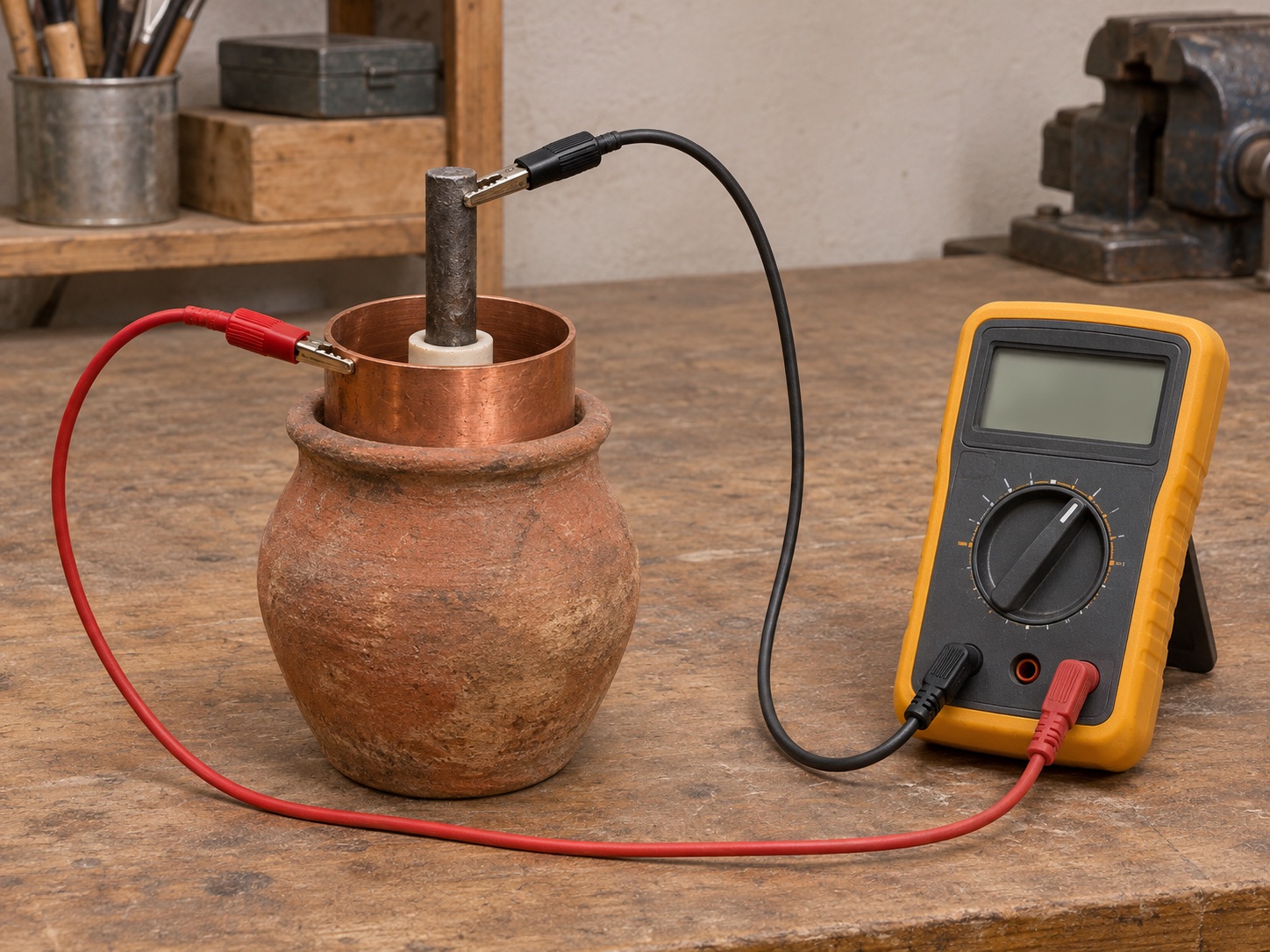
In a modern demonstration, a replica made with copper and iron can produce a voltage if the metals are kept apart in a conducting liquid. An acidic solution provides that liquid. Connect the leads of a meter to the two metals and the reading tells you that the replica can act as an electrochemical cell under those conditions.
The liquid is an experimental choice. So are the connections that carry current out of the jar. A voltage reading by itself gives little information about how long the replica can supply useful current. An electroplating test would also need a bath, a source of metal to deposit and an object to coat. The next measurement would be whether the cell can drive that process for long enough to produce a detectable deposit.
Conservation scientist Gerhard Eggert traced a galvanic gilding process that König recorded among Baghdad silversmiths. Eggert found that it matched a technique patented in Britain in 1840. The modern workshop practice therefore offers little help in establishing what the excavated jar did.
What would tie a test to ancient use
For the electroplating idea, a stronger case would connect the jar to workshop evidence such as fittings, residues or a coating with traces that distinguish the proposed process from other ways of gilding. A reconstruction can help identify what to look for. For example, it can show which parts corrode after a cell runs and which traces survive after the liquid is gone.
The Baghdad jar remains interesting because the arrangement of the metals offers a testable idea. The experiment leaves one question for the archaeological record. Where is the evidence that someone once completed the circuit?