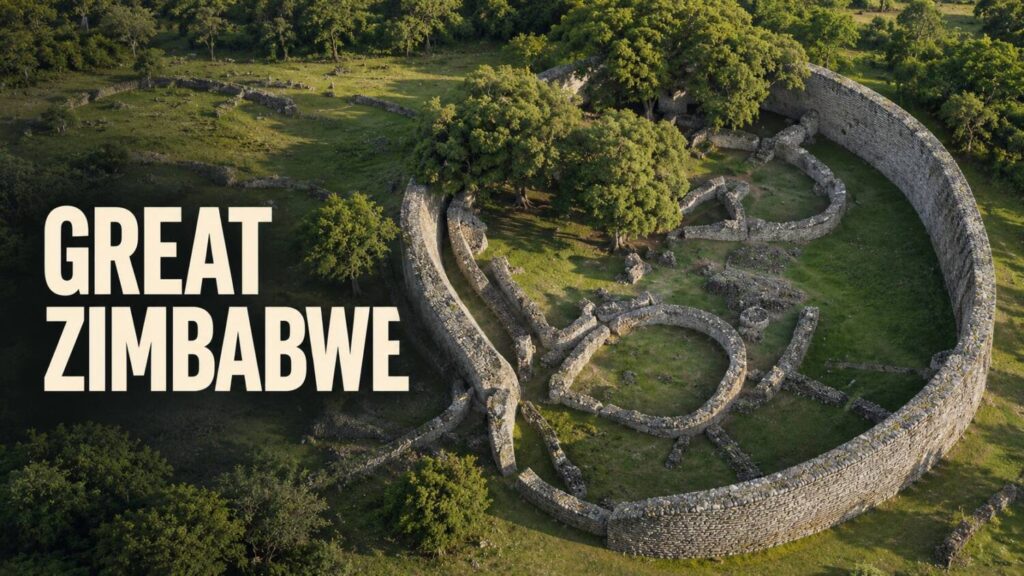
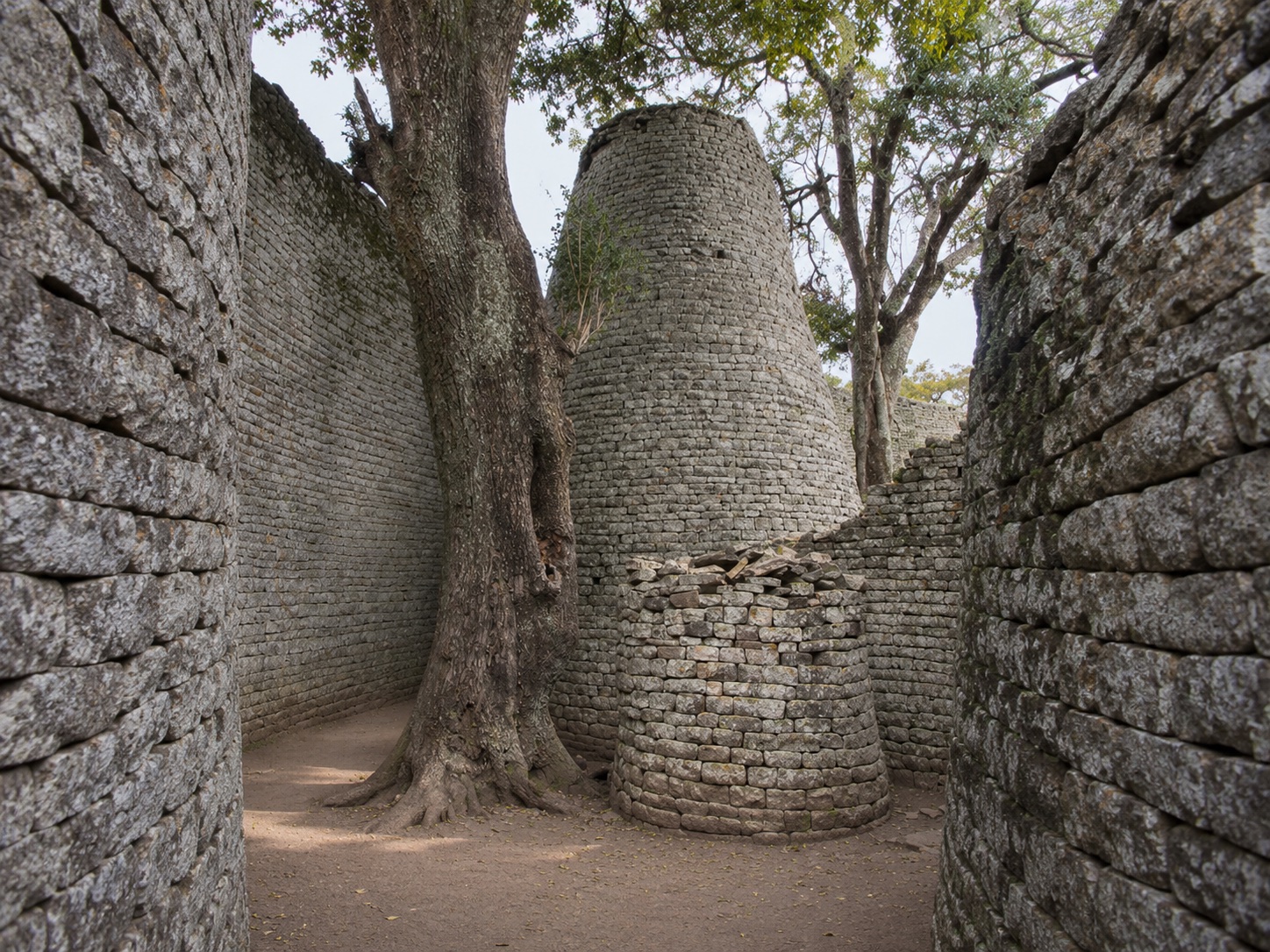
A narrow passage between two granite walls leads to a tower that tapers as it rises. The passage follows the curve of the Great Enclosure, the largest of the stone compounds at Great Zimbabwe. Its builders laid courses of cut granite without mortar. They were ancestors of the Shona people, and the walls they raised near present-day Masvingo were part of a city that grew over several centuries.
The UNESCO site record dates the Great Enclosure to the fourteenth century. It stands downhill from the Hill Complex, with other groups of ruins spread across the valley. The tower and outer wall are the most conspicuous remains. Inside the enclosure, traces of earthen dwellings give a glimpse of the people who lived within the stone perimeter.
The walls and the houses
Builders could find granite in the outcrops around the site. They used it to make long, curved walls that divided the ground into passages and compounds. For houses they also worked with earth. A study of Great Zimbabwe’s building materials describes how much of that earthen architecture survives at floor or foundation level. The stone has stood high enough to shape the way visitors see the site. The homes take a closer look.
The walls also shaped the questions archaeologists asked. Shadreck Chirikure and Innocent Pikirayi compared finds across the city and proposed that the Hill Complex, the Great Enclosure and some of the valley enclosures served as residences for successive rulers. That would make the walls a record of how the seat of power moved over time. The tower’s precise purpose remains open.
How colonial accounts changed the story
When the English antiquarian Theodore Bent published his account of excavating the ruins in 1892, he drew parallels with southern Arabia. He interpreted the architecture through places he already knew and attributed it to people from outside the region. The claim circulated in a colonial setting where European writers were ready to credit outsiders for a city of this scale.
David Randall-MacIver began from a different question. He examined what the buildings contained and compared the finds with material from other sites in the region. His 1906 account identified the ruins as medieval and African in origin. Gertrude Caton-Thompson’s excavations in 1929 reinforced that conclusion. By the time later researchers came to work through the site’s sequence, earlier digging had stripped away many deposits. The history of the excavations had become part of the evidence they had to account for.
What travelled through the city
There were goods from far away at Great Zimbabwe. Chirikure’s study of the city’s economy records imported glass beads and ceramics from China and the Islamic world. They trace connections through the Indian Ocean trading network. Other finds show the work that went on locally. The site yielded small ceramic vessels used for melting gold, both purpose-made crucibles and pieces of pottery put to a second use. A laboratory study found tiny droplets of gold trapped in the glassy residue inside several crucibles.
The city still has questions for the people who study it. A 2026 review of early states in southern Africa places Great Zimbabwe among several centres whose communities traded and shaped one another. At the Great Enclosure, the long wall still brings the eye round to the tower. The smaller finds carry the story outside it, to households and workshops around the city and to markets across the ocean.