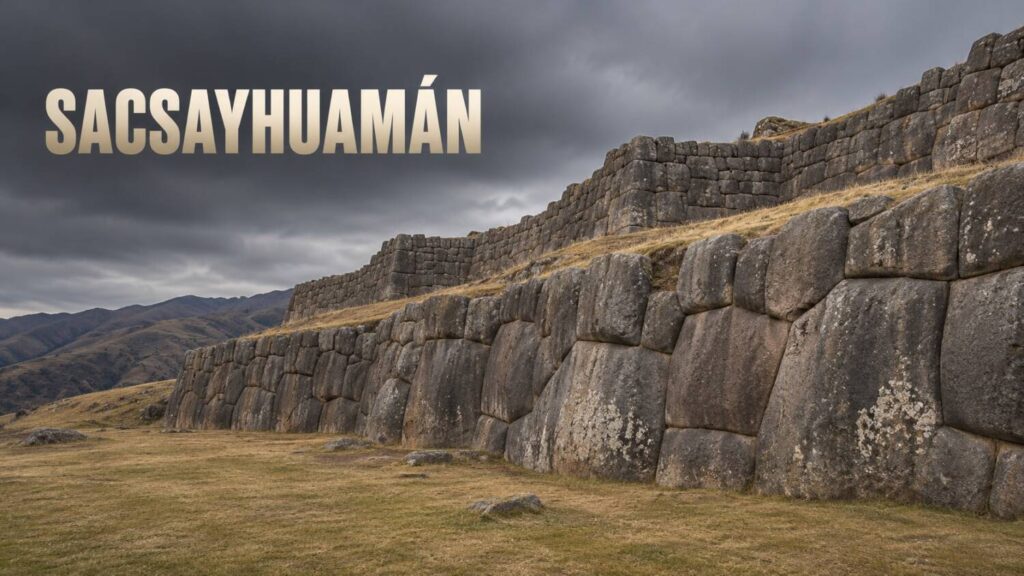
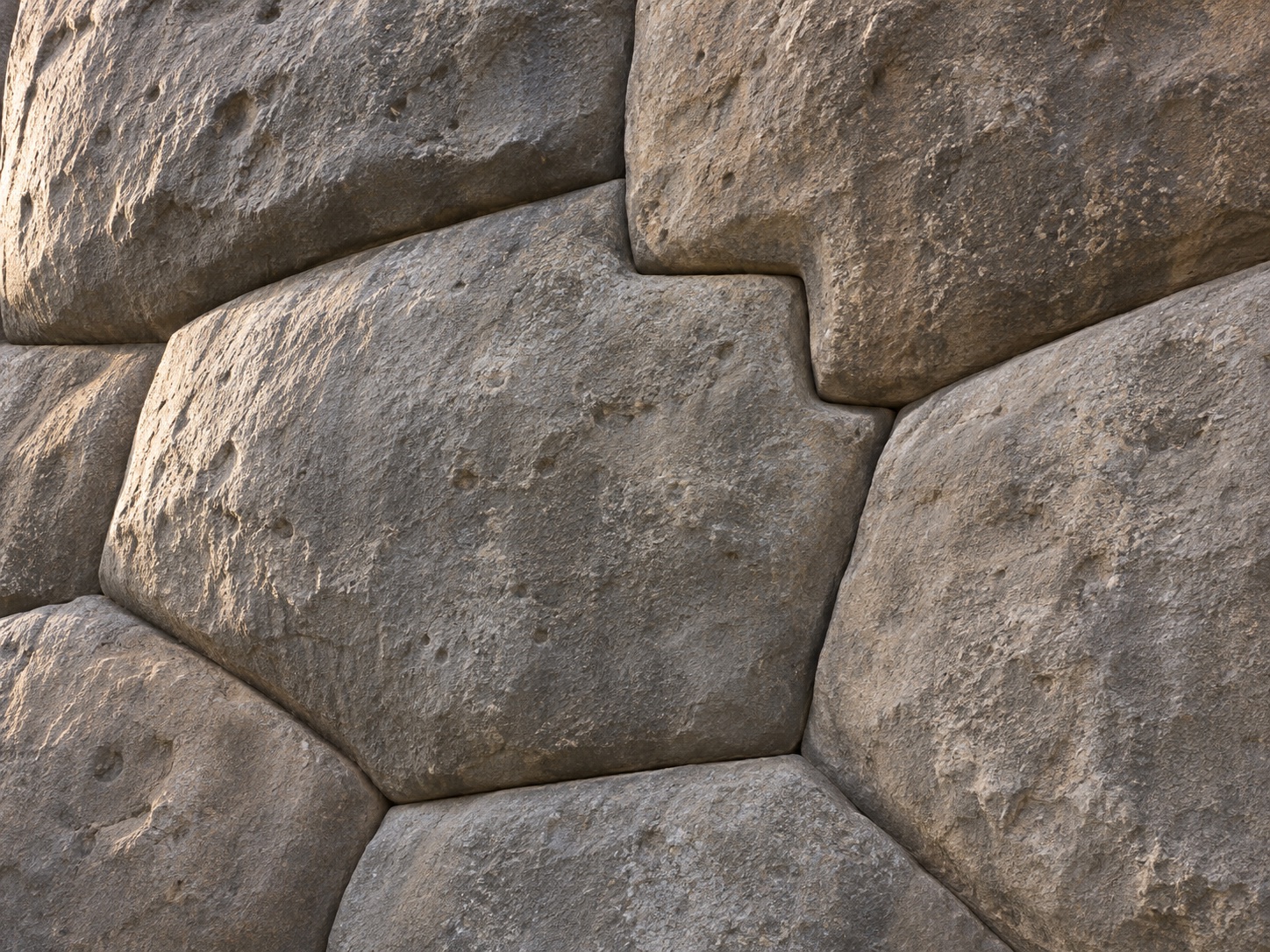
The lowest wall at Sacsayhuamán turns sharply across the hillside above Cusco. At each bend, the edges of the limestone blocks meet in a series of irregular joints. A corner on one stone fits into a recess in the next. Follow the wall for a few steps and the pattern changes again. The Inca masons had to fit each block to the stones around it, even where the wall changed direction.
The lower wall is one of three stepped lines of masonry in the part of the site known as the Baluartes. Peru’s archaeological park plan records limestone in this sector and identifies quarry areas elsewhere in the park. The standing walls show the result of the work. To understand how the builders reached it, archaeologists also look at stone that was left unfinished and the marks left by tools.
From the quarry to the wall
Writing after the Spanish conquest, Pedro de Cieza de León described Sacsayhuamán in his Chronicle of Peru. In his account, some crews quarried stone, others hauled it with heavy ropes, and others prepared the foundations. He saw the finished masonry and commented on the tight joints. His description of the labour gives a sense of how the work was organised, though it leaves the fitting process largely out of view.
Architectural historian Jean-Pierre Protzen approached that question through fieldwork at Inca quarries and experiments with hammerstones. He found that the work could begin with a block picked from a rockfall or pried loose along a natural fracture. In his experiments, repeated blows with hammerstones took material away in small increments. For the joint, he proposed setting a block against the course below, checking where it touched and dressing the contact surface until the pieces sat together. The experiments show how the shaping and fitting could work. Moving and positioning the biggest blocks at Sacsayhuamán remains a separate question.
What the loose stones at Cruz Moqo can tell us
The stones are harder to read at Cruz Moqo, a partly dismantled sector of the same archaeological park. Spanish builders reused stone from Sacsayhuamán in colonial Cusco. At Cruz Moqo, researchers now work with low wall foundations, standing fragments and stones that have shifted from their original positions. In a study published in June 2026, Nancy Reyes-Sevilla, Felipe Barrantes-Reynolds and Alexei Vranich documented 138 stones and tested ways to work out which faces might once have sat together.
The team printed scaled outlines of the faces and tried arranging them by hand. They also tested computer-assisted matches. Some groupings looked plausible by eye, while the computer tests were inconclusive. The problem was partly what the outlines left out. They recorded the face of a stone in two dimensions. A stone can appear to fit on paper while its depth or the shape of its sides prevents it from sitting that way in a wall. The team published its measurements and survey images so those possible arrangements can be tested further.
Back at the lower terrace, the joints are still in place. Each seam shows the shape two stones had to share. At Cruz Moqo, the same sort of seam is what researchers are trying to recover, one displaced block at a time.