
At Nandouwas, an artificial islet off Pohnpei in the western Pacific, long shafts of dark basalt enclose a burial vault. Some run along the wall. Others turn across it, their blunt ends facing out. But it was the coral tucked into the masonry that gave archaeologists a date. Two samples, taken from different parts of the tomb complex, suggest the builders put up the inner wall years before they filled part of the vault.
Nandouwas is one of more than a hundred artificial islets that make up Nan Madol. Its builders raised stone-edged platforms on the shallow reef beside Temwen Island, off Pohnpei’s southeastern coast. Tidal channels run between the platforms. Some held residences, others places of ceremony and burial. Together they formed the seat of the Saudeleur dynasty, whose chiefs came to rule Pohnpei.
The coral inside the tomb
Pohnpeian oral histories identify the central tomb at Nandouwas with the first chief to rule the whole island. In a 2016 study, archaeologist Mark McCoy and his colleagues tested pieces of branching coral from the inner enclosing wall and the burial vault. They used uranium-thorium dating, which measures how much thorium has built up as uranium in the coral decayed. A sample can give the age of the coral. Its position in the masonry helps explain when it might have been put there.
The researchers dated the wall sample to 1172–1186 CE and the vault sample to 1197–1209 CE. They interpreted both as coral collected alive from the reef for construction. On that reading, the wall and the vault fill mark two episodes of work. A piece from the islet’s platform gave a first-century date. The team interpreted it as fossil coral, already centuries old when builders picked it up. A precise date can still belong to a much earlier event than the one an archaeologist is trying to trace.
A 2024 study broadened the view by examining coral from 18 islets alongside charcoal from excavations. Its authors identified two major periods of construction across Nan Madol, with the earlier one spanning the 10th to 12th centuries. The dates at Nandouwas help place one episode in the life of the tomb. The wider survey gives a sense of how long people spent building and altering the complex around it.
Where the basalt came from
The basalt columns already had their shape before the builders moved them. They formed as volcanic rock cooled and fractured. At Nandouwas, masons laid the long stones lengthwise and crosswise to make walls. The ends show where a column turns into the wall, a detail that helps make sense of the masonry even where parts of it have fallen.
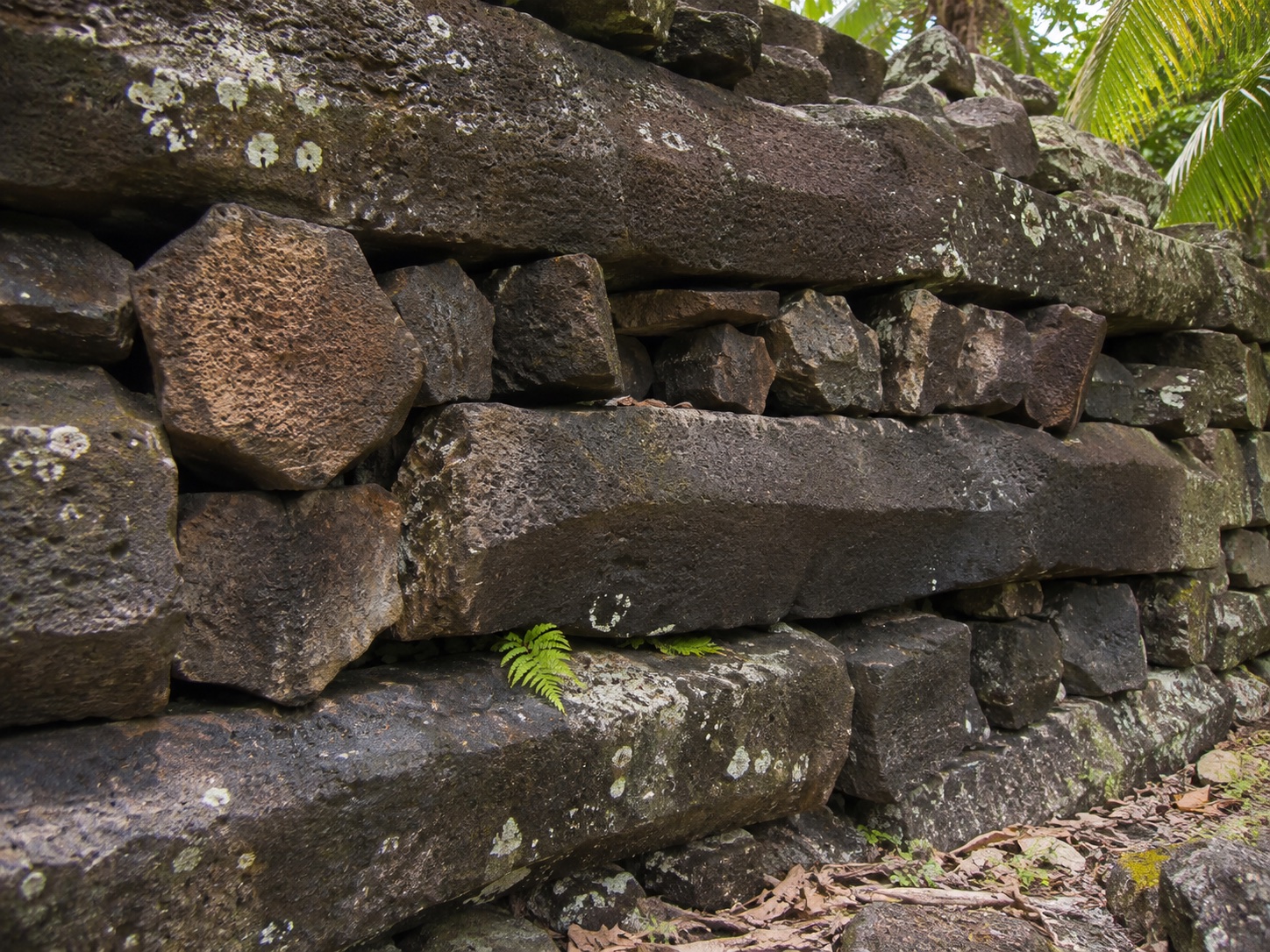
McCoy’s team used a portable X-ray instrument to compare the chemistry of the building stones with basalt from across Pohnpei. They traced some of the stone used at Nandouwas to Pwisehn Malek, a volcanic outcrop on the opposite side of the island. That gives the stones a point of origin and a destination. The route between them and the equipment used to move them remain open questions.
The Federated States of Micronesia’s historic preservation office records a Pohnpeian tradition in which two brothers, Olosihpa and Olosohpa, arrive by canoe and seek a place to build an altar. In that account, they raise the stones with the help of a flying dragon. The story places the founding of Nan Madol in a sacred setting. The tomb gives archaeologists a way to date one part of the place that grew there.
The channels today
Silt has accumulated in the channels, allowing mangroves to spread and threaten the stone structures. In its 2026 decision, UNESCO’s World Heritage Committee noted that crews had removed some of the vegetation and reopened key canal routes. It kept Nan Madol on the List of World Heritage in Danger.
Those channels are part of the architecture. They mark where one built platform ends and the next begins. At Nandouwas, the outline of the islet still tells you where the builders chose to put the tomb. The coral inside its walls tells you when they were at work.