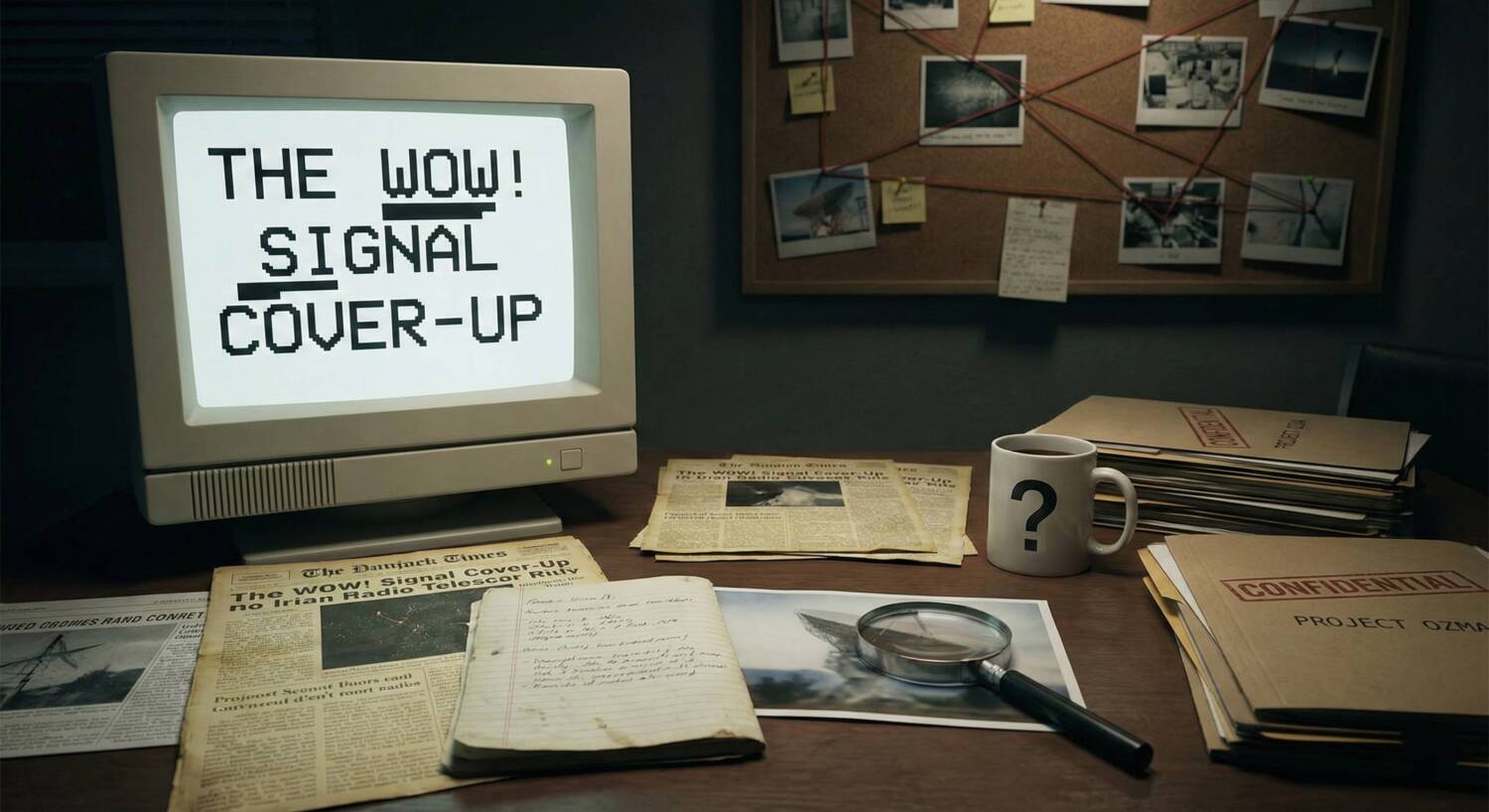
Coincidences can feel like messages because the mind is built to detect patterns, especially when events carry emotional weight. A cardinal appears on the day of good news, an old friend comes to mind before sending a text, or a discarded photograph turns up in an unexpected place. The event may be random, misremembered, or readily explainable, yet its timing can make it feel purposeful.
That tension, between meaningful experience and unsupported interpretation, helps explain why coincidences so often become evidence for paranormal ideas, omens, conspiracies, or “synchronicity.”
The brain turns scattered events into patterns
Human beings encounter an enormous number of events every day. Most pass without notice. We remember the ones that stand out: a repeated number, a striking resemblance, an unexpected meeting, or an event that seems to echo something we recently thought about.
As one discussion participant put it, we live in a “pattern-saturated world.” The same commenter argued that people normally filter out much of this information, while a failure of those filters can make unrelated stimuli seem unusually significant. The broader point does not depend on mental illness: perception is selective, and attention changes what feels prominent.
Once a person begins watching for a particular pattern, examples become easier to notice. A person who associates cardinals with good news may remember every cardinal seen near a positive event while overlooking the many days when cardinals appeared and nothing notable followed. The sightings are real; the interpretation may be shaped by what was noticed and retained.
Confirmation bias makes the pattern feel stronger
Confirmation bias describes the tendency to favor information that supports an existing belief. In coincidence stories, it can work quietly. A person forms a tentative association, perhaps between a number and an upcoming event, and then pays more attention to confirming instances.
This does not mean the person is fabricating the experience. It means the mind is comparing selected memories rather than every relevant observation. A repeated coincidence can therefore become more persuasive over time, even when the unremarkable counterexamples are more numerous.
The same process can operate in interpretations of repeated public symbols, media narratives, corporate logos, or political events. Some repetition is intentional: symbols are reused because they are recognizable, and certain shapes carry familiar associations. Other repetition may result from shared human habits, common designs, or the fact that people tend to notice examples that fit a developing theory.
Memory can turn an odd event into a paranormal one
Memory is another source of uncertainty. A discussion about a Polaroid that supposedly reappeared after being thrown away produced a common response: human memory is unreliable, even when a person feels certain about what happened. A therapist in the discussion described repeatedly encountering confident memories that differed from objective records, while another participant acknowledged memory’s limits but remained unconvinced that it explained the photograph.
That disagreement captures why these experiences are difficult to settle. A person may remember discarding an object, search for it later without finding it, and then discover it in a drawer. Several ordinary explanations may remain possible: the object was placed somewhere else, another person moved it, the original memory was incomplete, or the search missed it. Yet the emotional force of the discovery can make a supernatural explanation feel more satisfying than an uncertain mundane one.
Memory also changes as it is recalled and retold. Details that support the central mystery may become sharper, while ambiguities fade. A striking coincidence can therefore become more coherent in memory than it was at the time.
Coincidence is not the same as causation
Two events can be correlated without one causing the other. They can also occur close together without being connected by agency or intention. This distinction is central to paranormal interpretations.
One source in the discussion expressed it directly: “The correlations are real, but the assumed agency/causality is not.” A person may genuinely see a bird before receiving good news, or encounter someone with the same medical problem. The observation does not by itself establish that the bird delivered the news or that the encounter was arranged for a reason.
Everyday life also creates many opportunities for apparent improbabilities. People share common problems, use similar products, travel through overlapping environments, and participate in the same culture. A coincidence involving tattoos, medical treatment, or a household repair may seem extraordinarily specific, but the number of possible encounters and comparisons is large.
Rare events are also easier to identify after they occur. Before an event, there are countless possible outcomes. Afterward, one particular outcome can be described as astonishingly unlikely. This hindsight makes the coincidence feel more exceptional than it may have seemed among all the possibilities that did not occur.
Why synchronicity feels different from ordinary chance
“Synchronicity” is often used to describe coincidences that feel meaningful despite lacking an obvious causal connection. In the discussions, participants distinguished it from simple temporal proximity. For some, synchronicity means a coincidence that feels “glaringly” otherworldly: losing a wallet and then hearing from an old acquaintance who owes money, or thinking about a problem just as song lyrics seem to address it directly.
The concept is attractive because it preserves the emotional meaning of an event without requiring a conventional mechanism. A coincidence becomes part of a personal story, a sign during a period of change, an omen after a difficult decision, or confirmation that an “awakening” is underway.
One participant described waking at 3:33 a.m. on two consecutive nights shortly before beginning to notice more synchronicities. The same account acknowledged that the mind searches for patterns and connects them to existing beliefs, while still suggesting that some experiences feel difficult to dismiss. That ambivalence is typical: psychological explanations can describe how meaning is perceived without resolving what the experience means to the person.
Attention can create an apparent increase in signs
People often report that coincidences arrive in clusters. They may notice more repeated numbers, animal sightings, or unexpected contacts during a particular period, then experience fewer when their attention shifts elsewhere.
That perceived increase may reflect changes in awareness rather than changes in the outside world. Once a category becomes important, the mind detects it more efficiently. A person who starts looking for cardinals will likely notice more cardinals, just as someone who buys a particular car suddenly sees similar models everywhere.
A discussion participant summarized the issue by saying that synchronicities may increase because “awareness of them changes.” Another warned that deliberately recording every instance can make it easier to form connections among otherwise unrelated events, even when the observations themselves are accurate.
Paranormal explanations often grow from an interpretive leap
Coincidences can be the starting point for much larger claims. Repeated symbols may be interpreted as evidence of hidden coordination. Misremembered cultural details may become a Mandela Effect, a psychological operation, or evidence that reality itself has changed. Similar names and alleged political or national ties can be treated as clues to an unseen network.
These interpretations differ in content, but they share a structure: an observation is followed by an inference about intention. The observation may be accurate; the inference requires additional evidence.
For example, a changed logo, a misremembered quotation, or a film recalled differently can have ordinary explanations, including rebranding, memory distortion, or confusion between related versions. Some discussion participants instead described such experiences as attempts to destabilize “consensus reality.” The competing explanations cannot be evaluated solely by how uncanny the memory feels.
A disciplined way to examine a coincidence
Taking coincidences seriously does not require treating every coincidence as a message. A useful approach is to separate the experience into observation, memory, probability, and interpretation.
- Record the event before interpreting it. Note what happened, when it happened, and what was known beforehand.
- Include non-events. If a bird is believed to predict good news, record days when the bird appeared without good news and days when good news arrived without the bird.
- Check alternative explanations. Consider ordinary movement of objects, shared environments, common experiences, memory errors, and intentional human design.
- Distinguish meaning from mechanism. An event can be personally meaningful without proving supernatural agency.
- Ask what evidence would change the interpretation. A theory that explains every outcome may be difficult to test.
This method does not make unusual experiences meaningless. It clarifies what is known and what has been added by interpretation.
Meaning can be real without being supernatural
A coincidence may matter because of the meaning a person gives it. Seeing a cardinal after a long-awaited job opportunity can become a memorable symbol of hope. Thinking of an old friend before receiving a message can feel intimate and significant. Those emotional responses are genuine even if the events arose through chance, selective attention, or ordinary social patterns.
The danger comes when personal significance is treated as proof of external intent, particularly when coincidences are used to support accusations, elaborate conspiracies, or escalating beliefs that ordinary events are directed specifically at the observer.
Coincidences feel like messages because the mind is exceptionally good at finding connections, and because emotionally important connections are the ones most likely to be remembered. Synchronicity may remain a compelling personal vocabulary for that experience. But the feeling of a message, by itself, cannot establish that anyone or anything sent one.