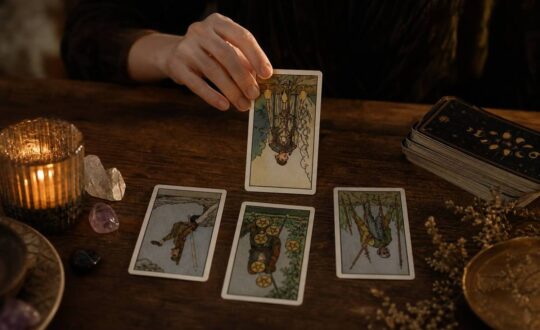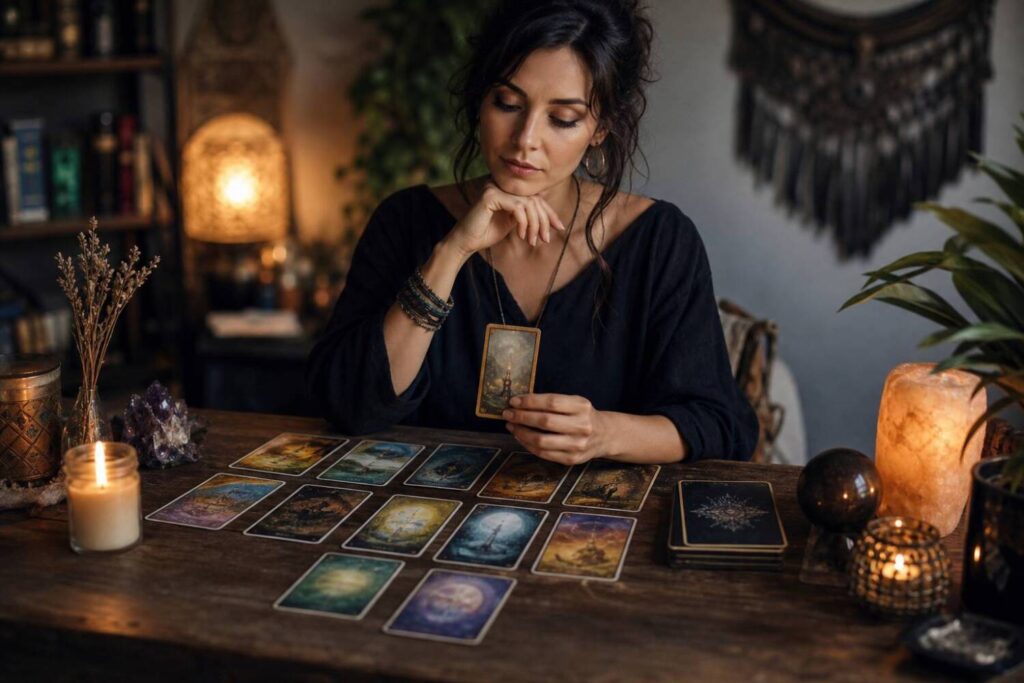
A card turns over, an image catches your eye, and a meaning arrives almost at once. Landscape means outdoors. Death means an ending. The Empress means motherhood. These quick associations can be useful starting points, but they are not automatically intuition, and they do not prove that a reading has predicted what will happen.
That distinction is at the heart of a reader’s account of a reading about lost wireless earbuds. Seeing Landscape paired with the Bat, the reader’s first thought was “outdoors,” leading to an interpretation that the earbuds might be outside or somewhere away from home. In another pair, Death appeared with a woman. The account describes how the reader interpreted the symbols, but the available story does not establish where the earbuds were found. Its value is instead in the question it raises: when a meaning comes quickly, how can a reader tell whether it is a useful impression or a story assembled too soon?
Tarot can be approached as a reflective practice without treating it as proof of prediction. A card may help someone notice a concern, consider a possibility, or give shape to a question. That can be meaningful even when the reading cannot verify a future event or establish a fact, such as the location of a missing object. The reader’s task is not to make every first impression sound certain. It is to notice how interpretations form, examine them, and leave room for ambiguity.
Separate the First Thought from the Final Reading
A quick association is often just that: a connection between an image or card name and an idea. “Landscape means outdoors” is a clear example of a first association. It might turn out to be relevant, but it may also narrow the reading before the reader has considered the question, the other cards, or the deck’s own imagery and meanings.
Several tarot readers in the discussion describe interpretation as something that can unfold rather than arrive all at once. An initial impression may be followed by more associations as the spread takes shape; sometimes a clearer understanding comes only after looking at the cards together. This does not mean that the first thought must be discarded. It means it can be recorded as a possibility rather than treated as a verdict.
Try distinguishing three stages in a reading:
- Observation: What is visibly present in the image, and what words or details stand out?
- Association: What does that detail bring to mind, and what meaning do you connect to the card?
- Interpretation: How might that meaning relate to the question and to the other cards?
This simple pause can make the reading more transparent. It helps a reader see the difference between noticing an image and deciding what that image means. It also makes it easier to revise an interpretation when another card or a later thought suggests a different possibility.
Intuition Is Not a Shuffling Technique
People sometimes talk about intuition as if it must announce itself through a special feeling when shuffling, a card that seems to call from the spread, or a physical sensation in the body. But not every reader experiences those things. One beginner in the discussion wondered whether not feeling drawn to a card, or relying on jumpers, meant they lacked intuition. A reply made a useful distinction: how someone shuffles and chooses cards is a matter of reading routine; intuition may come into play during interpretation instead.
Readers describe intuition in different ways. Some mean an immediate impression; others describe a bodily response, an inner voice, or a connection that emerges while considering the cards. One psychological framing offered in the discussion is that intuition can involve rapid, unconscious pattern recognition: the mind brings together information before a person has fully put the reasoning into words. That can help explain why an impression feels sudden, but it does not make every sudden impression correct. A feeling can be a prompt to explore, not a guarantee.
It is also reasonable for a reader to prefer words such as inspiration, imagination, or storytelling. The discussion notes that “intuition” can become an all-purpose label, especially when the reader has not yet learned the card meanings or is improvising without examining their assumptions. Vocabulary matters less than the practice of asking: What am I responding to? What else could this card mean here? Am I noticing a pattern, or simply building a story around the first detail I saw?
Use Card Meanings Without Being Trapped by Them
Cards can carry multiple meanings, and the question can change which meanings seem relevant. The Empress discussion illustrates how one card can invite a range of readings: creation, self-worth, care, leadership, fertility, or other aspects of its archetype. A reader who finds a book description flat or incomplete does not have to force it into a single definition. At the same time, an impression does not become more reliable simply because it feels personal. Studying a card’s established meanings and imagery can give improvisation a foundation, while reflection helps a reader consider how those meanings might fit the particular question.
A practical method is to keep a few possible interpretations open before settling on one. For a card that suggests an ending, for example, ask what the idea of an ending might mean in this reading rather than assuming it predicts a literal loss. For an outdoor image, consider whether it points to a place, a feeling, a memory, or nothing especially relevant. These are questions to test, not a claim that every card has one hidden answer.
Make Space for Bias and Uncertainty
Desire and anxiety can influence interpretation. If a reader strongly wants a particular outcome, or fears one, a card may seem to confirm that expectation. The discussion cautions against confusing this kind of projection or confirmation bias with intuition. A useful check is to ask whether the same interpretation would seem convincing if it pointed toward a less welcome outcome. Another is to list a plausible alternative before presenting a reading as settled.
When reading for someone else, share interpretations as possibilities rather than facts the other person must accept. Invite them to say what resonates, but do not pressure them to agree. Their response can provide context for reflection; it should not be treated as automatic proof that a prediction is true. If a reading concerns a factual matter, such as where an item is, cards should not replace ordinary ways of checking and searching.
Let Tarot Prompt Reflection, Not Certainty
Distinguishing intuition from a quick association is less about discovering a perfect inner signal than building a habit of attention. Notice the first thought, name it as an association, compare it with the question and the other cards, and consider what might be shaping your interpretation. Over time, readers may become better at recognizing which impressions feel useful and which are driven by habit, hope, or fear. Practice can develop discernment without promising infallibility.
A tarot reading does not need to prove the future to be worthwhile. It can help a reader or querent explore meanings, clarify a concern, or consider a perspective they had not noticed before. Treating the cards as prompts rather than evidence preserves that reflective value, and leaves room to say, honestly, “This is one interpretation, not a certainty.”