

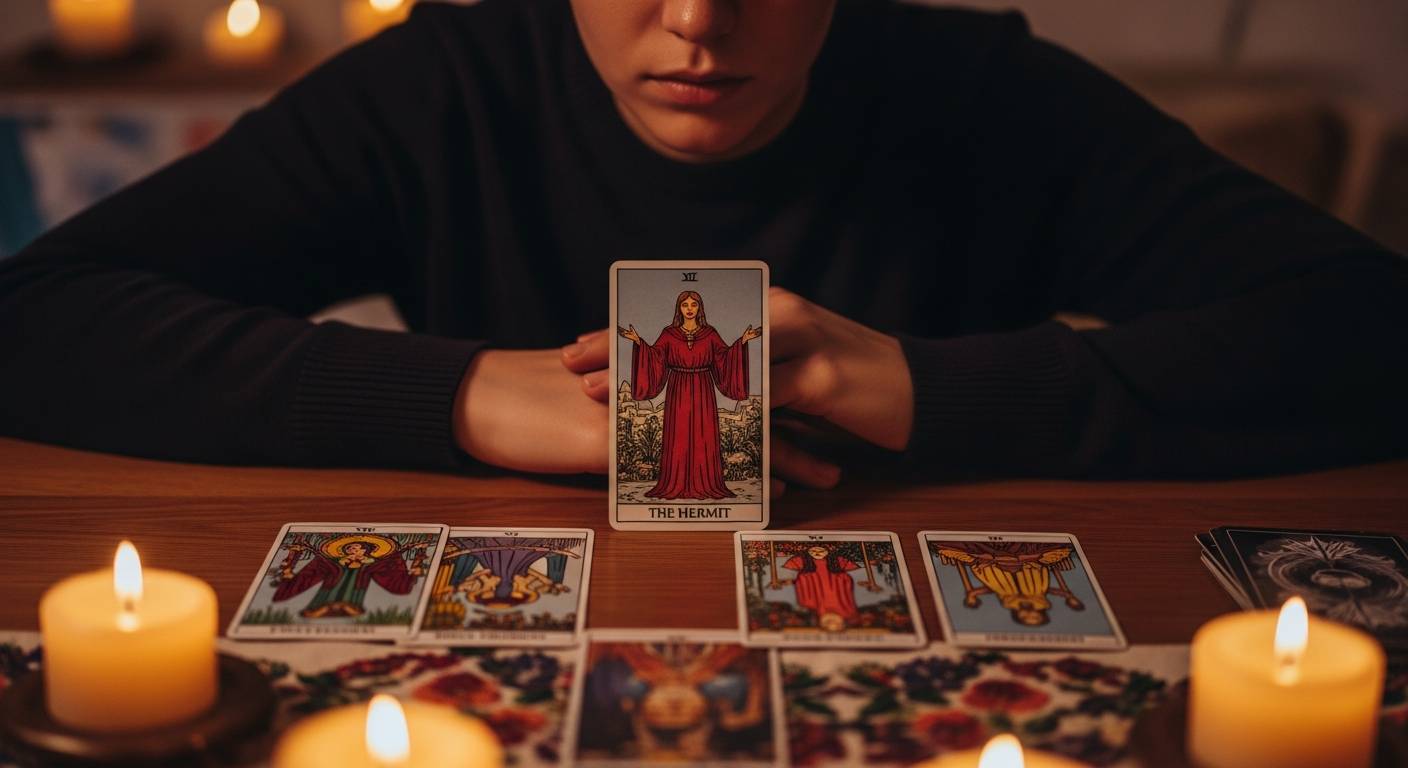

Tarot is often used during periods of uncertainty, heartbreak, stress, grief, confusion, or emotional vulnerability. In those moments, the cards can feel comforting because they offer reflection, symbolism, and the possibility of guidance.
But sometimes tarot slowly shifts from a reflective spiritual practice into something emotionally overwhelming. Instead of helping someone feel calmer or more grounded, readings begin increasing anxiety, fear, confusion, and emotional dependency.
This is far more common than many people realize, especially online where constant readings, social media tarot content, and repeated reassurance-seeking are normalized.
The Difference Between Guidance and Reassurance-Seeking
Healthy tarot practice usually focuses on reflection, insight, emotional awareness, and thoughtful decision-making. Reassurance-seeking works differently.
Reassurance-seeking happens when someone repeatedly looks for certainty to temporarily relieve fear or anxiety. That relief may feel calming for a short time, but the anxiety often returns stronger afterward.
In tarot practice, reassurance-seeking can look like:
- Repeating the same reading multiple times a day
- Asking multiple readers the same question
- Searching for confirmation of a preferred outcome
- Obsessively checking relationship or future predictions
- Feeling unable to make decisions without tarot
- Panicking when difficult cards appear
Over time, tarot may stop feeling empowering and start feeling emotionally compulsive.
Why Repeated Tarot Readings Increase Anxiety
Repeated readings often create more confusion rather than more clarity. When someone is emotionally attached to a specific outcome, every card can begin feeling loaded with fear or urgency.
Small interpretive differences may suddenly feel catastrophic. Contradictory cards create spiraling thoughts. Difficult cards become emotionally magnified.
This happens because anxiety changes how people interpret uncertainty.
Many tarot readers eventually discover that constantly pulling cards about the same issue weakens intuition rather than strengthening it. Emotional attachment begins overpowering reflection.
In many cases, taking space from the cards temporarily creates more clarity than forcing additional readings.
Fear-Based Interpretation and Emotional Projection
Tarot cards are symbolic. Their meaning often depends heavily on emotional context and interpretation.
When someone is anxious or emotionally distressed, neutral or reflective cards can suddenly feel threatening. Cards associated with uncertainty, endings, introspection, or transformation may become interpreted as signs of disaster.
For example:
- The Moon may trigger fear about deception or instability
- The Tower may feel like proof catastrophe is coming
- The Hermit may feel like isolation or abandonment
- The Three of Swords may feel emotionally overwhelming during heartbreak
In calmer emotional states, those same cards may be interpreted as reflection, honesty, emotional processing, necessary change, or personal growth.
This does not mean the reading is fake. It means emotional projection strongly shapes symbolic interpretation.
The Problem With Reader Hopping
When anxiety intensifies, many people begin searching for more readers hoping someone will finally provide certainty or reassurance.
This usually creates the opposite effect.
Different readers naturally interpret cards differently. Some are psychologically oriented, some spiritual, some predictive, and some highly intuitive. Hearing multiple interpretations in emotionally vulnerable situations often increases confusion and emotional exhaustion.
Reader hopping can also create dependency patterns where the person stops trusting their own judgment and constantly seeks outside validation.
Tarot and Relationship Obsession
Relationship anxiety is one of the biggest drivers of compulsive tarot reading. Questions about ex-partners, reconciliation, cheating, commitment, texting, soulmates, and future outcomes often create emotionally charged reading cycles.
People may repeatedly ask:
- Will they come back?
- Are they lying to me?
- Do they still love me?
- When will they contact me?
- What are they thinking right now?
Because relationships involve uncertainty and emotional vulnerability, tarot can easily become a coping mechanism for fear and attachment rather than a reflective spiritual practice.
This does not mean relationship readings are inherently bad. It means emotional boundaries matter.
When Tarot Intersects With Anxiety Disorders or OCD
For people already struggling with anxiety disorders or OCD tendencies, tarot can sometimes accidentally reinforce compulsive reassurance loops.
Repeated checking behaviors may temporarily reduce fear, but they can also strengthen dependence on certainty-seeking rituals.
This is why many grounded tarot practitioners encourage balance, emotional awareness, and self-care alongside spiritual practice.
Tarot should never replace professional mental health support when someone is struggling with severe anxiety, panic, obsessive thoughts, or emotional distress.
Signs You May Need a Break From Tarot
Sometimes the healthiest thing a person can do is step away from tarot temporarily.
Possible warning signs include:
- Feeling panic before every reading
- Constantly checking the same situation
- Feeling emotionally dependent on cards
- Difficulty making decisions without readings
- Interpreting every card negatively
- Feeling emotionally drained after readings
- Using tarot to avoid uncertainty entirely
Taking a break does not mean abandoning spirituality. Often, it helps restore emotional balance and rebuild a healthier relationship with intuition.
How to Use Tarot in a More Grounded Way
Tarot tends to feel healthier and more useful when approached with emotional balance and self-awareness.
Helpful practices include:
- Limit repeated readings on the same issue
- Journal interpretations instead of immediately re-pulling cards
- Use tarot for reflection rather than certainty extraction
- Take breaks during emotionally intense periods
- Ask open-ended questions instead of demanding fixed outcomes
- Focus on personal growth and emotional insight
- Develop trust in your own judgment outside the cards
Many experienced readers eventually realize that tarot works best when it supports reflection, not emotional dependence.
Tarot Should Support Clarity, Not Fear
Tarot can be thoughtful, comforting, spiritually meaningful, and emotionally insightful when approached in a balanced way. But when readings begin feeding fear, panic, compulsive checking, or emotional exhaustion, it may be a sign that anxiety has started overtaking intuition.
The goal of tarot is not perfect certainty. In many cases, the most grounded spiritual practice comes from learning how to tolerate uncertainty with greater self-awareness, emotional honesty, and compassion toward yourself.