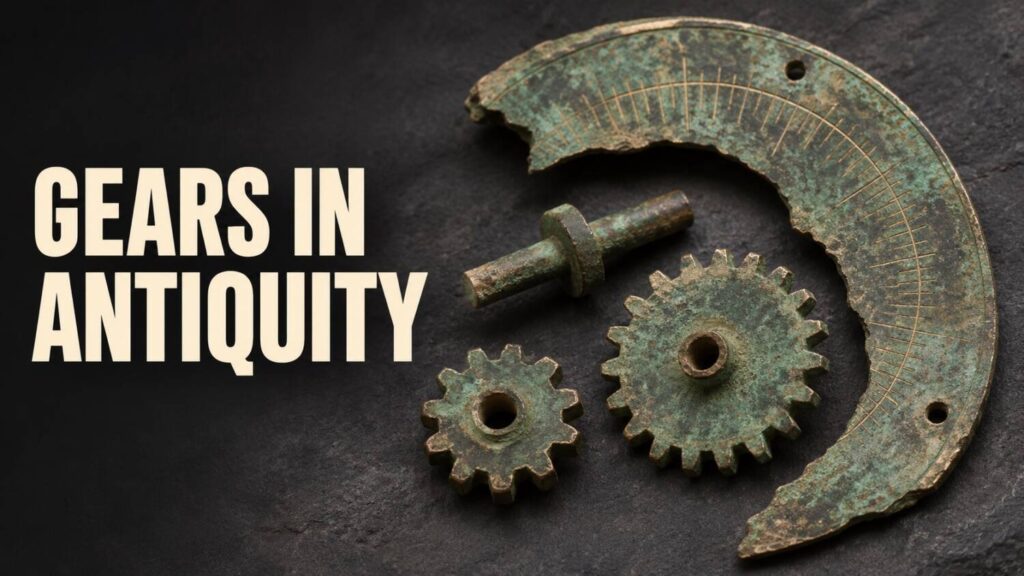
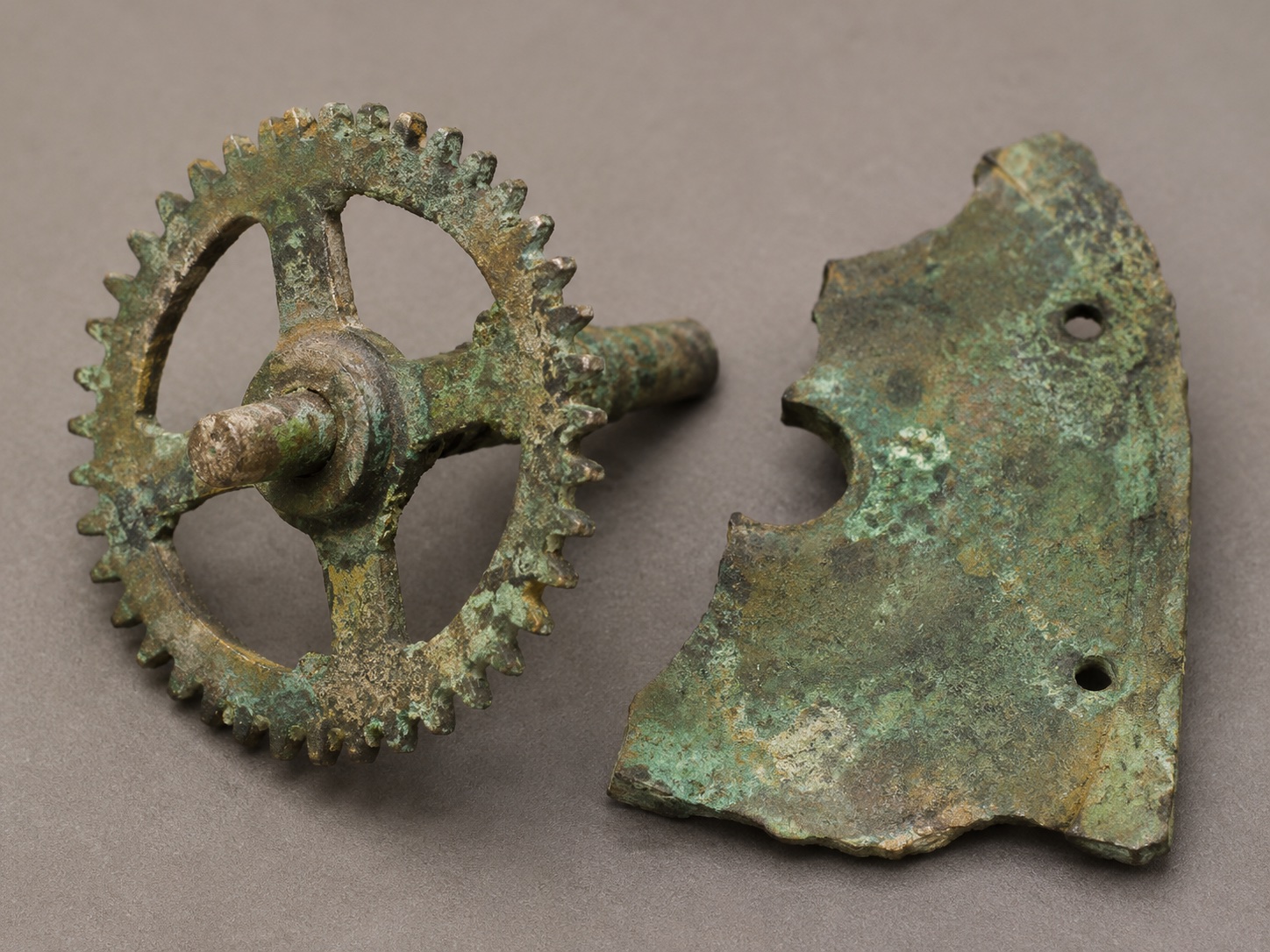
A bronze fragment in the Science Museum Group’s collection preserves a disc for the Moon and a gear. It belongs to a portable sundial-calendar made in the Byzantine Empire, several centuries after Antikythera. Together with a dial plate and other surviving parts, it gives historians another example of what gearing could do. The two objects are a long way apart in time.
What Antikythera establishes
The Antikythera Mechanism survives in corroded bronze fragments recovered from a shipwreck. In a 2006 study, researchers used X-ray imaging to inspect hidden gears and inscriptions and identify displays related to astronomical cycles. The surviving teeth and markings constrain how parts of it worked. Reconstructions still differ where a whole set of parts is missing.
Even the markings around a dial can leave a question open. A 2024 analysis of holes beneath the calendar ring found that their spacing favoured a total near 354. That estimate concerns one surviving feature. Its role in the full display still has to fit the other parts and inscriptions.
A model described by Cicero
In On the Nature of the Gods, Cicero has one speaker cite a device made by Posidonius. Turning it reproduced the motions of the Sun, Moon and five planets. The passage uses the example in an argument about whether the ordered motion of the heavens implies design. It tells readers what the model represented and leaves its internal construction undescribed.
The account supports the idea that a model of the heavens could be understood as a crafted object in Cicero’s time. It leaves open whether the model used the same mechanical arrangements as the object found off Antikythera. Neither a tooth count nor a drawing survives with the passage.
A calendar with surviving gears
The Science Museum Group dates its sundial-calendar to between 400 and 600 CE. Four parts survive, including the sundial plate, a suspension arm, a geared Moon disc and an axle with a ratchet and two gear wheels. In their study of the instrument, J. V. Field and M. T. Wright used those pieces to reconstruct a calendar associated with the portable sundial.
Those parts establish a later use of gearing for a different display. The dates leave centuries between the devices, and the evidence gives no continuous line of workshops or surviving models across that span. How to Read an Ancient Artefact explains why a material fragment and a written description answer different questions. Cicero tells us what his speaker expected a model to show. The Byzantine fragment preserves part of the means by which a display could move.