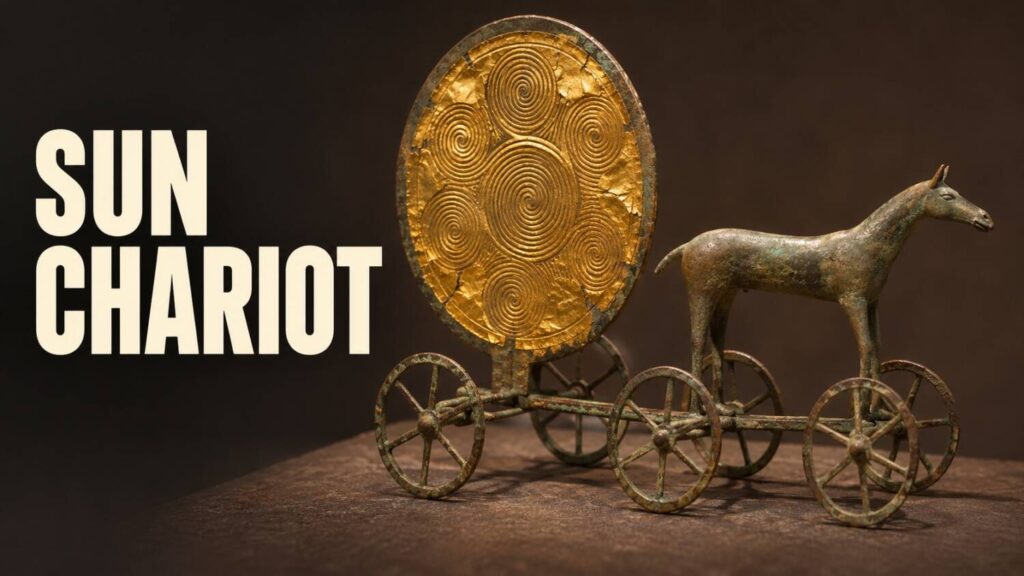
From one side, the disc on the Trundholm Sun Chariot catches the light in gold. From the other, it shows the darker colour of bronze. A small horse stands in front of the disc, and both are mounted on wheels. The National Museum of Denmark’s collection record lists the piece as B7703. Its materials and arrangement are where the interpretation begins.
What came out of the bog
The object came to light in September 1902, when Trundholm Mose, a former bog in northwestern Zealand, was ploughed. The museum dates it to around 1400 BCE, in the Early Bronze Age. The gold foil carries carefully worked spiral ornament. The horse, the wheel assembly and the disc are small enough to form a single portable object.
Parts were still in the ground long after the original find. A 1998 search at the findspot recovered 21 more pieces, including parts of the wheels and axles. Conservators fitted them to the object. What visitors see today includes evidence that the first recovery missed.
A journey with two sides
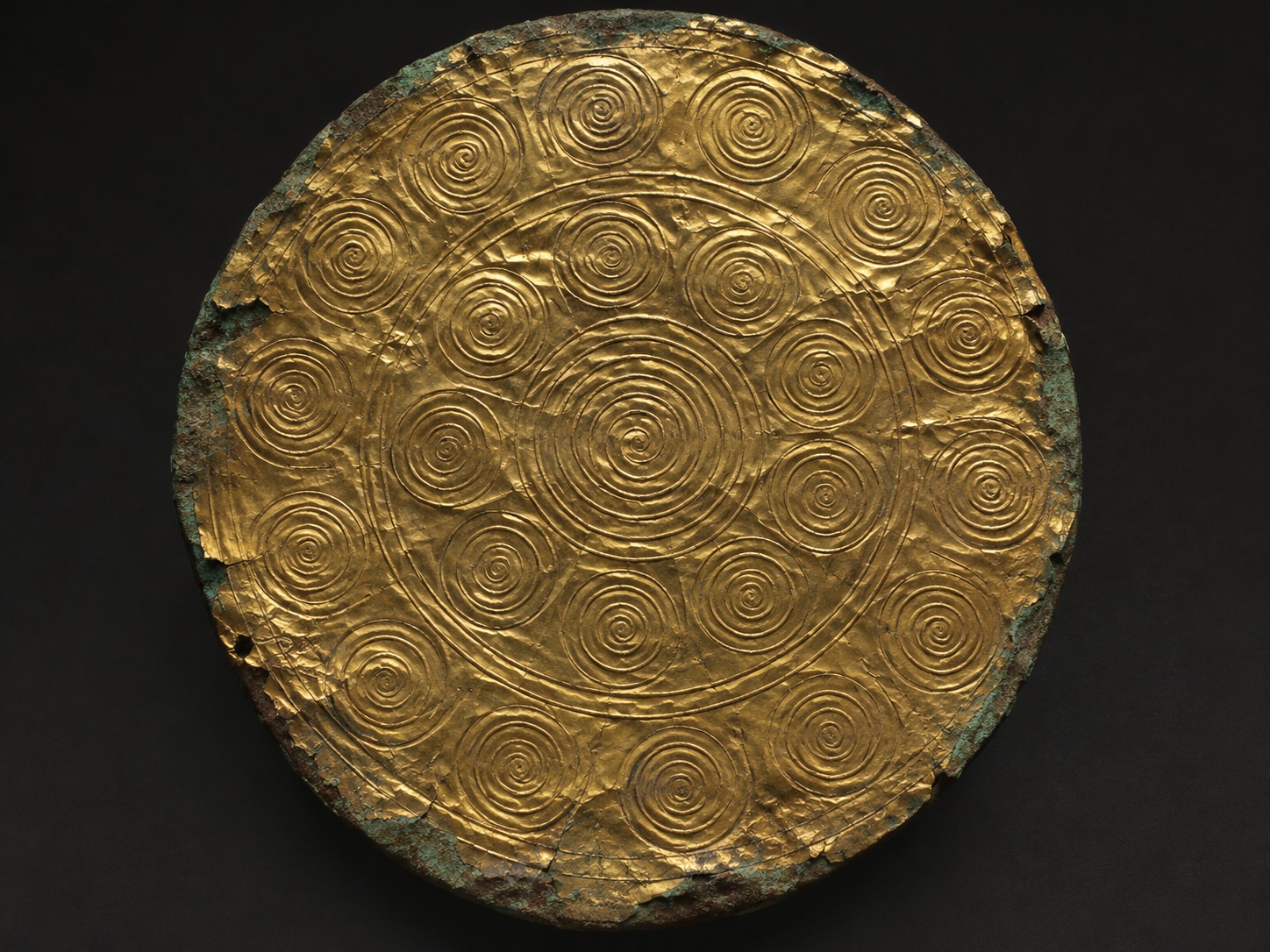
The museum interprets the horse as drawing the sun across the sky. The wheels give the horse and disc a way to move together. The gold face is visible when the horse travels in one direction as seen from the side. A viewer standing in the same place would see the bronze face on the return. The museum’s account of the sun’s journey reads those faces as day and night.
In a 2026 study of Nordic Bronze Age imagery, archaeologist Flemming Kaul examines horses, ships and solar forms across rock carvings and decorated bronzes. He argues that some of the small images on bronze objects depict stages in the sun’s journey. That comparison gives the Trundholm horse and disc a wider setting. It also shows that the story has been reconstructed from several kinds of object.
What the wheels can tell us
An object made to roll could demonstrate motion. How often it moved, who handled it and whether it was used in a ceremony are harder questions. There is no surviving account of how people at Trundholm used it. The place where it was found tells us where it ended up, and the wheel fragments help establish what it could do.
How to Read an Ancient Artefact follows that distinction between construction and use. At Trundholm, the relationship between horse, wheel and disc is still visible. Turn the disc around and the gold disappears. The meaning of that change is the part archaeologists have had to reconstruct.