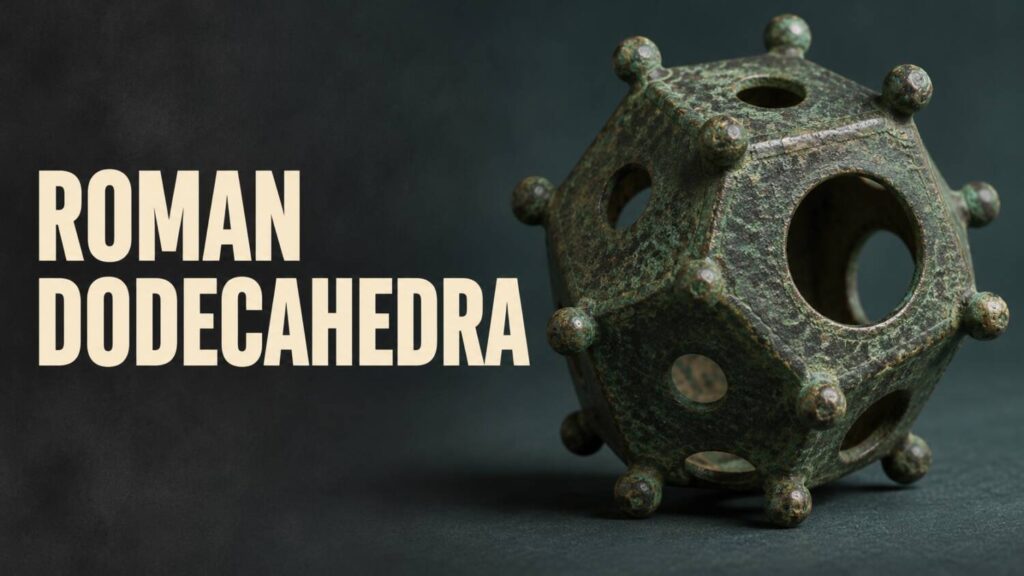
In June 2023, a volunteer excavating a trench at Norton Disney in Lincolnshire found a hollow metal object with twelve faces. Each face had a round opening, with small knobs where the corners met. The object came from a recorded archaeological context, giving researchers a chance to ask why someone left it there.
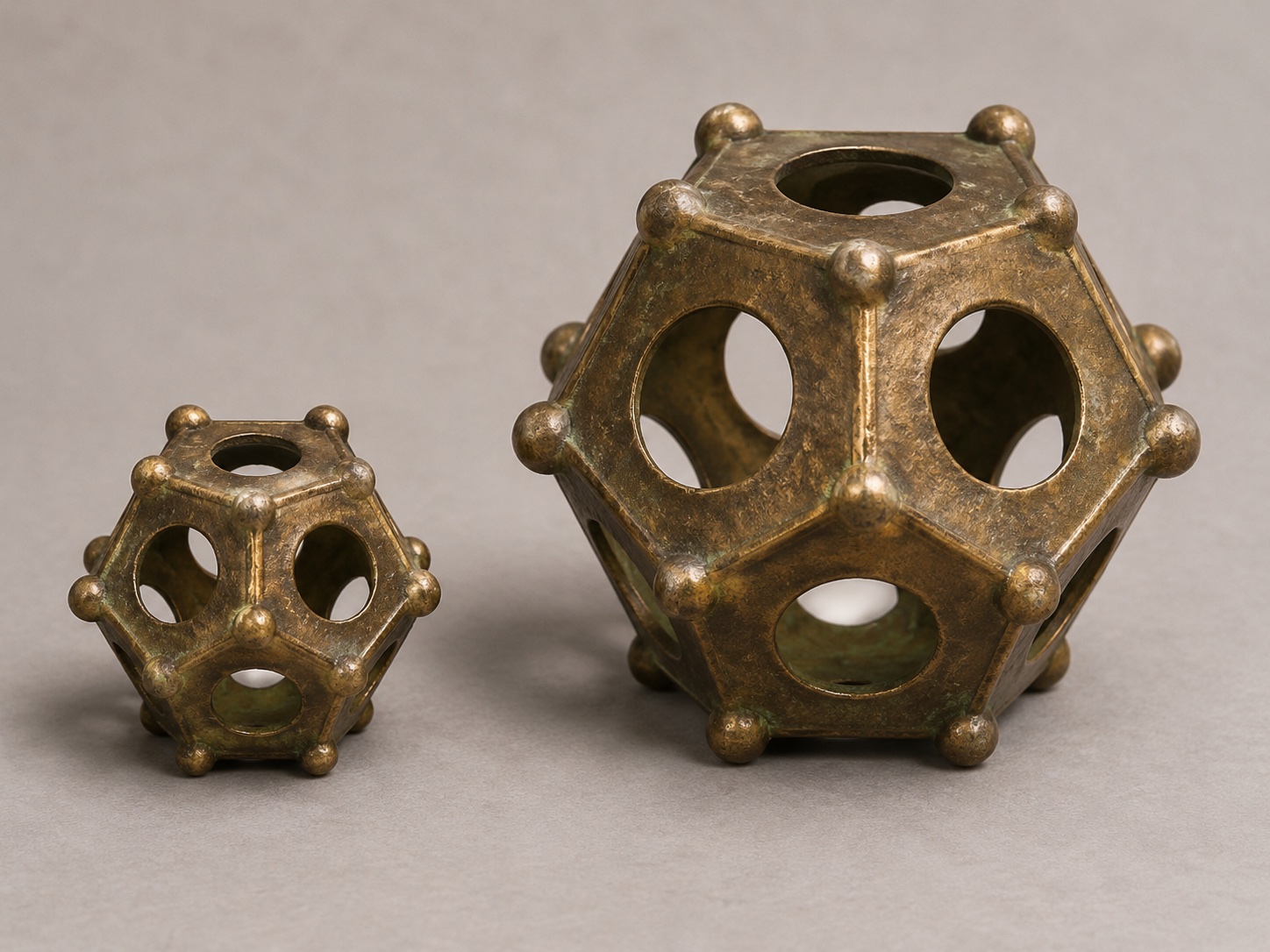
Two objects on the measuring table
The Norton Disney excavation team describes the find as a well-preserved copper alloy casting recovered from a feature later investigated as a possible sand quarry pit. Lincolnshire County Council gives its height as about 8 centimetres and its weight as 245 grams.
A London Museum example measures 66 millimetres high by 75 wide and 78 deep. The figures give a sense of how objects with the same overall shape can differ. If a proposed use depends on a common scale, it needs to explain how the differences in body size and aperture diameter were handled.
The sighting test
In a published preprint, Amelia Carolina Sparavigna used measurements from a dodecahedron from Jublains, France, to build a model for testing distance. The idea uses two opposing holes as a sight. With their sizes and separation known, an observer can work out the distance to a target of known size when it fills the view in a particular way.
That model gives the holes a job and produces measurements that can be checked. An ancient instrument could have been calibrated individually. The question then becomes whether other examples have usable pairs of openings arranged in a pattern that makes sense for the same task.
A findspot and a possible use
The Norton Disney team considers a ritual use possible, in part because of the way the object appears to have been deposited. That is an interpretation of the final place it was left. An object can have a long working life before someone puts it in a pit, so the placement is one line of evidence to compare with wear, construction and other find contexts.
A recent study in The Antiquaries Journal looks for the shape’s possible inspiration in ancient philosophical texts. Those texts offer comparisons for the twelve-sided form. A contemporary description connecting the surviving objects to a specific practice is still missing.
The Lincolnshire find adds a largely intact object and a recorded place of deposition. A future comparison could start with a short list of observations from each example, including the sizes of opposing holes and wear around their edges. Those are the details a convincing explanation has to account for.