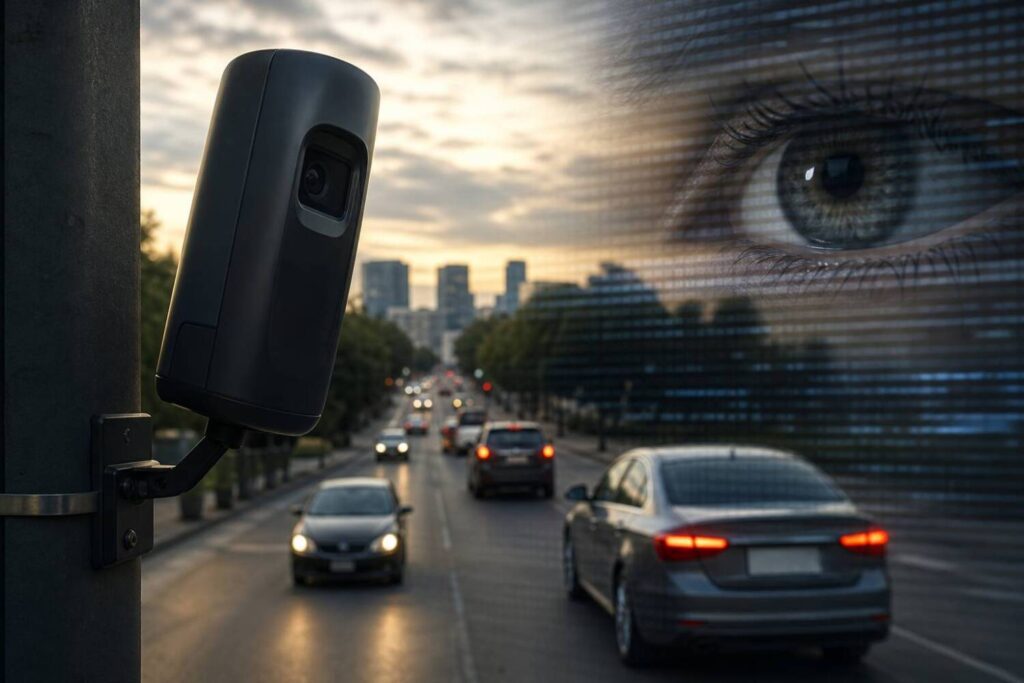
Automated license-plate reader cameras can turn scattered observations of vehicles into a record of where they have been. That capability may help investigators follow a vehicle connected to an incident, but it also creates privacy risks: repeated location records can reveal patterns of movement, while weakly protected camera data or accounts could expose sensitive information.
Recent online discussion about Flock Safety has mixed those concrete concerns with far broader claims. A report summarized in the discussion says hackers copied nearly all the data stored on a Flock camera and exposed details of how its software tracks vehicles and people. Separately, a post attributes claims about missing security protections and exposed information to a cybersecurity researcher. The dossier does not independently verify those claims, and it offers no evidence for speculation that the cameras were ordered by a foreign government or intended to enable social control.
Tracking capability creates a privacy trade-off
License-plate readers record vehicle plates and related images. When records from multiple cameras can be compared, they can help trace a vehicle’s movements across locations. The report summarized in the discussion describes Flock’s software as tracking both vehicles and people; the material provided does not explain precisely how the software makes that connection.
That distinction matters. A single image may show a vehicle at one place and time. A series of records, if linked and reviewed, can reveal a broader travel pattern. The discussion includes a user’s example of plotting a route against camera locations, but it does not establish how complete any particular network is. The privacy concern is the potential to assemble repeated observations into a more revealing picture of someone’s movements.
There can also be an investigative benefit. Commenters raised examples such as finding a vehicle involved in property damage or locating a missing person. Those are illustrations of possible uses, not evidence in the dossier about how often cameras help solve cases. Whether the benefit justifies the collection depends in part on who can search the records, for what purposes, and under what rules.
Reported security concerns are specific, and consequential
The report described in the discussion says hackers took down a Flock camera, made a near-complete copy of its stored data, and shared files with 404 Media and WIRED. It says the material revealed more about how the system tracks vehicles and people. The available summary does not provide technical details sufficient to assess the breach independently.
A separate post quotes a cybersecurity researcher as saying Flock did not require customers to use multi-factor authentication, that law-enforcement accounts were being offered for sale on a dark-web marketplace, and that sensitive information on cameras was insufficiently protected. The listed information includes photos, license-plate data, logs, API keys, passwords, and communications. These are serious allegations, but the dossier supplies them as a researcher’s claim reposted on Reddit, not as independently documented findings.
If accurate, these weaknesses could put more than plate records at risk. Passwords and API keys can potentially provide access to systems or data, while exposed communications and logs may reveal operational details. The central security question is therefore not only what a camera collects, but how access is controlled and how information stored on the device is protected.
Separate documented concerns from speculation
Discussion threads also allege that the cameras are being directed by Israel, set up to monitor civil unrest, or designed to impose a social-credit system or enforce petty rules. The supplied material provides no evidence for those claims. Nor does it establish that government agencies have unrestricted access to the data or that the cameras are routinely used for purposes beyond those described in the report.
Keeping those claims separate from the reported tracking and security issues makes the debate more useful. The camera data described in the report, and the security lapses alleged by the researcher, are specific matters that can be examined. Claims about hidden motives require evidence of their own.
Questions for communities considering the systems
Public oversight can focus on concrete terms rather than assumptions. Residents and officials can ask:
- What information do cameras collect and retain, and for how long?
- Who is authorized to search or obtain the records, and are searches logged?
- What protections are required for customer accounts and data stored on cameras?
- What purposes are permitted, and how can a community review whether those limits are followed?
Those answers help clarify the actual trade-off: a tool that may assist with vehicle investigations also creates records of movement, and its value depends on safeguards that protect both the data and the people captured in it.