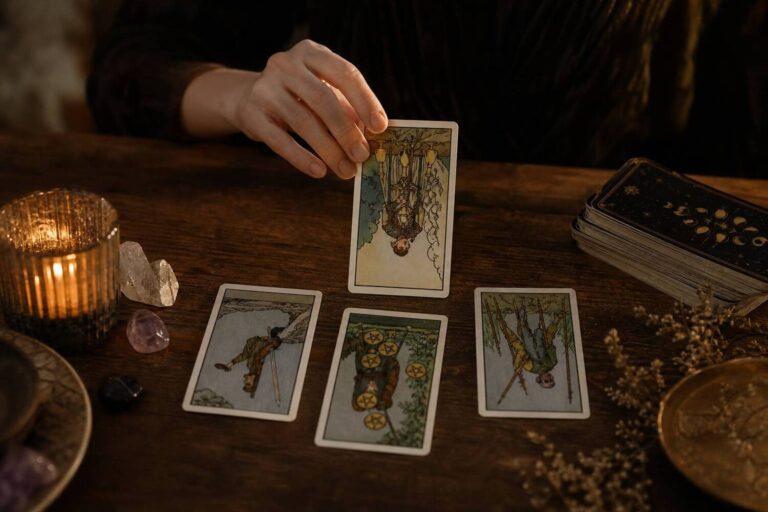
Imagine laying down the Four of Cups when you have just learned that fours suggest stability. The card might speak of emotional disconnection, while the number promises a foundation. Are those meanings at odds? Not necessarily. Still water can be peaceful, but it can also become stagnant.
That small shift in perspective is a useful beginning for tarot numerology. A number can offer a theme to consider alongside a card’s suit, imagery and established meanings. It does not have to dictate the answer. The question you asked, the card’s position and the symbols around it all help determine which possibility is most relevant.
What numbers contribute to a reading
One way to approach the numbered Minor Arcana is to treat the number as a stage or quality and the suit as the area of experience in which it appears. In a system that associates four with stability, structure or containment, the suit helps you explore what is being held steady.
Cups, for example, can point toward emotions and relationships. The Four of Cups might therefore invite you to consider emotional stillness: a welcome pause, perhaps, or a settled state that has become difficult to move beyond. Disconnection is not erased by the idea of stability; it can be one way stability feels when it hardens into stagnation.
Compare that with the Four of Pentacles, where the same theme might be considered in relation to resources, security or possessions. The number provides a shared question, but it does not make the two cards interchangeable.
Let the card have its own voice
If a numerical keyword seems to conflict with the card in front of you, resist the urge to force a neat match. Instead, ask what the tension reveals. A stable situation can feel secure to one person and limiting to another. The details of the reading matter.
Suppose the Four of Cups appears in response to a question about rest. Emotional stillness might suggest a needed pause. In a question about feeling stuck, the same card might prompt reflection on whether comfort has become disengagement. Neither interpretation is an automatic verdict; each is an invitation to look more closely at the situation.
The surrounding cards and the position in the spread can add further context. A card describing a difficulty may invite a different emphasis from one describing a resource. Begin with what the card is commonly understood to express, then use the number to deepen or question that understanding.
Why systems do not always agree
Tarot readers do not all use one numerical framework. Some find number-and-suit combinations especially useful with Marseille or other pip decks. Others prefer to begin with the illustrations and a few key meanings in a Rider-Waite-Smith-style deck, using numerology as an additional layer rather than a prerequisite.
Different traditions may also attach more than one kind of number to a Major Arcana card. A card number can indicate its place in a deck, while a number described as a “key number” may refer to a separate correspondence within a particular system. For example, one explanation connects such key numbers with numbered paths on a Qabalistic Tree of Life. That is a system-specific attribution, not a reason to assume every number printed or discussed beside a card means the same thing.
When a book presents unfamiliar attributions, look for its explanation of the system before trying to reconcile them with another source. If the explanation is unclear, you can note the distinction and return to it later. You do not need to settle every correspondence before you begin reading.
Tarot numerology and Kabbalah
Beginners sometimes encounter the claim that tarot numerology comes directly from Jewish Kabbalah. The relationship is more complicated. Some tarot traditions draw on Western esoteric interpretations that incorporated Jewish mystical teachings, but tarot and Jewish Kabbalah are not the same practice.
People also differ over questions of access to Kabbalah and what constitutes appropriate study or practice. Some Jewish practitioners consider it a closed practice, while others describe a more varied picture. If you want to explore those traditions, approach them with care and seek out their own teachings and perspectives. You can learn to read tarot’s numbered cards without treating Jewish religious practice as a shortcut to card meanings.
A gentle way to practice
Choose one deck and a guide that helps you understand its images. Work slowly enough to notice what each card contributes before adding another system. For a numbered card, try recording:
- The card: What established meaning or visible detail first catches your attention?
- The suit: What area of experience does it bring to mind?
- The number: What theme might it add, and could that theme have more than one expression?
- The context: How do your question, the card’s position and any surrounding cards change the emphasis?
If study begins to feel crowded, set the extra correspondences aside for a while. Return to the image and the question you brought to it. With the Four of Cups, you might ask: Where does stillness feel restorative, and where might it be keeping me from noticing something?