
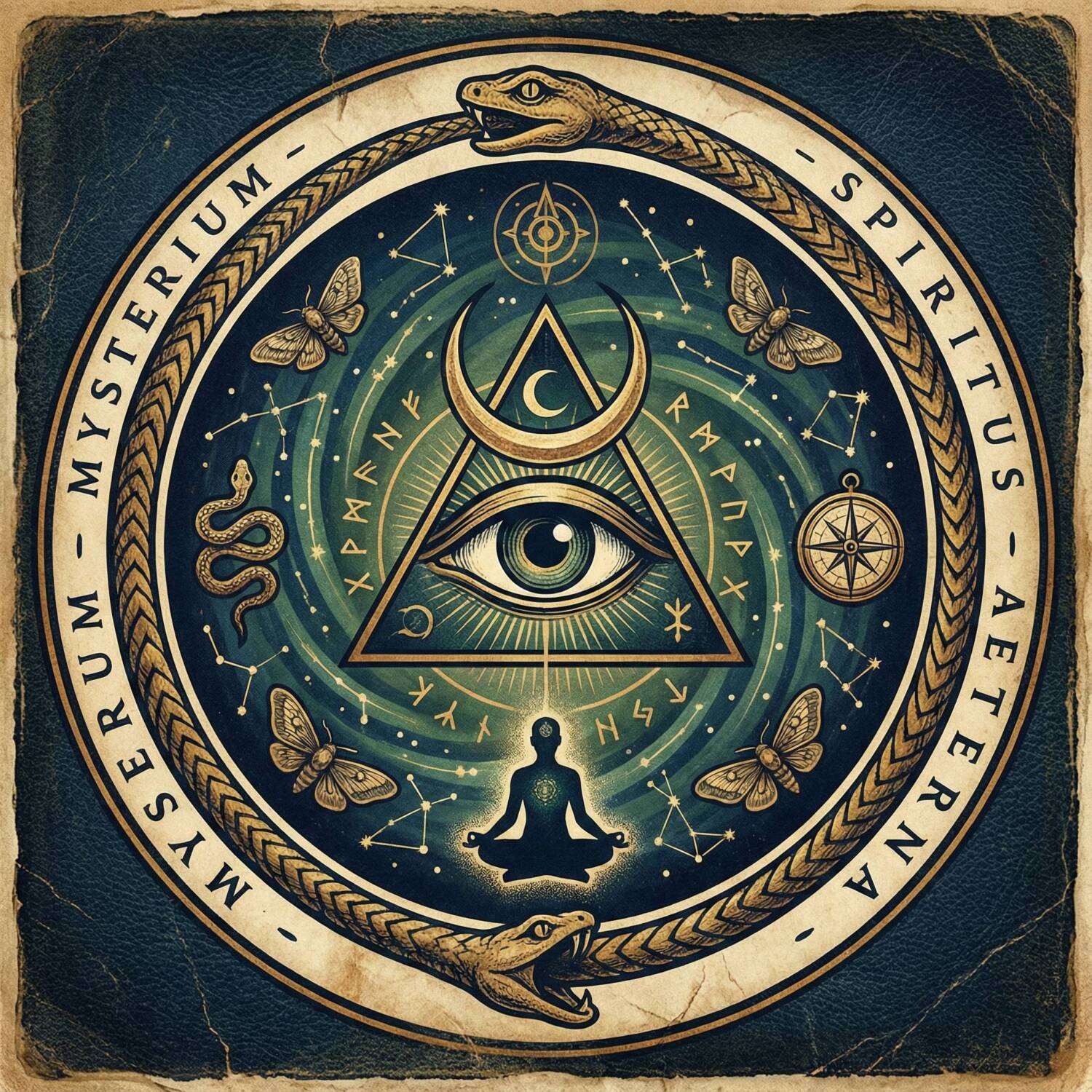
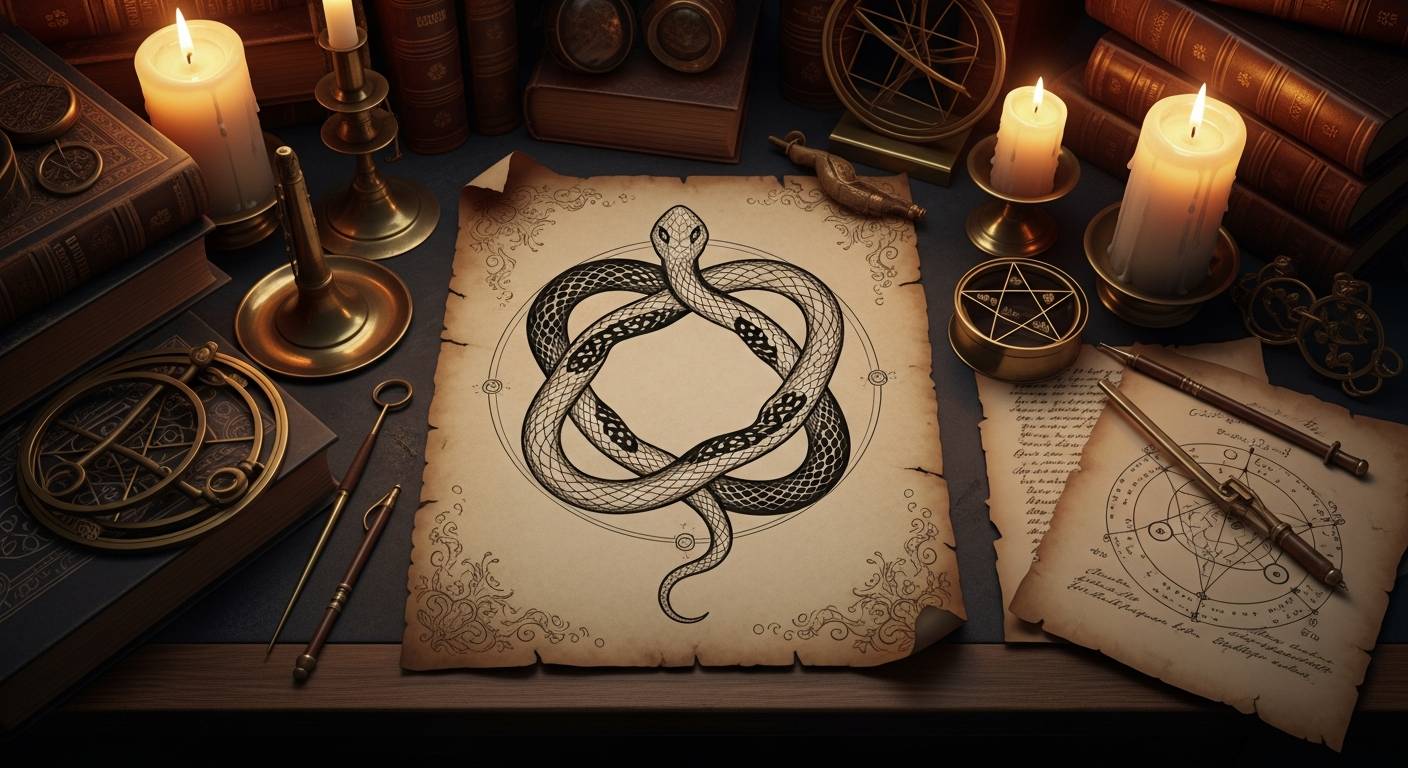

The ouroboros is one of the oldest and most enduring symbols in esoteric tradition. It is usually shown as a serpent or dragon eating its own tail, forming a circle with its body. The image is simple, but its meaning reaches across ancient religion, alchemy, philosophy, magic, psychology, and modern mystery culture.
At first glance, the ouroboros can seem strange or even unsettling. A creature consuming itself appears destructive. Yet the symbol is rarely only about death or self-destruction. More often, it represents a cycle: ending and beginning, loss and renewal, death and rebirth, dissolution and return.
The ouroboros has survived for thousands of years because it expresses something universal. Nature moves in cycles. Time appears to turn. Life feeds on life. What ends becomes the material for what begins. The serpent biting its own tail gives that pattern a single unforgettable image.
What the Ouroboros Looks Like
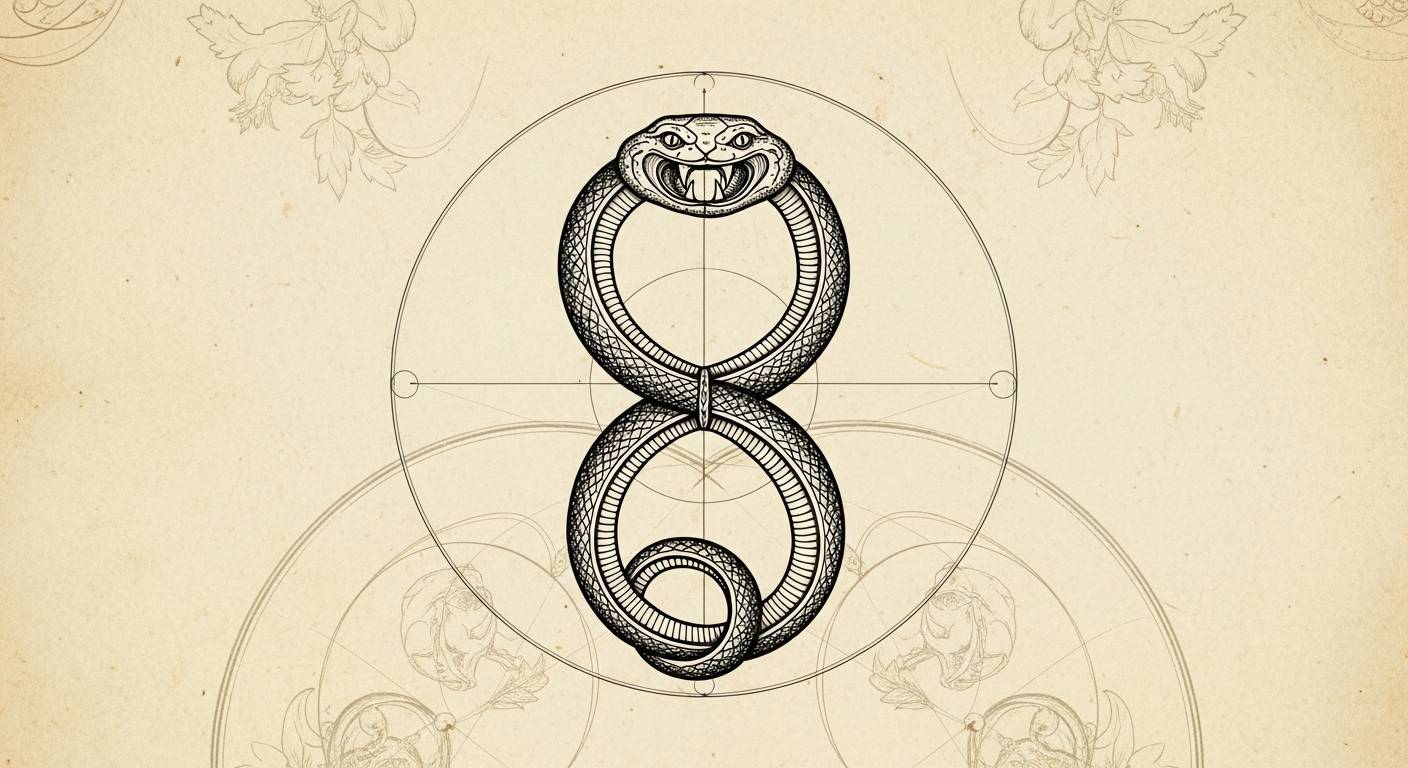
The most familiar ouroboros is a serpent arranged in a circle, with its mouth biting or swallowing its own tail. Some versions show a simple snake. Others show a dragon, winged serpent, or more elaborate mythical creature. The circle may be neat and symmetrical, or rough and organic, depending on the artistic tradition.
The circular shape is central to the symbol. A line has a beginning and an end, but a circle returns to itself. By turning the serpent into a circle, the image suggests continuity, repetition, enclosure, and self-containment.
Some versions of the ouroboros show the creature half light and half dark. Others place it around cosmic symbols, alchemical diagrams, eggs, worlds, or sacred emblems. These additions deepen the basic meaning, but the core idea remains the same: a living creature forms a closed cycle by consuming and renewing itself.
Ancient Egyptian Origins
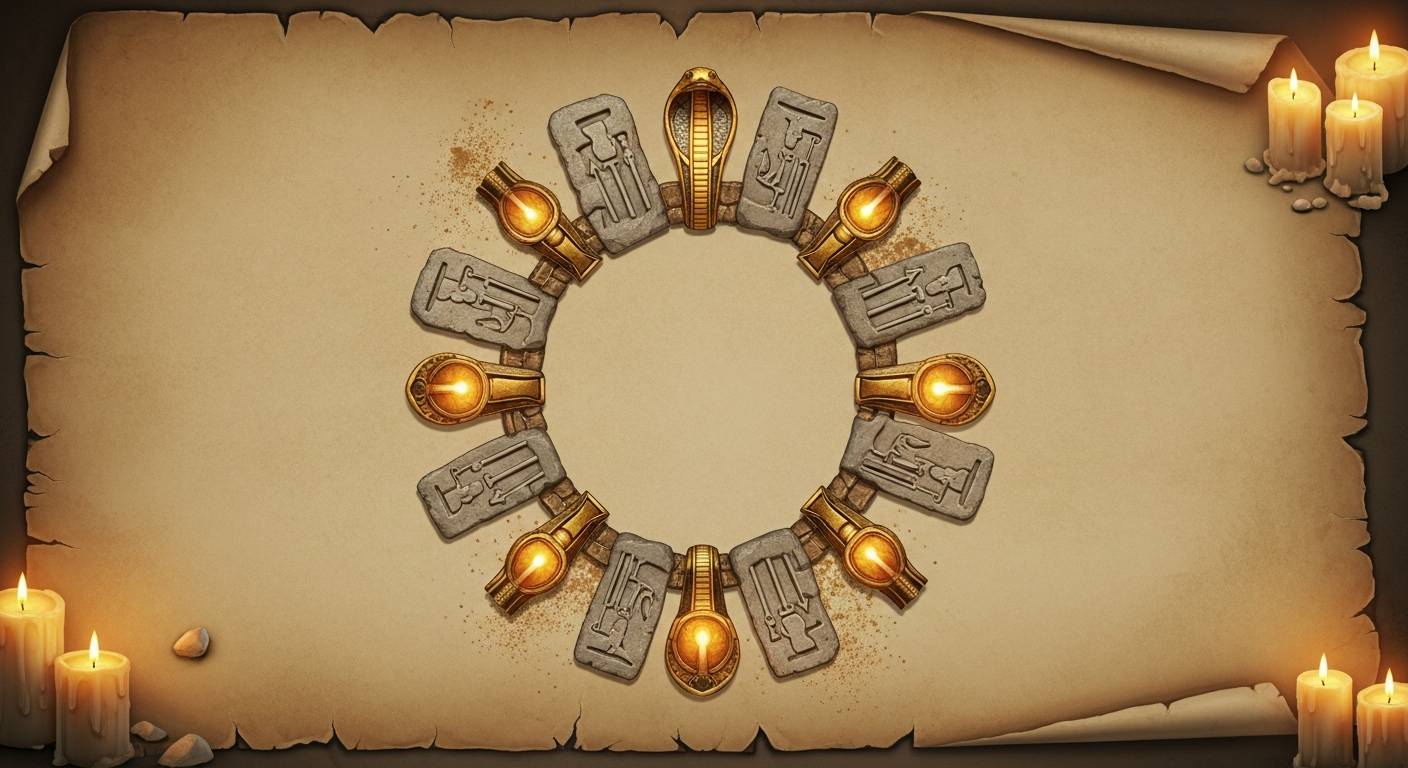
The ouroboros is often traced to ancient Egypt, where serpent imagery played an important role in religious and cosmic symbolism. One of the most famous early examples appears in funerary and underworld material, where a serpent encircling or enclosing divine figures can suggest protection, cosmic boundary, or the mystery of renewal after death.
Egyptian religion often imagined the world in terms of cycles: the daily journey of the sun, the passage through the underworld, the return of light, and the renewal of divine order. A serpent arranged in circular form fit naturally into this way of thinking.
The Egyptian background does not mean every later ouroboros has exactly the same meaning. Symbols travel and change. Still, the ancient Egyptian use of circular serpent imagery helped establish a visual language that later traditions would reinterpret through Greek, Gnostic, magical, and alchemical ideas.
Greek and Gnostic Interpretations
The word ouroboros comes from Greek and is commonly understood as meaning tail-devourer or tail-eater. This name captures the central image directly: a creature consuming the end of its own body. The Greek wording helped fix the symbol in later philosophical and esoteric discussion.
In Greek and late antique thought, the ouroboros could suggest the unity of all things, the circular nature of time, or the self-contained structure of the cosmos. In some Gnostic and magical contexts, circular serpent imagery became connected with cosmic boundaries, hidden knowledge, and the relationship between the material world and higher spiritual realities.
The ouroboros was useful because it could hold opposites together. It showed creation and destruction in one body. It suggested motion and stillness, hunger and completion, death and life. That ability to unite opposites made it especially attractive to esoteric systems that saw the visible world as a set of signs pointing toward deeper truths.
The Ouroboros in Alchemy
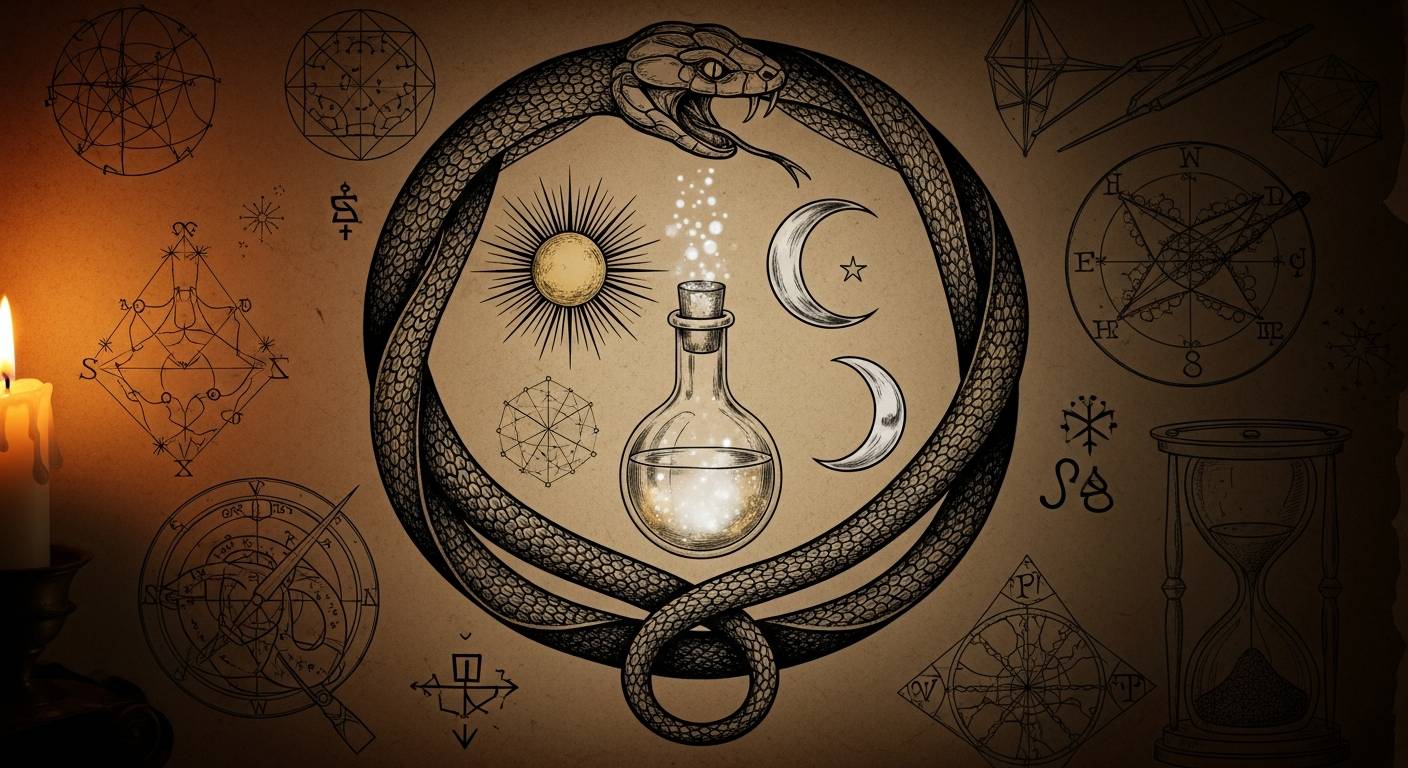
Alchemy gave the ouroboros one of its most powerful symbolic homes. In alchemical manuscripts and diagrams, the serpent eating its own tail could represent transformation, unity, dissolution, and the closed cycle of the work. It was a symbol of matter changing form, breaking down, returning, and becoming something new.
Alchemical imagery often uses strange animals, vessels, kings, queens, suns, moons, and serpents to express processes that are both material and spiritual. The ouroboros fits this world perfectly because it shows a process contained within itself. The creature destroys and sustains itself at the same time.
One famous alchemical idea linked to the ouroboros is the unity of opposites. The serpent can suggest that what appears divided may actually be part of one continuous process. Beginning and end, poison and medicine, decay and renewal, body and spirit all turn within the same circle.
Eternal Return and Cyclical Time
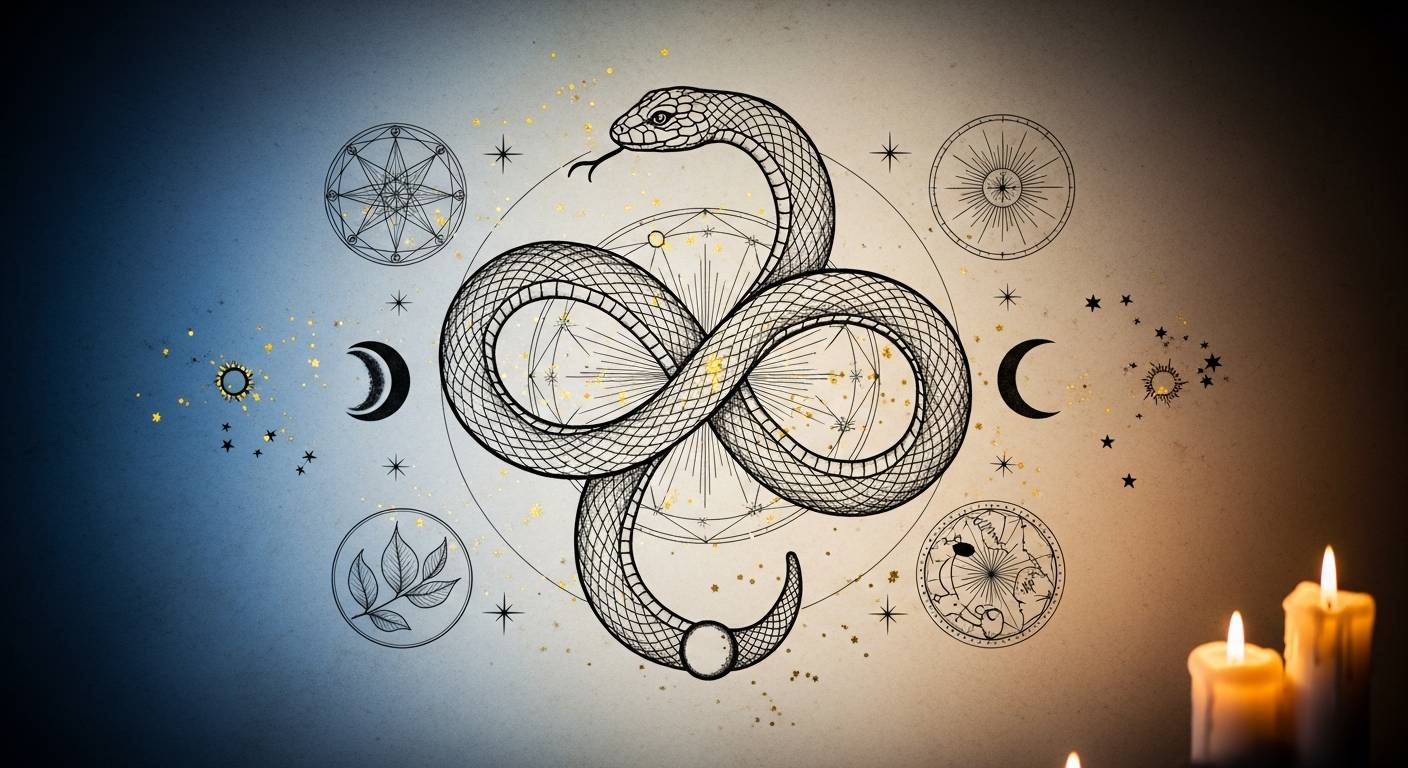
One of the most common meanings of the ouroboros is cyclical time. Unlike a straight line, which moves from past to future without returning, a circle suggests recurrence. Seasons repeat. Stars return. Civilisations rise and fall. Lives begin, end, and give way to new life.
The ouroboros gives this idea a living form. The serpent is not simply placed inside a circle. It becomes the circle. Its body is the boundary, the path, and the cycle itself. This makes the symbol feel more alive than a geometric diagram.
In mystery and esoteric writing, the ouroboros often appears when people are trying to describe patterns that never fully end. It can represent the universe renewing itself, the soul passing through stages, or the idea that every ending secretly contains the next beginning.
Death, Rebirth, and Self-Renewal
The ouroboros is often associated with death and rebirth because the image contains both destruction and continuation. The serpent consumes itself, yet the circular form suggests that this act does not end the creature. Instead, consumption becomes part of its ongoing existence.
This is why the symbol can represent self-renewal. Transformation often requires something old to be broken down. In nature, dead matter feeds new growth. In mythology, descent can precede return. In alchemy, dissolution can precede recombination. The ouroboros gathers these patterns into one image.
The serpent itself strengthens this meaning because snakes shed their skin. Across many cultures, that process made serpents natural symbols of renewal, hidden vitality, healing, danger, and rebirth. A serpent consuming its tail intensifies the same idea: life changes by turning back into itself.
The Ouroboros as a Symbol of Wholeness
The ouroboros can also represent wholeness. Because the serpent forms a closed circle, it does not need an outside beginning or endpoint. It contains its own motion. It is both eater and eaten, cause and result, beginning and end.
In esoteric symbolism, this kind of closed form can suggest completeness. The circle has long been used to represent unity, eternity, perfection, and the boundary of sacred space. When the circle is made from a living serpent, the idea becomes more mysterious and more dynamic.
Unlike geometric emblems such as the pentagram, the ouroboros turns the idea of sacred order into a living cycle, one that consumes and renews itself at the same time.
This is one reason the ouroboros appears in magical, alchemical, and philosophical contexts. It can suggest that reality is not made of isolated fragments, but of connected processes. What appears separate may be part of one larger whole.
Serpent and Dragon Symbolism
The ouroboros is usually a serpent, but some versions resemble a dragon. Both creatures carry deep symbolic weight. Serpents can represent danger, wisdom, healing, hidden knowledge, fertility, death, and renewal. Dragons can represent chaos, treasure, cosmic force, guardianship, or overwhelming power.
Modern audiences often read serpents and dragons as monsters, but older traditions were more complex. A serpent might be feared, revered, avoided, invoked, or treated as a guardian of sacred mysteries. Its closeness to the earth and its ability to shed skin made it a natural symbol of hidden life and transformation.
In the ouroboros, the serpent or dragon is not merely an enemy. It becomes a cosmic image. Its hunger is not random destruction, but part of the symbol’s cycle. It consumes, encloses, protects, renews, and returns.
Psychological and Modern Esoteric Meanings
In modern esoteric and psychological interpretation, the ouroboros is often read as a symbol of the self, the unconscious, or the process of inner transformation. Its circular form suggests a closed psychic system, a return to origins, or the integration of divided parts of the self.
Depth psychology helped revive interest in ancient symbols by treating them as images of inner experience. In that setting, the ouroboros can represent an early undivided state, a cycle of renewal, or the difficult process of confronting what has been hidden and making it part of a larger whole.
Modern occult and spiritual writers also use the ouroboros to describe personal transformation, ancestral cycles, karmic patterns, and the relationship between destruction and renewal. These interpretations vary widely, but they all draw from the same visual power: the self-consuming serpent that survives by returning to itself.
Common Misunderstandings
One common misunderstanding is that the ouroboros is simply a dark or evil symbol. Its imagery can look unsettling, but its historical meanings are usually more complex. It often represents cycles, renewal, eternity, transformation, and unity rather than simple destruction.
Another misunderstanding is that the ouroboros belongs to one single religion, occult order, or magical system. In reality, it has moved through many contexts: Egyptian religion, Greek language, Gnostic imagery, alchemical manuscripts, magical symbolism, philosophy, psychology, and popular culture.
It is also easy to mistake the ouroboros for any circular dragon or serpent image. Not every coiled serpent is an ouroboros. The defining feature is the creature biting or swallowing its own tail, creating a closed loop of consumption and return.
Why the Ouroboros Still Matters
The ouroboros still matters because it gives form to one of the oldest human observations: endings and beginnings are often connected. The symbol shows a creature destroying itself and sustaining itself in the same act. That contradiction is exactly what makes it powerful.
Across ancient religion, alchemy, esoteric philosophy, psychology, and modern mystery culture, the ouroboros has remained a symbol of return. It suggests that life is not only a straight path forward, but also a cycle of repetition, renewal, and transformation.
The serpent eating its own tail is strange because it refuses to separate opposites. Death and life, hunger and completion, chaos and order, self and world all meet inside the circle. That is why the ouroboros continues to appear wherever people search for symbols of hidden unity and eternal change.