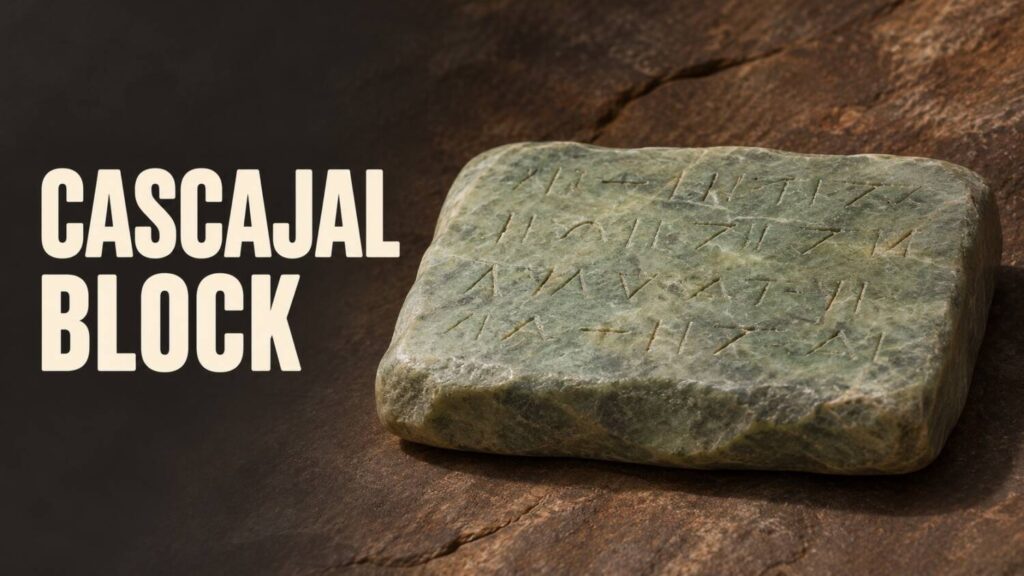
The Cascajal Block presents a pale green surface cut with rows of signs. The first published count identified 62 marks grouped into 28 sign types. Some recur. Others appear once. The difficulty begins away from that surface, with how the slab was found. A mark can be studied under a microscope. The layer the slab originally lay in is harder to recover.
The slab and its find context
The block came to researchers’ attention after earthmoving near Lomas de Tacamichapa in Veracruz, Mexico. The team that published it in 2006 compared material reported from the disturbed deposit with finds from the Olmec region and proposed a date around 900 BCE. The association supplies a possible period. It lacks the control of a slab recorded in its original layer. The 2006 report
That is why questions about age, authenticity and writing have to be tested separately. A tool mark may be consistent with ancient lapidary work. That observation has a different bearing on the case from a recurring sequence of signs, which might tell us about the organisation of the inscription.
Examining the surface
A later study used multiple lighting angles to clarify faint marks, X-ray fluorescence to characterise the stone and electron microscopy to inspect impressions of the cuts. The analysis supported identification of the material as serpentine and found manufacturing traces comparable to those on securely provenanced Olmec objects. The authors also published a revised drawing of the signs. Imaging and materials study
The findings strengthen the attribution to ancient Olmec workmanship. The context still limits how precisely the object can be dated. The revised drawing helps readers see which cuts the authors counted, which is essential when a small change can alter a proposed sequence.
How much one inscription can show
The 2006 team argued that the repeated and ordered signs are consistent with writing. Assigning sound or word values is harder with one short example. A second inscription using the same forms would show which sequences recur in a new setting. Until then, the slab’s surface can provide better readings of individual cuts while their meaning remains open.
In a 2025 handbook chapter, Stephen Houston made the case for treating the block as writing while describing it as a rare example. That scarcity limits the comparisons available. A repeated motif elsewhere can help establish the cultural setting of a sign without providing a reading of the line in which it appears. The Case for Olmec Writing
The guide to why ancient scripts stay unread compares the evidence available for other inscriptions and manuscripts in this series.