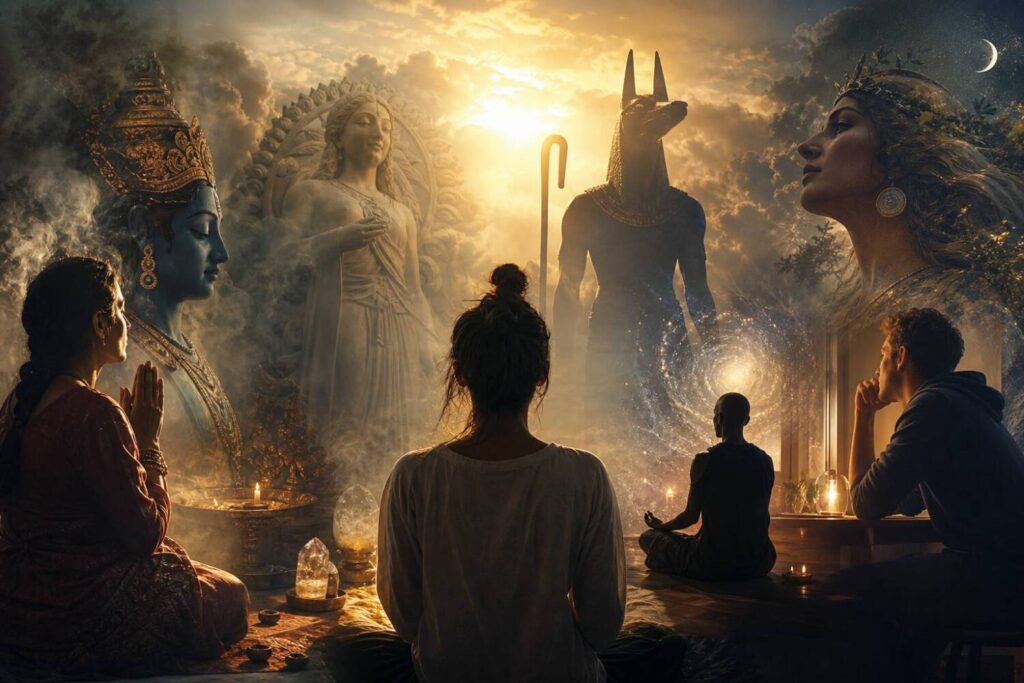
What does it mean to “work with” a deity? For one person, it may describe devotion to a god understood as a distinct, living presence. For another, it may mean invoking an archetype: a set of qualities, stories or images used to reflect on the self. Someone else may have a relationship with spirits without calling it worship, or practice witchcraft without involving deities at all.
These differences can be especially puzzling for newcomers. In online discussions, people ask whether working with Hecate requires belief in Greek mythology, whether an atheist can invoke a deity, and whether a sense of guidance means a god has been present throughout their life. There is no single answer, because the same words can describe different beliefs and practices.
Devotion and belief in deities
For some practitioners, deity work is part of a religious life. A pagan who worships deities may understand them as real beings and approach them through offerings, ritual, prayer or other acts of devotion. The relationship can be understood as personal, but it also exists within a wider religious framework: the deity has stories, a cultural setting and meanings that are not simply invented by the individual practitioner.
Belief in a deity does not necessarily imply the same interpretation of every myth associated with that deity. Nor does devotion to one god automatically answer whether other gods exist. One practitioner in the discussion described focusing on the Irish pantheon while also respecting and believing in other pantheons. Another described devotion to Shiva and Ganesha within Hinduism, finding comfort in meditation and devotional practice.
Those examples point to different ways people locate themselves: within a particular pantheon, a religious tradition, or a personal relationship shaped by several influences. They should not be treated as interchangeable or as representative of everyone in those traditions.
Working with, worshipping and relating
The phrase deity work does not always mean worship. Some people describe an ongoing relationship with a deity or spirit in which they seek guidance, offer attention or perform rituals. One participant in the discussion drew a distinction between having relationships with spirits and worshipping them.
Practitioners also describe different expectations within those relationships. One person said some deities seemed to require frequent offerings and rituals, while others felt less demanding. These are reports of personal experience, not a reliable measure of what any deity requires of everyone.
Relationships can also feel uncomfortable or unwelcome. In a discussion asking for difficult experiences, participants described avoiding certain deities, feeling that a connection demanded too much energy, or interpreting a meditation as distressing. Others said they preferred deities associated with qualities they trusted. Such accounts show that personal boundaries matter to practitioners; they do not establish a universal character assessment of a deity.
Archetypes and atheist practice
An atheist witch may not believe that gods exist as independent beings, yet still find deity imagery useful. Several participants described deities as archetypes: collections of qualities that can be invoked or cultivated within oneself. In that approach, invoking a deity need not mean asking an external being to act. It can instead be a way to focus attention on a quality, a story or an aspect of one’s experience.
One commenter described honoring Freya as a way of honoring qualities they associated with her, including wisdom and resilience. Another said they sometimes invoked an archetype but did not make offerings. These are individual interpretations, not a fixed atheist method.
Other practitioners who do not believe in deities focus their craft on the natural world, ancestors, spirit guides or other interests. Witchcraft is not automatically synonymous with deity worship. A person drawn to Hecate, for example, may first need to decide what that attraction means to them: religious devotion, interest in stories and symbolism, or an open question they are still exploring.
Uncertainty, signs and personal interpretation
Not everyone begins with a settled belief. An agnostic or questioning practitioner may be interested in deity practice without claiming to know whether a deity exists independently. They might explore a ritual or story while leaving its meaning unresolved.
The question of signs illustrates why interpretation matters. Some people understand a recurring image, a childhood memory or a feeling of guidance as evidence that a deity has accompanied them. Others regard that conclusion as dependent on a person’s religious or spiritual framework, rather than something every tradition assumes. The experience may be meaningful to the person involved without proving one explanation to everyone else.
Why traditions and context matter
Deities are not just a list of names attached to desirable qualities. They appear in particular religious and cultural contexts, and practitioners disagree about how those contexts relate to one another. Some take an eclectic approach, drawing from different pantheons. Others stay within one tradition or understand devotion through a specific religious community.
There is disagreement, too, over whether differently named deities are distinct beings, expressions of a broader divine reality, or ways of describing forces of nature. Each position changes the meaning of a practice. An offering to a distinct god, an act of devotion to one face of the divine and a symbolic exercise with an archetype may look similar from the outside, but they rest on different assumptions.
For someone beginning to explore, reading about the relevant culture and tradition is a useful starting point. So is asking what a practice means to the people who use it, rather than assuming that one online explanation applies everywhere. A person can remain curious, set boundaries and take time to decide whether devotion, symbolic practice or no deity work at all fits their beliefs.