Choose a bowl and a small amount of money you can comfortably set aside. A money bowl is a form of prosperity spellwork: practitioners gather money, written intentions and other meaningful materials in one place as a focus for abundance. The finished bowl may be elaborate or spare. Its ingredients matter to the person making it, but the practice has no single recipe.
In online witchcraft discussions, people share bowls made with garden herbs, rice, coins, crystals and tarot cards. They also ask whether they have chosen the right container or included enough ingredients. The answers reveal a flexible practice, with room for different beliefs about how a ritual should work.
Choose a container and a base
Start with a container that suits the space you have. One practitioner used a vintage Pyrex bowl; another described changing from ceramic to brass after reading that brass was favorable in some traditions. A commenter with limited space wondered whether a money jar could serve instead. These examples show how the vessel can be a practical choice as well as a symbolic one.
Rice and salt appear as a base in several shared examples. One maker colored both with mica before adding other objects; another placed them at the bottom and mixed in herbs. A base can hold smaller items and give the arrangement a sense of order, but practitioners responding to a beginner’s long ingredient list said that no complete list was strictly necessary.
Add ingredients with a purpose
Choose a few materials whose presence makes sense to you, rather than trying to reproduce every bowl you see. In the examples shared online, ingredients include:
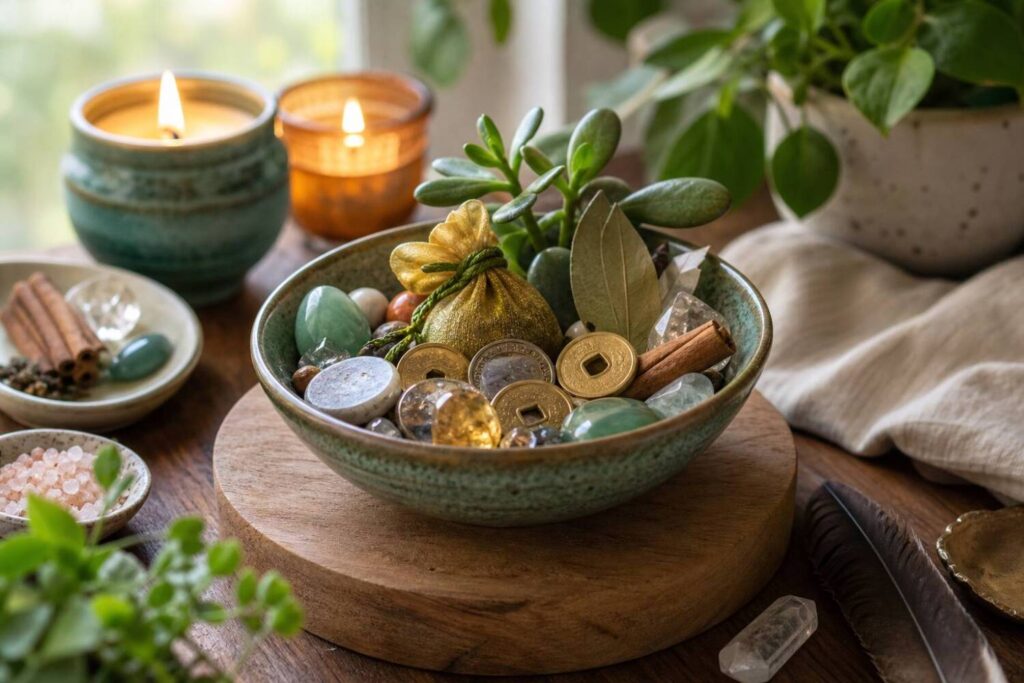
- Herbs and spices: rosemary, thyme, mint, lavender, sage, cinnamon and bay leaves. One maker used fresh and dried garden herbs; another included bay, rosemary, mint and cinnamon.
- Money: coins, bills or a mixture. Some people use what they already have, while one maker planned to add bills later.
- Written intentions: a petition, meaning a written statement of a wish or intention, or words written on a leaf.
- Personal symbols: crystals, rune stones, a copper ball or tarot cards chosen as relevant to the maker’s purpose.
Not every practitioner assigns the same meaning to each ingredient. In one discussion, a person suggested that each item should reflect an intention, rather than being added only because someone else had named it. Another recommended choosing a few favorites from a longer list. Neither response establishes a universal rule; both encourage a maker to be deliberate.
State the intention and arrange the bowl
Write down what you want the bowl to represent. One practitioner placed sage leaves bearing intentions on top of a mixture of rice, salt, herbs and money. Another included separate petitions alongside rune stones and tarot cards. You might use a short written statement, a leaf or an object that keeps your intention in view.
Then arrange the materials in a way that lets you attend to each choice. Some practitioners frame their intention broadly as abundance; others include their community in it, expressing a wish for money to flow toward them so they can also give back. The bowl gives that intention a physical form, whether a person understands it as spellwork, a reminder or both.
Decide how to tend it
Practices differ after the bowl is made. One commenter said they move money in and out frequently so its energy does not “stagnate.” Another described leaving money in the bowl and continuing to add to it. These are different approaches, not steps that every maker must follow.
If you use the bowl to set money aside, decide whether it is savings you intend to leave untouched or cash you may take out and replace. That practical decision can sit alongside whatever symbolic meaning you give the movement of money.
Keep ritual and financial outcomes distinct
People may connect a bowl with later events, but an account of a change in finances does not establish that the ritual caused it. One commenter associated their bowl with a mortgage refund. Another person described losing money and being scammed shortly after switching to a brass vessel. Neither experience proves that a bowl attracts money or causes loss.
A money bowl is not a guarantee of income, protection from scams or financial stability. It can be meaningful as a ritual without becoming an explanation for every gain or setback. A responding practitioner likewise noted that spells cannot override ordinary events. Practical attention to spending, saving and recognizing scams remains important.
When your bowl is complete, place it somewhere suitable and decide how you want to tend it. You can add to it, move money through it, or leave a few chosen objects in place. Let the final arrangement reflect an intention you can name, rather than a promise it cannot make.