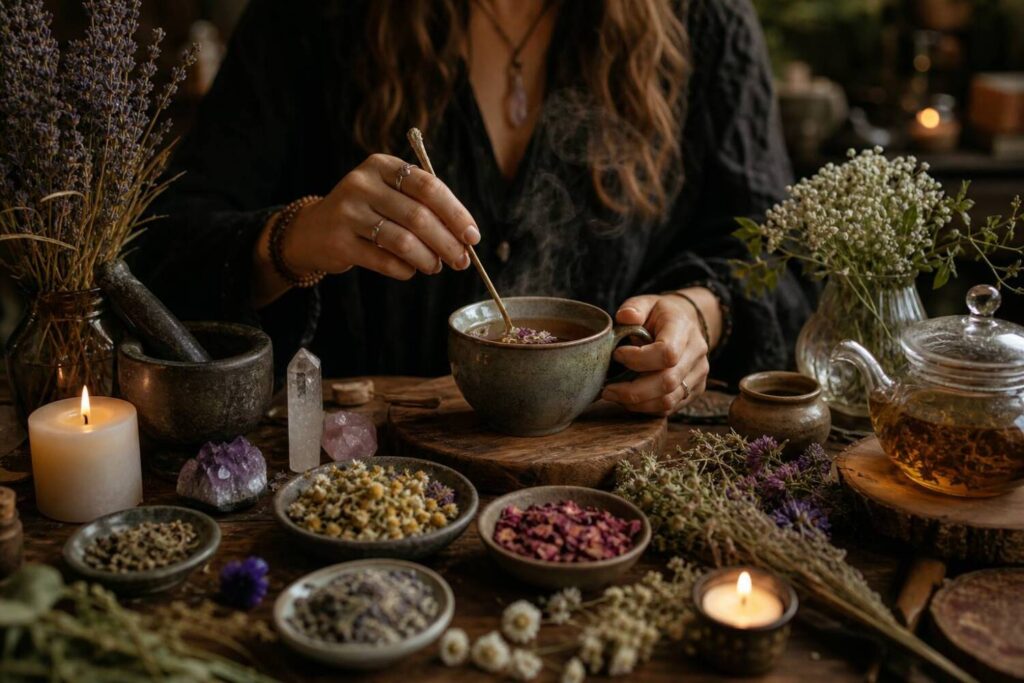
In contemporary witchcraft, tea can be both an ordinary drink and a deliberate point of focus. Practitioners describe brewing a cup as a way to bring intention into a familiar part of the day: choosing herbs, preparing the infusion, and taking a pause before moving on. Some say they focus an intention or do energy work over the herbs; others value the ritual’s quiet, everyday character. Neither approach has to be treated as a universal rule. The practice is personal, and its spiritual meaning comes from the practitioner’s beliefs rather than from a proven medicinal or supernatural effect.
That everyday quality is part of tea’s appeal. A cup can fit into a morning routine, a moment of reflection, or a period of stress without requiring an elaborate ceremony. One practitioner described tea as a comfort offered through both minor and difficult moments. In a ritual context, the preparation itself can act as a cue to slow down and attend to the present. That sense of grounding is a subjective experience, not evidence that tea can resolve a practical problem or guarantee a spell’s outcome.
Herbs, symbolism, and personal correspondences
Tea witchery often involves assigning symbolic meanings to ingredients. In one suggested blend, rose was associated with good fortune or luck, green tea with prosperity, and bay laurel with success or manifestation. The same discussion mentioned ginger as an alternative for success. Another practitioner described working in threes, with rose, lavender, and chrysanthemum, sometimes changing the blend to include tea leaves when caffeine was wanted.
These examples are personal correspondences, not a standardized system. A practitioner might select an ingredient because of a meaning they have encountered, a relationship they have developed with it, or simply its taste. The distinction matters: saying that someone uses bay laurel to symbolize success is different from claiming that drinking it causes success. Likewise, practitioners may describe an herb as an “ally” or speak of its “natural magic”; those are expressions of spiritual belief, not established medical findings.
Simple actions can give an intention a shape. A person might choose a blend that represents a goal, hold that goal in mind while the tea brews, and drink it as a reminder to take practical steps. In a discussion about seeking work, for example, a commenter proposed a blend connected symbolically to luck, prosperity, and success alongside a morning routine of grounding and affirmations before job applications. The useful distinction is that a ritual may support reflection or focus for the person doing it, while applications and other real-world actions remain necessary.
Working with taste and ritual without forcing either
Not every herb makes an appealing cup. In a discussion about mugwort, people described its flavor as earthy, bitter, or unpleasant, while others said they drank it plain. Suggested additions included peppermint, hibiscus, chamomile, honey, citrus, and maple syrup. These are examples of flavor preferences shared by individuals, not a recipe that suits everyone. A ritual does not need to involve drinking an ingredient: the mugwort discussion also included a suggestion to use it in a bath. Whatever the format, practitioners can adapt the practice to their preferences rather than treating discomfort as a test of commitment.
Ritual timing can be just as flexible. Some practitioners plan activities around lunar phases; others point out that a “blue moon” is a calendar description, a second full moon in a Gregorian month, and need not have special significance in every magical practice. Tea can therefore be part of a moon-related ritual, a daily grounding habit, or an ordinary cup with no astrological timing at all. The point is to choose a structure that has meaning to the person using it, not to assume that a date or ingredient carries the same meaning for everyone.
Safety and the boundary between belief and medicine
Spiritual symbolism should not be confused with medical benefit. A practitioner may find a tea comforting or meaningful, but that experience does not establish that an herb treats an illness. The source discussions include specific warnings about mugwort: commenters advised against drinking it during pregnancy or when trying to become pregnant, and one commenter cautioned that it may be associated with heavy bleeding and pain. These are community warnings, not a substitute for individualized medical advice. Anyone considering mugwort or another herb for consumption, especially when pregnant, trying to become pregnant, or concerned about menstrual symptoms, should check with a qualified health professional before using it.
Keep the practice modest and informed: know which herbs are in a blend, do not assume that “natural” means suitable for everyone, and do not use a ritual in place of medical care. Tea witchery can offer a personally meaningful pause, a sensory routine, or a way to express intention. Its symbolism can matter to a practitioner without being presented as a medicinal claim or a guarantee of results.