
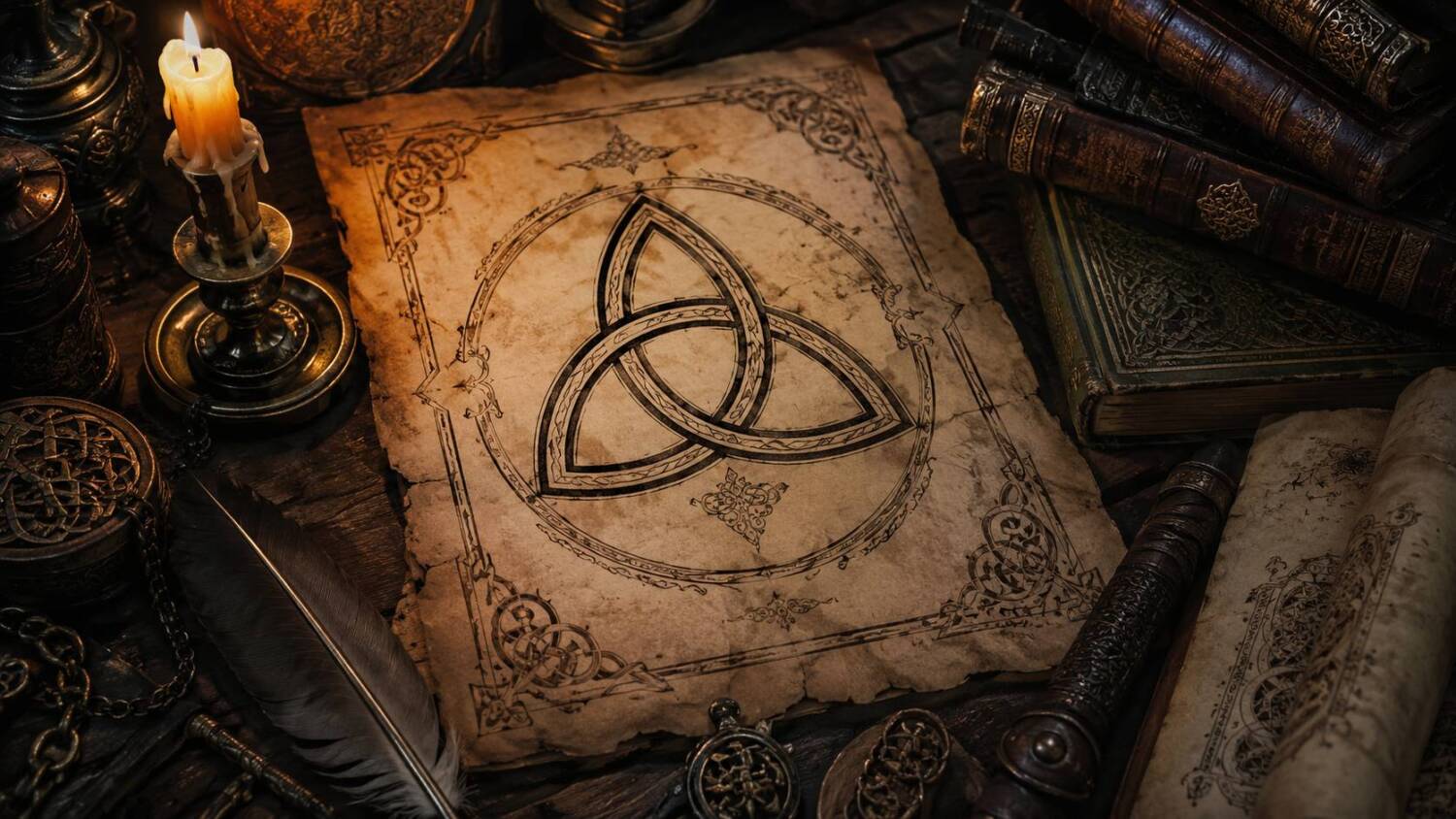

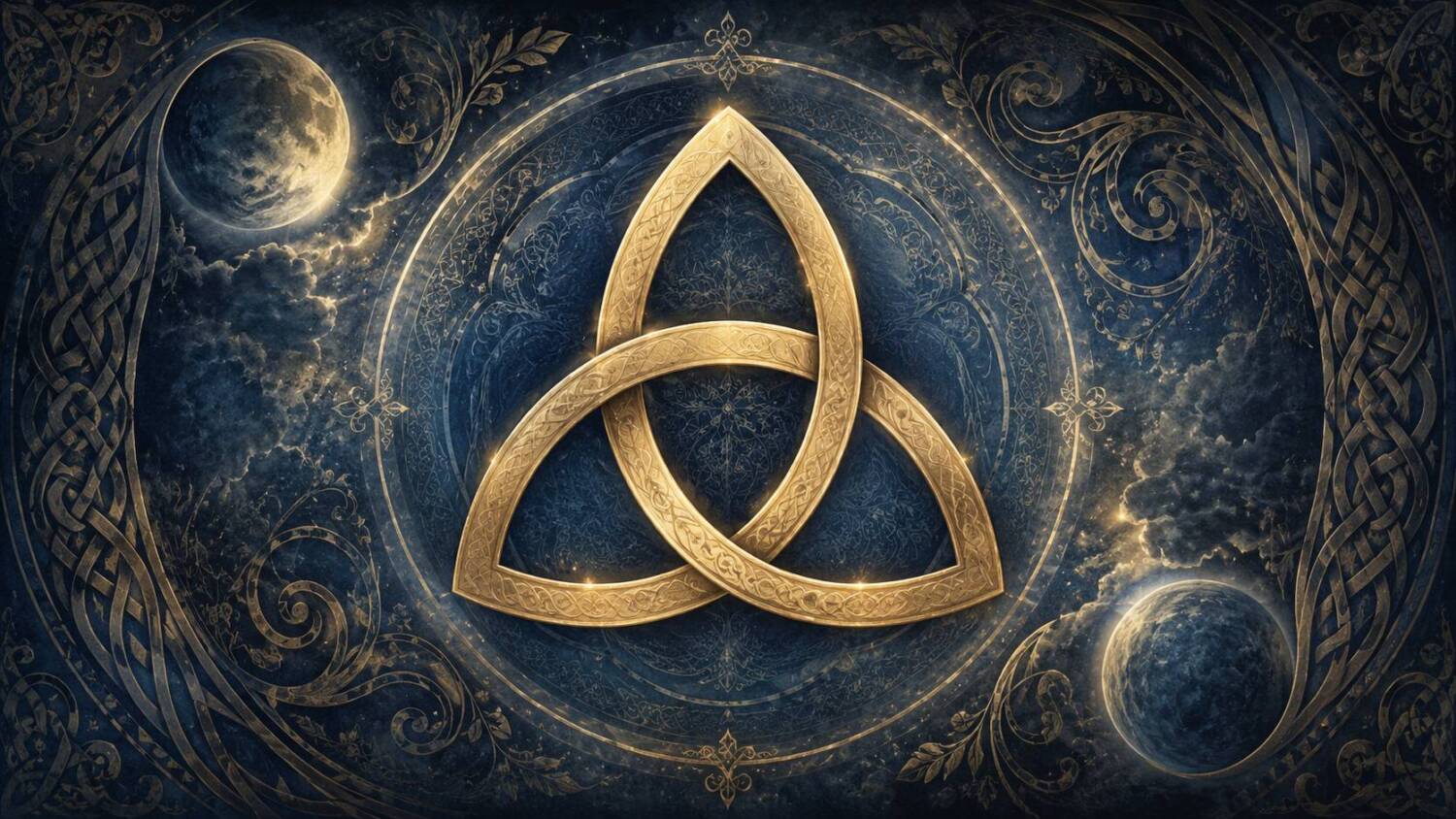
The triquetra is one of the most recognisable knot symbols in Celtic, Christian, Pagan, and modern esoteric culture. It is usually formed from three interlaced arcs or leaf-like points, creating a continuous shape with no obvious beginning or end.
Its name comes from a Latin word meaning three-cornered. That simple description explains the symbol’s appearance, but not the depth of its meaning. Across different traditions, the triquetra has been linked with threes: life, death, and rebirth; earth, sea, and sky; maiden, mother, and crone; Father, Son, and Holy Spirit; body, mind, and spirit.
The triquetra’s power comes from its combination of unity and multiplicity. It shows three distinct parts woven into one continuous form. That makes it a natural symbol for connection, sacred order, eternity, spiritual balance, and the hidden bonds between different forces.
What the Triquetra Looks Like
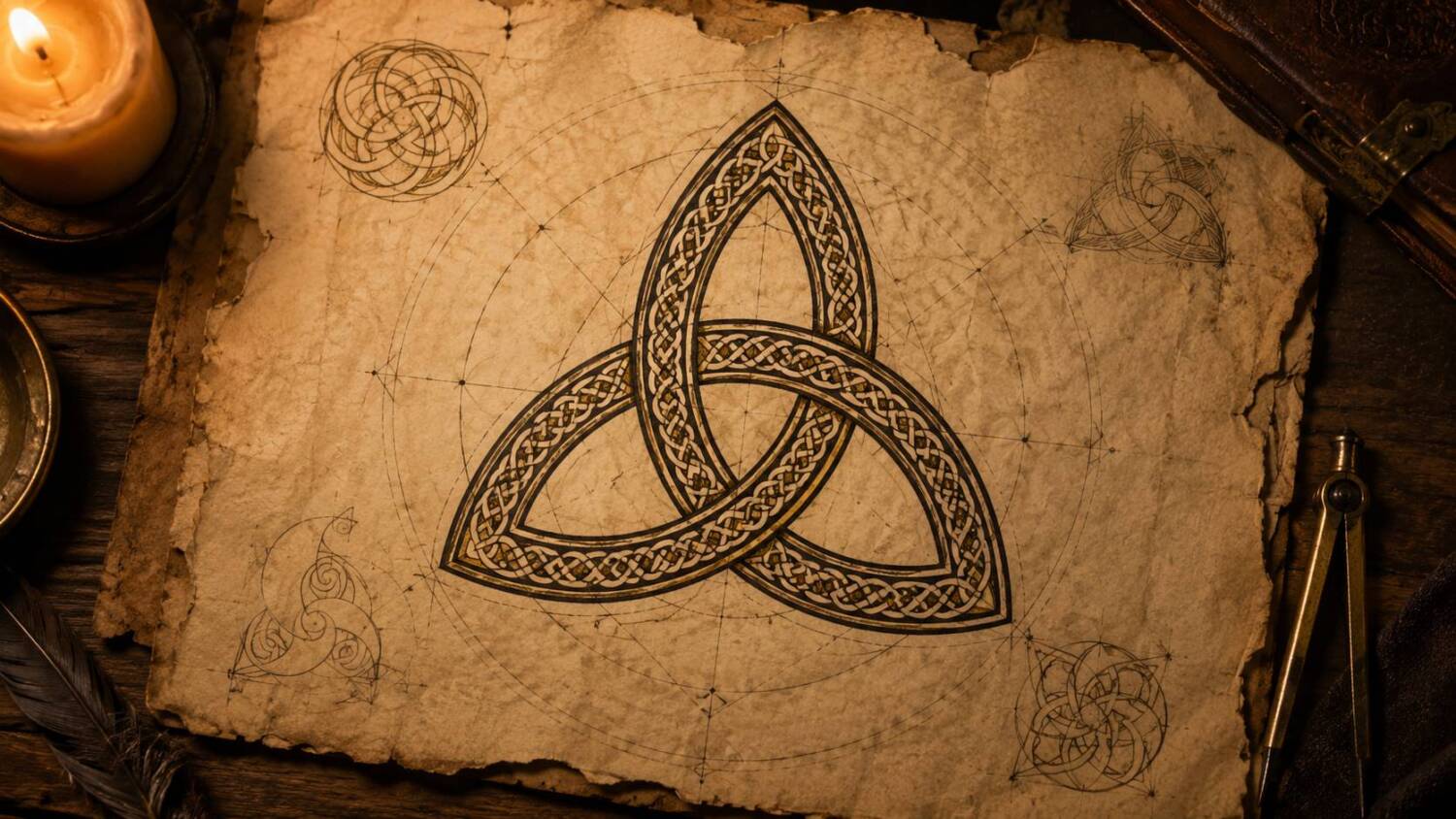
The triquetra is usually drawn as three interlocking loops or pointed ovals. Each loop flows into the next, creating a continuous knot. The design can look like three leaves, three fish shapes, or a flowing triangular knot.
Some versions appear as a simple line drawing. Others are woven into elaborate Celtic knotwork, placed inside a circle, or surrounded by decorative borders. When a circle is added, it can suggest eternity, unity, protection, or the unbroken cycle that holds the three parts together.
The most important visual feature is continuity. The line appears to weave over and under itself without breaking. This gives the triquetra its sense of endlessness and interconnection, qualities that explain why it has been used in religious, magical, and decorative settings for so long.
Ancient Roots and Early Knotwork
The triquetra is often associated with Celtic art, but its deeper history is not limited to one culture or one simple origin. Three-part interlaced designs and knot-like forms appear in different ancient artistic traditions. The specific triquetra shape became especially prominent in Insular art, the artistic tradition of early medieval Ireland and Britain.
In that setting, knotwork was more than decoration. Interlaced patterns appeared in manuscripts, stone carvings, metalwork, and religious objects. Their continuous lines suggested complexity, order, eternity, and sacred beauty.
The triquetra’s association with Celtic identity grew over time because it fit naturally into the visual language of Celtic and Insular design. Its flowing form, threefold structure, and endless line made it memorable, adaptable, and rich in symbolic possibility.
The Power of Three
The number three is one of the main reasons the triquetra became so symbolically powerful. Human cultures often use threes to organise meaning. A beginning, middle, and end creates a complete sequence. Past, present, and future create a model of time. Birth, life, and death describe the human condition.
The triquetra gives this threefold pattern a single visual form. Each point can be seen as distinct, but none stands apart from the whole. The symbol therefore suggests that three forces can be different while still belonging to one structure.
This makes the triquetra easy to adapt. Different traditions can place their own triple meanings onto it without changing the basic shape. That flexibility is one reason the symbol has survived across religious, spiritual, magical, and popular contexts.
Christian Meanings of the Triquetra
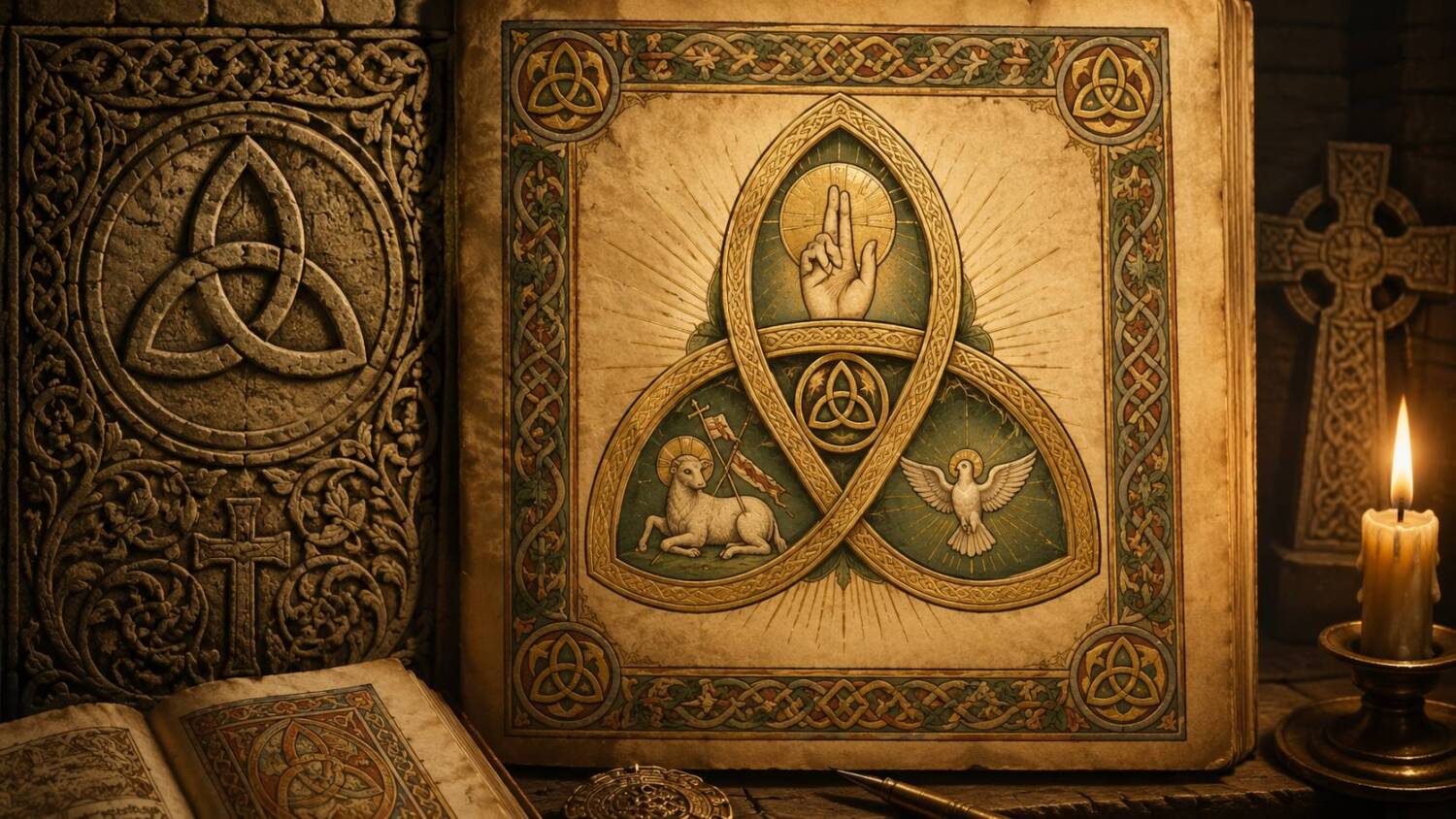
The triquetra became important in Christian art because it could represent the Trinity: Father, Son, and Holy Spirit. The three points suggested three persons, while the continuous line suggested unity. This made the symbol especially useful for expressing a difficult theological idea through visual form.
In early medieval Christian art, knotwork and interlaced symbols appeared in illuminated manuscripts, carved stones, and sacred objects. The triquetra could function as both ornament and doctrine, a beautiful pattern that also pointed toward divine unity.
This Christian meaning is important because the triquetra is sometimes treated today as purely Pagan or occult. Its history is more complex. The same form has been used in Christian, cultural, magical, decorative, and modern spiritual settings.
Celtic Identity and Cultural Revival
Today, the triquetra is strongly associated with Celtic identity. It appears in jewellery, tattoos, artwork, memorials, logos, and spiritual design connected with Ireland, Scotland, Wales, and broader Celtic heritage. For many people, it represents ancestry, continuity, and connection to a mythic past.
This modern Celtic meaning is partly historical and partly revivalist. The symbol does have deep roots in Insular and Celtic-style art, but many of its modern interpretations developed through later cultural revival, romanticism, and contemporary spirituality.
That does not make the symbol less meaningful. Symbols often gain power through reuse. The triquetra has become a way for modern people to express belonging, heritage, spiritual continuity, and respect for older artistic traditions.
Pagan and Wiccan Interpretations
In modern Pagan and Wiccan traditions, the triquetra is often connected with triple forms of divinity and nature. One common interpretation links it with the Triple Goddess: maiden, mother, and crone. This reading connects the symbol with life stages, feminine divinity, lunar cycles, and the rhythm of growth and decline.
Other Pagan interpretations connect the triquetra with earth, sea, and sky, or with life, death, and rebirth. The symbol’s threefold structure makes it especially suitable for spiritual systems that emphasise cycles, balance, and the interdependence of natural forces.
This modern use places the triquetra beside other esoteric symbols that have been reinterpreted across traditions, such as the pentagram, which also carries different meanings depending on context, orientation, and belief system.
The Triquetra and Eternity
The triquetra’s endless line gives it a strong connection with eternity. Because the knot has no clear beginning or end, it suggests continuation, return, and unbroken connection. This meaning becomes even stronger when the triquetra is enclosed within a circle.
In this sense, the triquetra belongs to a wider family of symbols that express continuity through circular or interwoven form. The ouroboros shows eternity as a serpent consuming and renewing itself. The triquetra shows eternity as interlaced relationship, three forms held together by one unbroken line.
This is why the symbol is often used for relationships, family, spiritual commitment, and remembrance. It suggests that what appears separate may remain bound together within a larger whole.
Protection, Unity, and Spiritual Balance
The triquetra is sometimes used as a protective or balancing symbol. Its interwoven structure suggests harmony among different forces, while its continuous line implies strength through connection. In jewellery and charms, it can represent spiritual protection, unity, and the keeping together of body, mind, and spirit.
Unlike more commanding symbols such as the Seal of Solomon, the triquetra often feels less like authority over hidden forces and more like harmony among them. Its power is in binding, balancing, and connecting.
This makes it especially popular in personal symbolism. People may use it to represent family bonds, spiritual identity, ancestry, faith, or the idea that different parts of life can be held in balance.
Modern Pop Culture and Esoteric Use
The triquetra is widely used in modern pop culture. It appears in fantasy art, supernatural fiction, jewellery, tattoos, spiritual branding, music imagery, and occult-inspired design. Its shape is elegant, recognisable, and mysterious without being as confrontational as some darker occult symbols.
Modern audiences often read the triquetra as ancient, magical, Celtic, feminine, protective, or mystical. These meanings may overlap, even when the user does not follow one specific tradition. The symbol has become flexible enough to suggest mystery without needing a detailed explanation.
That flexibility is part of its modern appeal. Like the ankh, the triquetra has moved from older religious and cultural settings into global visual culture, where it continues to gather new meanings.
Common Misunderstandings
One common misunderstanding is that the triquetra belongs to only one tradition. In reality, it has been used in Christian, Celtic, Pagan, decorative, magical, and modern popular contexts. Its meaning depends on where it appears and how it is being used.
Another misunderstanding is that the triquetra is automatically occult. While it is used in modern esoteric and Pagan settings, it also has a strong Christian history and a major role in decorative Celtic-style art. Treating it as only occult flattens its history.
It is also misleading to assume that every triquetra means the Triple Goddess or the Trinity. Those are two important interpretations, but the same threefold form can also represent time, nature, unity, family, eternity, or balance.
Why the Triquetra Still Matters
The triquetra still matters because it expresses a powerful idea in a simple form: three things can remain distinct while belonging to one whole. That idea has allowed the symbol to move across Christian theology, Celtic art, Pagan spirituality, personal devotion, and modern esoteric culture.
Its continuous line gives it depth. The triquetra is not only a three-cornered design. It is a knot, a form of connection. It suggests that life is made from relationships between parts: past, present, and future; body, mind, and spirit; birth, death, and rebirth.
Whether seen as a Celtic knot, a Trinity symbol, a Pagan emblem, or a sign of spiritual balance, the triquetra remains one of the most enduring symbols of unity within multiplicity. Its mystery lies in the way it turns connection itself into an image.