

The ankh is one of the most recognisable symbols of ancient Egypt. It is usually shaped like a cross with a loop at the top, a form that appears in temple carvings, tomb paintings, statues, amulets, and images of gods, pharaohs, and the dead.
Most often, the ankh is understood as a symbol of life. That meaning is simple on the surface, but the ancient Egyptian idea of life was not limited to ordinary physical existence. The ankh could suggest breath, vitality, divine power, fertility, protection, rebirth, and continued existence beyond death.
Its power comes from the way it bridges worlds. The ankh appears in the hands of gods, near the faces of kings, and in scenes connected with the afterlife. It is not only a sign that life exists. It is a sign that life can be given, renewed, protected, and carried across the boundary between the earthly and the eternal.
What the Ankh Looks Like
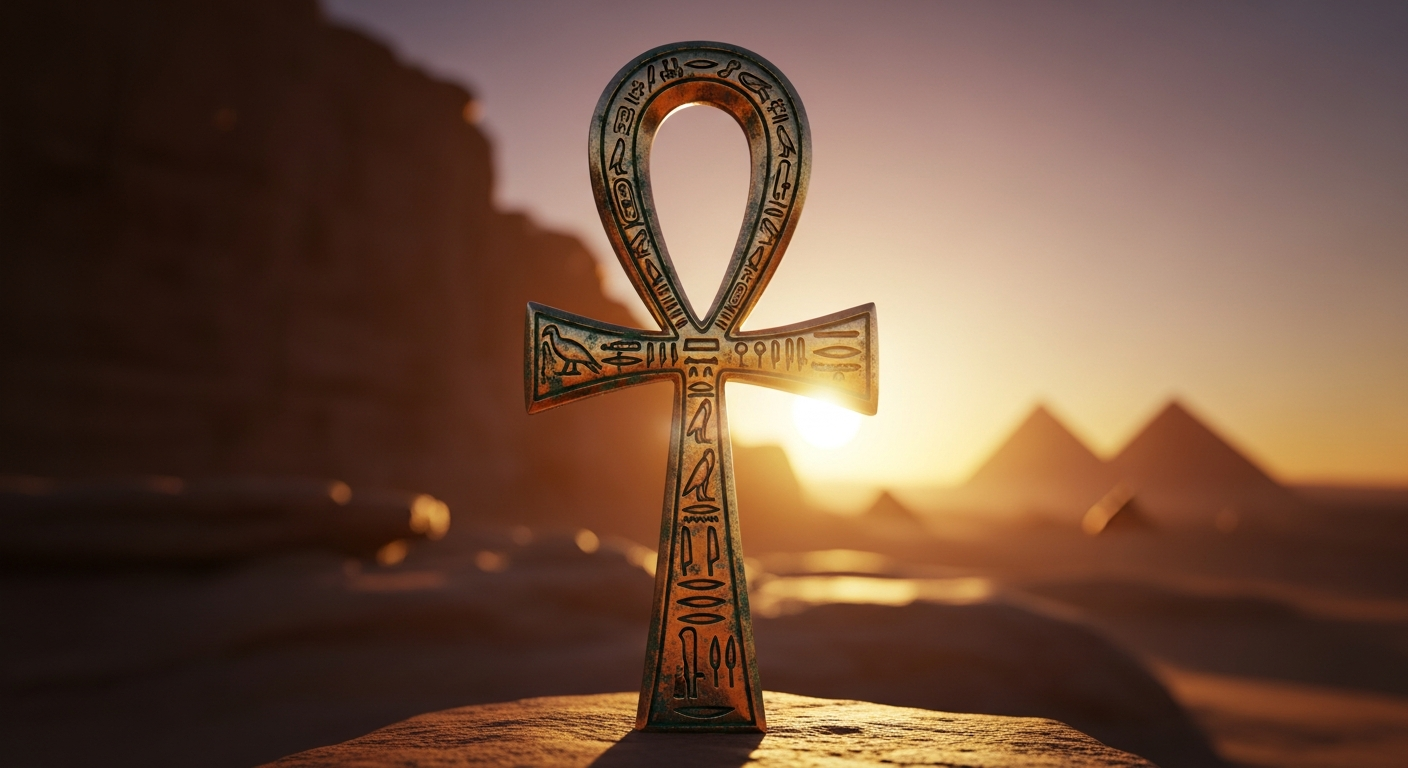
The ankh is formed from three main elements: a loop at the top, a vertical stem, and a horizontal crossbar. The result resembles a cross with an oval or teardrop-shaped handle. Because of this shape, it is sometimes called the key of life, the Egyptian cross, or the breath of life symbol.
The loop is one of the most distinctive parts of the design. It makes the ankh immediately different from a simple cross. The lower stem and crossbar give the symbol structure, while the loop creates a sense of opening, passage, or handle-like function.
Ancient Egyptian art often shows gods holding the ankh by its loop, as if it were an object of power. In other scenes, the ankh is placed near a person’s mouth or nose, suggesting the giving of breath, vitality, or divine life force.
The Ankh as a Symbol of Life
The most common meaning of the ankh is life. In ancient Egyptian writing and art, the symbol was closely tied to the idea of living existence. It could refer to physical life, but also to the deeper force that animated the body and connected human beings to divine order.
In many temple and tomb scenes, gods offer the ankh to kings or hold it near their faces. This gesture suggests the gift of life or breath. The life represented by the ankh is not self-made. It comes from the gods, from cosmic order, and from forces beyond ordinary human control.
This makes the ankh different from a decorative good-luck charm. It is a symbol of life as sacred power. To hold the ankh, receive it, or be shown near it was to be linked with vitality, legitimacy, protection, and the favour of divine forces.
Gods, Pharaohs, and Divine Authority
The ankh appears frequently in images of Egyptian gods and pharaohs. Deities such as Isis, Osiris, Ra, Hathor, and Anubis may be shown holding the symbol, sometimes extending it toward a ruler or a deceased person. The gesture suggests that life and power flow from the divine world into the human world.
Pharaohs were not shown with the ankh only because they were alive. The symbol reinforced their sacred role. The ruler was connected to the gods, responsible for maintaining order, and dependent on divine life force. The ankh visually expressed that relationship.
In this context, the ankh also becomes a sign of authority. It marks those who possess or receive life-giving power. When a god holds the ankh, the symbol suggests mastery over life, death, breath, and renewal.
The Ankh and the Afterlife
The ankh is strongly connected with the Egyptian afterlife. Ancient Egyptian religion placed great importance on continued existence after death, but that existence required preservation, ritual care, judgement, and divine support. The ankh became a natural symbol for this hope of life beyond the grave.
In tomb art, the symbol could represent renewed life in the next world. It appears in spaces designed not merely to remember the dead, but to support their ongoing existence. Death was not imagined as simple disappearance. It was a passage into another condition of life.
This link between death and renewal places the ankh beside other ancient symbols of continuity, including the ouroboros, which also expresses the idea that endings and beginnings can belong to the same cycle.
The Key of Life
The ankh is often called the key of life because its looped shape resembles a handled object. This modern phrase captures something important about the symbol, even if it simplifies its ancient meaning. The ankh looks like something that can be held, offered, or used to open a hidden passage.
As a symbolic key, the ankh suggests access to life, breath, divine favour, and the afterlife. It can be imagined as opening the way between worlds: earthly life and eternal life, human weakness and divine power, mortality and renewal.
This key-like meaning helps explain why the symbol remains so popular. It does not only signify life as a biological fact. It suggests that life is a mystery, a threshold, and a gift that can be granted by powers beyond the visible world.
Fertility, Union, and Creative Power
Some interpretations connect the ankh with fertility, union, and creative force. Because ancient Egyptian symbolism often linked life with generation, renewal, and cosmic balance, it is understandable that the ankh came to be read as a sign of creative power.
Modern writers have sometimes interpreted the loop and crossbar as a union of male and female principles. This reading is common in esoteric discussion, though it should be treated carefully. The ankh’s core ancient meaning is life, and fertility may be one expression of that broader idea rather than its only meaning.
What is clear is that the ankh belongs to a symbolic world where life, birth, death, sexuality, kingship, divine order, and renewal were deeply connected. The symbol’s strength comes from that wide field of association.
Protection and Amulets
The ankh was not only carved on temple walls. It also appeared as an amulet, an object worn or carried for protection, blessing, and symbolic power. In ancient Egypt, amulets were important because they connected the body to divine forces and sacred meanings.
An ankh amulet could express a wish for life, health, protection, and continuation. It was a small object carrying a large idea: that life could be guarded by sacred symbols and sustained by divine order.
This protective role links the ankh to other esoteric symbols used as charms or talismans, such as the Seal of Solomon. Both symbols became associated with the idea that a sacred form could carry power beyond ordinary decoration.
The Ankh in Modern Esoteric Culture
In modern esoteric culture, the ankh appears in jewellery, tattoos, occult art, Gothic fashion, New Age design, music imagery, fantasy fiction, and spiritual symbolism. It is often used to suggest immortality, mystery, ancient wisdom, hidden power, or connection to Egyptian spirituality.
Modern use does not always preserve the full ancient religious context. Sometimes the ankh is worn as a sign of life and protection. Sometimes it appears as a fashion symbol. Sometimes it is used to evoke the mystery of ancient Egypt or the promise of life beyond death.
This modern flexibility is part of the ankh’s survival. Like the Eye of Providence, it has moved far beyond its original religious setting and become a symbol that different cultures reinterpret through their own fears, hopes, and fascinations.
Common Misunderstandings
One common misunderstanding is that the ankh is simply an Egyptian version of the Christian cross. Although the shapes can look similar, the ankh developed in a different religious world and carried meanings tied to Egyptian ideas of life, breath, divine power, and the afterlife.
Another misunderstanding is that the ankh is only an occult symbol. Modern occult and esoteric culture has adopted it, but its roots are ancient Egyptian. Its older meanings are religious, royal, funerary, protective, and cosmic rather than narrowly occult.
It is also misleading to treat the ankh as a symbol with only one meaning. Life is its central idea, but ancient Egyptian life included breath, fertility, divine favour, kingship, protection, renewal, and continued existence after death.
Why the Ankh Still Matters
The ankh still matters because it turns one of humanity’s deepest desires into a simple and memorable form. It is a sign of life, but not life reduced to biology. It points toward breath, sacred power, protection, renewal, and the hope that existence continues beyond death.
Its endurance comes from its balance of clarity and mystery. The shape is easy to recognise, yet difficult to exhaust. It can be read as a key, a breath symbol, a divine gift, an amulet, or a sign of immortality.
From temple walls and tomb art to modern jewellery and esoteric design, the ankh remains a symbol of life passing through time. It connects the body with the divine, death with renewal, and ancient Egypt with the modern imagination.