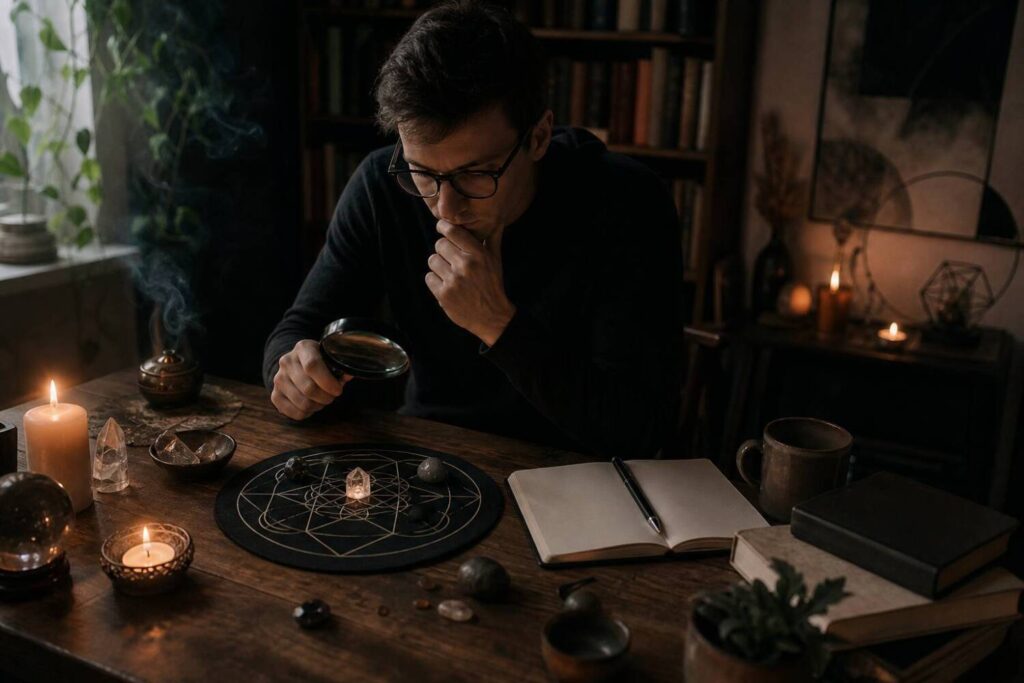
One meditation practitioner recalled a moment that made their occult practice feel real: after they had tried to project an energetic shield in a tense situation, a friend described a sensation the practitioner connected with that effort. The friend had not, according to the account, been prompted to say it. For the practitioner, the apparent connection was striking.
A reader of the discussion asked a different question: how could the practitioner tell that the friend’s sensation came from the shield rather than another cause? Both responses begin with the same reported moment. They differ in what they think that moment can establish.
That distinction matters for anyone curious about occult practices but unwilling to set evidence aside. An experience can be vivid, meaningful and worth examining without settling the question of what caused it. Skepticism need not prevent exploration; it can help keep observation separate from interpretation.
Curiosity does not require belief
In online discussions, several skeptics describe wanting to explore the occult while struggling with supernatural claims. One university researcher, raised atheist, became fascinated by Western esotericism and asked whether there was something a non-believer could do that might change their mind. Another person, who described relying on Occam’s razor, falsification and evidence, wondered how to approach practices that seemed difficult to reconcile with that framework.
Respondents did not offer a single route. Some encouraged study and practice rather than a forced change of belief. Others described treating belief itself as something that could be adopted temporarily for a practice. Still others said they were interested in occult subjects for intellectual or historical reasons without accepting their supernatural claims.
These are different possibilities, not steps toward an inevitable conversion. A skeptic can read about a tradition, try a practice or consider a symbol without deciding in advance that its metaphysical explanation is true.
Start with what meditation feels like
Meditation was one suggestion for a curious beginner. A simple starting point is to sit quietly for a short period and attend to the breath, noticing when attention moves elsewhere. The observation might be calm, restlessness, boredom, discomfort or no particularly noticeable change.
Those observations are real reports of experience, but they do not all answer the same question. “I felt calmer afterward” describes a person’s perceived state. “Meditation caused me to feel calmer” is a causal interpretation, which becomes more plausible or less plausible as the person considers what else may have affected them. “An external force made me calmer” adds a further claim that the feeling alone cannot establish.
Keeping a brief record can help preserve the distinction. Before a session, note your mood and expectations. Afterward, write down what you noticed before deciding what it means. Over time, you can compare sessions and look for changes, while remembering that a personal record is not a controlled study. If a practice becomes distressing, stop rather than treating distress as evidence that you must continue.
Personal meaning and external claims
Occult practices may also involve symbols, rituals or divination. A commenter suggested tarot as a way to work with symbols and intuition. A skeptic could examine a card’s imagery and ask what associations it brings to mind, without assuming that the card predicts the future. The exercise may prompt reflection on a concern even if its value lies in that reflection rather than in a supernatural message.
Meaning and proof are not rivals. A ritual can feel significant because it gives shape to an intention, marks a transition or concentrates attention. That significance belongs to the person’s experience. A claim that the ritual changes events outside the person, however, calls for a different kind of evidence.
The meditation practitioner’s shield account illustrates the difference. The practitioner reported an unexpected response from a friend and understood it in light of their practice. The account does not, by itself, show whether the friend’s sensation was caused by a projected shield, another feature of the situation or something else. Taking the witness seriously means preserving both the force of the moment for them and the uncertainty about its cause.
Make a claim testable before testing it
If a practice is said to produce an effect beyond personal experience, it helps to state the claim in advance. What, specifically, should happen? When? What result would count against the claim? A prediction that can be interpreted as a success no matter what occurs is difficult to assess.
For example, someone who tries to find a particular object after concentrating on it might record in advance what would count as finding it and over what period. They should also record occasions when it does not appear. Once attention has been directed toward something, noticing it later can feel especially striking; the impression of a pattern is not, by itself, proof that concentration made the object appear.
A more demanding test would consider ordinary alternatives, reduce opportunities for cues or selective reporting, and ask whether the result can be repeated. Even then, a small personal exercise may leave substantial uncertainty. The stronger the claim about an external effect, the stronger and more carefully gathered the evidence needs to be.
Leave room for an answer you did not expect
Exploration is not a promise that belief will follow. A person may find meditation useful, a ritual meaningful or an encounter puzzling while remaining unconvinced by a supernatural explanation. They may also find that a practice does little for them. Neither outcome requires them to dismiss practitioners or abandon standards of evidence.
The most useful question is not simply whether an experience felt mysterious. It is what was noticed at the time, what was remembered or recorded afterward, and which part of the story is an interpretation added to explain it.