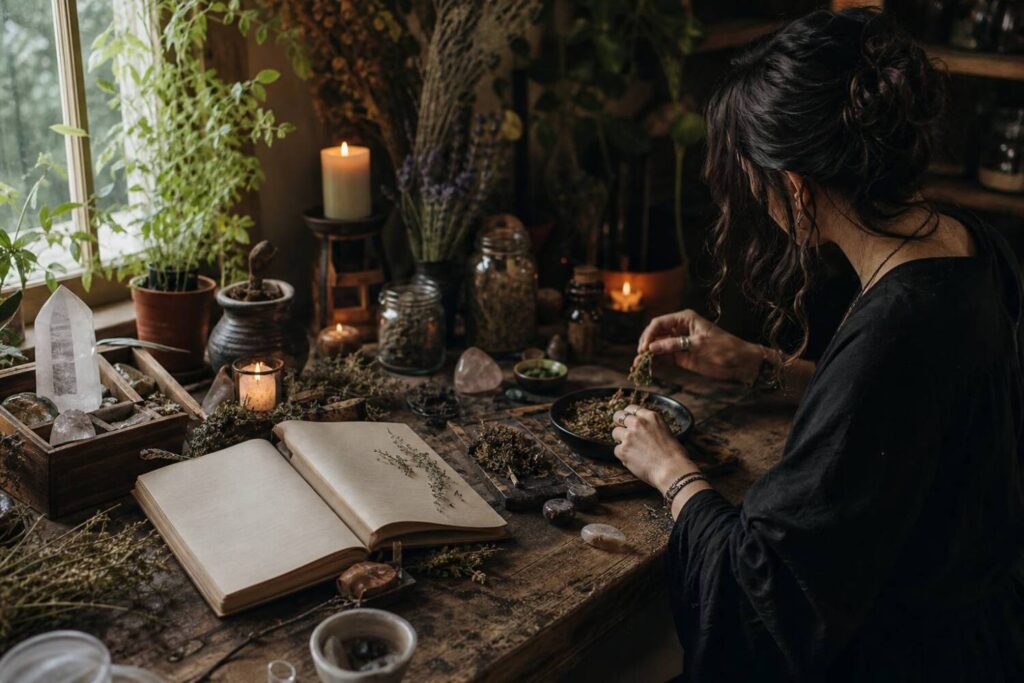
For practitioners who have spent years studying ritual, symbolism or occult philosophy, choosing what to do next can be harder than finding another book. The challenge is not necessarily a lack of knowledge; it may be the absence of a simple, repeatable way to put that knowledge into practice. Advice from experienced practitioners points in two directions: begin doing small things rather than endlessly preparing, but do not turn practice into a punishing obligation.
Choose a starting point, not a permanent label
An attraction to plants, nature, healing or protection may make green witchcraft an appealing place to begin. It is not the only possible fit. The same interests might lead someone to kitchen witchcraft, nature-focused folk practice or an animist perspective. These labels can offer useful starting questions, but they do not need to settle a practitioner’s identity before any practice begins.
A more experienced student, particularly one already familiar with ceremonial or initiatory systems, may want a different kind of hands-on work. Traditional witchcraft, Reclaiming, everyday folk-magic approaches and historical ritual collections offer distinct ways to explore practice. The suggestions in one discussion ranged from Gemma Gary’s writing on traditional witchcraft to Reclaiming’s experimental and communal approach, and from practical everyday spellwork to the Greek Magical Papyri. These are not interchangeable routes. They come with different sources, symbols and contexts, and a recommendation that suits one practitioner may not suit another.
Instead of asking which tradition is objectively best, ask what kind of practice you want to experience. Do you want to work with plants and the natural world? Build modest acts of intention into domestic routines? Follow a more formal ritual structure? Explore a particular historical or regional body of practice? A provisional answer is enough to begin. It can guide a period of exploration without becoming a commitment to adopt every belief or custom associated with a label.
Move from study to a small experiment
When someone already knows the theory of a working, the next useful step may be to try it rather than study several more systems first. That does not mean abandoning research. It means giving study a practical question to answer: What am I trying? What did I do? What did I notice? What would I change next time?
A low-pressure experiment can be straightforward. Set aside a few minutes to ground and meditate, practise a protection exercise, draw a tarot card, or create a brief ritual around an intention. Someone drawn to plants might start by learning about one plant at a time and recording what they find interesting, rather than attempting an elaborate herbal working immediately. Someone who enjoys ceremony can adapt familiar ritual skills into a short practice. The point is not to reproduce an impressive rite, but to make a deliberate choice and pay attention to the process.
Keep a notebook. Record the date, the practice, the intention and any reflections afterward. This turns an abstract interest into a body of personal observations and makes it easier to see which exercises are meaningful, which feel forced and which merit further research. Notes also help separate what a source says from what the practitioner personally believes or experiences.
Build consistency without demanding constant spellwork
Consistency need not mean casting spells every day. Practitioners in the discussions cautioned that a rigid demand for constant spellwork can make the craft feel tedious and lead to burnout. Some people prefer occasional, deeply engaging workings; others find that small everyday actions help them feel connected. A sustainable routine should fit the practitioner rather than imitate someone else’s online schedule.
One flexible structure is to choose a modest daily or frequent habit and a less frequent, more focused practice:
- Daily or frequent: spend a few minutes meditating, make a tarot or rune draw, or bring intention to an ordinary activity such as preparing a drink.
- Weekly or occasional: review notes, study a plant or piece of folklore, or try one small ritual connected to a specific purpose.
- When genuinely inspired: set aside time for a larger working, a seasonal observance or a more formal ritual.
This is a menu, not a test of commitment. If a habit becomes dull, scale it back or change it. A practitioner who naturally works in cycles can treat periods of pause as part of a personal rhythm rather than proof of failure. The aim is to create a route back to practice, not to make every day carry the same spiritual demands.
Research traditions in their own contexts
Practical traditions should not be reduced to interchangeable collections of spells. The Greek Magical Papyri, for example, are described in the discussion as a collection of practical works dating from the first century BCE through the first century CE. They can be approached as historical evidence of practices from their own period, not as a generic template that automatically represents every modern witchcraft tradition.
Likewise, a recommendation for Appalachian folk healing describes an approach with a Christian theological basis. That context matters. A reader can study the material, consider whether its framework is compatible with their own beliefs and avoid presenting it as a context-free set of techniques. The same care applies to regional or named traditions more broadly: learn where a practice comes from, how it is described by its sources and what assumptions it carries before borrowing elements from it.
Discussions also raise questions about ancestry and cultural appropriation. Exploring family history may be meaningful, but ancestry should not be treated as automatic access to a single, clearly defined spiritual practice. Nor should traditions be collapsed into one universal form of folk magic. Research carefully, acknowledge uncertainty, and distinguish respectful study from claims of belonging or authority.
Let practice refine the questions
There is no need to solve an entire spiritual path before beginning. Start with one approach that genuinely interests you, choose a small exercise, and keep a record. Read enough to understand the practice’s context, then let experience show what questions deserve more study. Over time, that cycle, research, practice, reflection and further research, can provide more direction than either endless preparation or pressure to perform magic constantly.
The aim is not to collect traditions as though their differences were cosmetic. It is to find a responsible, workable way to practise while remaining curious about where methods come from and honest about what they mean to you.