

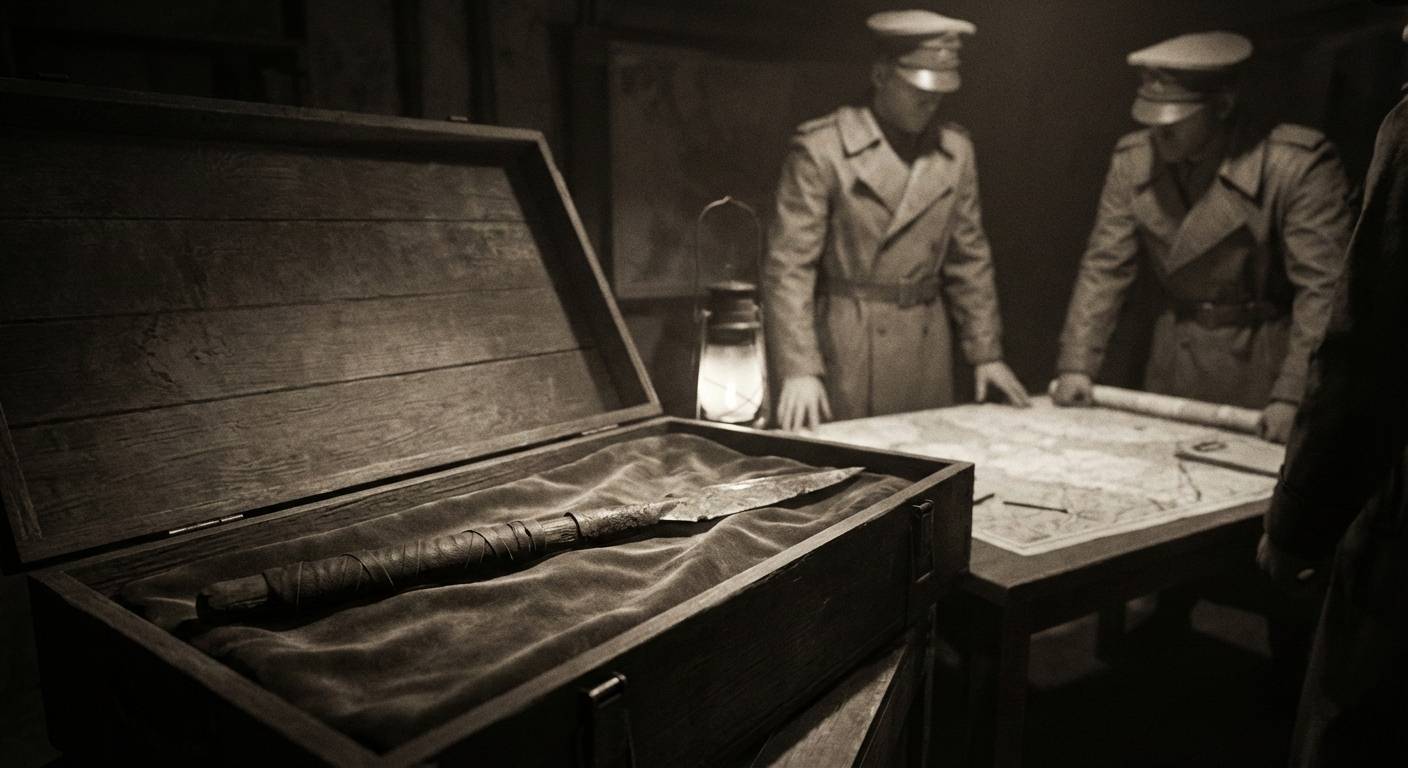
Few relics in history inspire such fascination and debate as the Spear of Destiny, the weapon said to have pierced the side of Christ during the Crucifixion. Beyond its sacred legend, the relic’s supposed ability to confer divine power upon its possessor has made it the centerpiece of countless myths, occult stories, and conspiracy theories.
While the spear displayed today in Vienna’s Hofburg Museum is officially recognized as the “Holy Lance” of the Holy Roman Empire, many researchers and believers claim it is a replica. If the real Spear of Destiny ever existed, they argue, it vanished under mysterious circumstances during or after the Second World War.
Theories of Substitution: The “Fake” Spear
The idea that the spear in Vienna is not the true relic gained prominence after the war. When Allied troops discovered the Imperial Regalia hidden in a Nuremberg vault in 1945, the spear among them was catalogued and later returned to Austria. But critics have pointed to several inconsistencies.
First, modern metallurgical analysis has dated the Vienna spear’s components to the 7th century—centuries after the lifetime of Jesus. To many, this undermines its claim as the authentic relic of the Crucifixion. However, defenders argue that the spear may have been altered or repaired over time, incorporating newer metalwork while preserving a sacred core.
Second, eyewitnesses from the Nazi period reported that the relic stored in Nuremberg looked different in size and structure compared to the one now on display. Some claim that the Nazis, obsessed with the relic’s occult reputation, created replicas for ceremonial or symbolic purposes—and that the original was hidden or lost before the war ended.
The most famous version of this theory suggests that the genuine Spear of Destiny was secretly removed from Nuremberg in early 1945, possibly by high-ranking SS officers or members of esoteric Nazi orders. If true, the spear taken by the U.S. Army—and later returned to Austria—would indeed be a decoy.
Hidden Relic or Sacred Artifact in Exile?
Many treasure hunters and researchers have followed the trail of the supposed “real” spear. Their theories range from plausible to wildly speculative.
- The German Bunker Theory: Some claim that as the Allies advanced into Germany, the spear was hidden deep within one of the underground bunkers or mines where the Nazis stored art, gold, and sacred relics. Locations such as the Harz Mountains and the tunnels beneath Wewelsburg Castle—Heinrich Himmler’s so-called “spiritual center” of the SS—are often mentioned as possible hiding places.
- The Vatican Custody Theory: Another theory suggests that the true spear was secretly transferred to the Vatican near the end of the war, possibly as part of a covert agreement between Church officials and fleeing Nazi elites. The Vatican has made no official statement supporting or denying this claim, which has only deepened the intrigue.
- The Antarctic Legend: More fantastical accounts propose that Nazi occult groups transported their most sacred artifacts—including the Spear of Destiny—to secret bases in Antarctica or South America, hoping to preserve them for a future “rebirth” of their ideology. While these tales verge on myth, they reflect the persistent aura of mystery surrounding the spear’s fate.
The Power and Prophecy of the Spear
Part of the reason the Spear of Destiny continues to attract speculation lies in its supposed curse or prophecy. Medieval lore claimed that whoever held the spear would hold the destiny of the world—but the moment they lost it, their life would end.
Writers like Trevor Ravenscroft popularized the idea that Hitler’s possession of the spear symbolized his rise to power, and that losing it to Allied forces in 1945 symbolized his downfall. The coincidence of Hitler’s suicide occurring hours after the spear’s capture by the U.S. Army became part of the myth’s enduring fabric, though historians caution that this timeline was later dramatized for effect.
Modern Investigations and Skepticism
Recent forensic analyses have sought to separate fact from legend. Studies of the Vienna lance have confirmed that it dates to the early medieval period, likely the 7th or 8th century, and that its internal spike may have been added later. To many scholars, these findings suggest that while the spear may not be the actual Roman weapon from Calvary, it still carries immense symbolic and historical weight.
For others, however, science cannot erase the allure of mystery. The legend of a hidden “true” Spear of Destiny persists in documentaries, treasure-hunting expeditions, and even modern conspiracy forums. Its mystique endures because it lies at the intersection of faith, power, and myth—a story too vast and too mysterious to fade away entirely.
A Relic of Faith or a Myth of Power?
Whether the spear in Vienna is the genuine relic or merely a medieval symbol, the idea behind it remains the same: the belief that sacred power can be contained within an earthly object. That belief has moved emperors, inspired wars, and shaped legends for nearly two millennia.
Perhaps the Spear of Destiny’s greatest power lies not in its physical form, but in the human imagination—in the way it continues to embody the eternal tension between faith, ambition, and the quest for ultimate power.
 The Spear of Destiny: The Holy Relic That Haunted History