

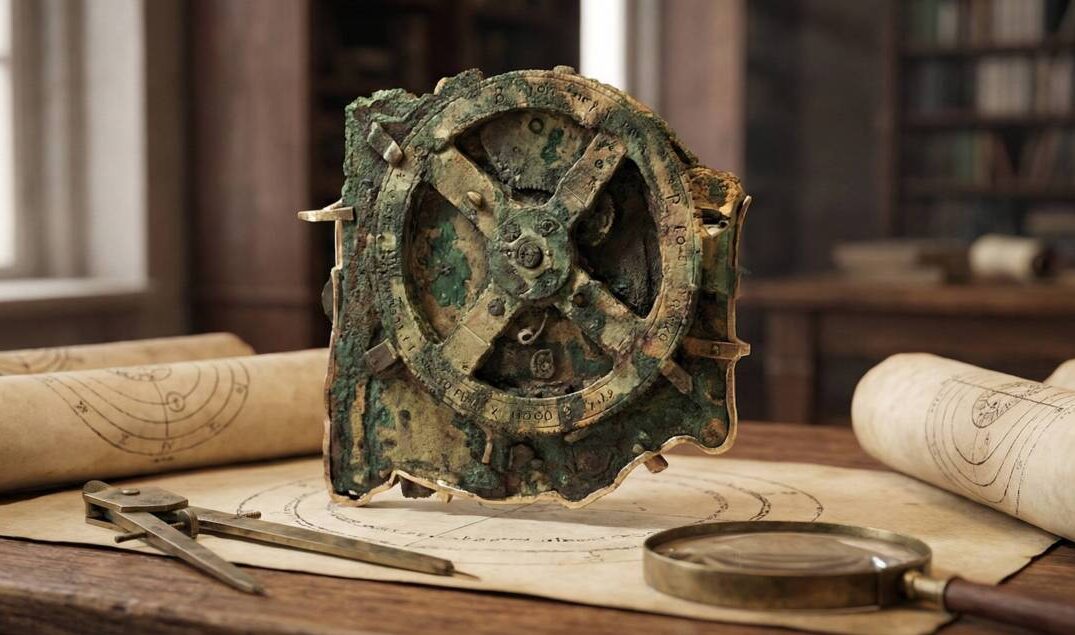
More than a century after it was recovered from the depths of the Aegean Sea, the Antikythera Mechanism remains one of the most enigmatic discoveries in human history. Once thought to be nothing more than a corroded piece of bronze, this intricate device has been revealed through decades of research and scanning technology to be an astonishing feat of ancient engineering. While we know it was used to track celestial movements, its full purpose continues to inspire debate and wonder.
At its core, the Antikythera Mechanism was a mechanical calculator designed to model the motions of celestial bodies. Turning a hand crank on the side would engage a system of over 30 precisely cut gears, each tooth carefully designed to represent mathematical ratios corresponding to astronomical cycles.
The main front dial displayed the position of the Sun and Moon against the backdrop of the zodiac, allowing users to visualize their location at any given date. What made this even more extraordinary was the mechanism’s ability to show the phases of the Moon, waxing, waning, full, and new, using a small ball painted half black and half white that rotated in sync with the lunar cycle.
This level of precision was not just impressive, it was revolutionary. No other device with comparable complexity is known to have existed until the rise of medieval clockwork mechanisms more than a thousand years later.
The back of the Antikythera Mechanism featured two spiral dials filled with inscriptions and pointers that revealed its deeper purpose.
One was the Metonic cycle dial, named after the Greek astronomer Meton, which represented a 19-year period that synchronized the solar year with the lunar month. The other was the Saros cycle dial, used to predict eclipses. By tracking this 18-year and 11-day cycle, the mechanism could forecast the precise timing of solar and lunar eclipses, not just their occurrence, but whether they would be total or partial.
Another small dial, the Callippic cycle, refined these measurements even further, accounting for the gradual drift between lunar and solar time. In essence, the Antikythera Mechanism functioned as a portable observatory — a tool that could calculate the cosmos with a mechanical precision that seems far ahead of its age.
One of the most curious discoveries about the Antikythera Mechanism is the Olympic Games dial. This small circular indicator tracked a four-year cycle, marking the timing of the Panhellenic Games — including the Olympics, Nemean, Isthmian, and Pythian festivals. This shows that the device wasn’t just a scientific instrument, it was also a calendar for society, linking celestial events with cultural and religious life.
The purpose of the Antikythera Mechanism has been a subject of endless speculation. Was it built for a scholar or philosopher, perhaps as a teaching tool to demonstrate the harmony of the heavens? Or was it a navigational aid for sailors who relied on the stars to cross the seas?
Some researchers suggest it may have been used by astrologers, who would have considered the movement of planets and eclipses to hold deep significance for human affairs. Others believe it could have been a royal or temple instrument, used for ceremonial purposes tied to celestial cycles.
Recent analysis suggests that the mechanism may have been designed using the astronomical theories of Hipparchus of Nicaea, one of the greatest Greek astronomers. His work on lunar motion perfectly matches the calculations embedded in the gearing. However, there is still no direct proof linking him to the mechanism, and the identity of its maker remains an enduring mystery.
What is clear is that whoever built it possessed a mastery of mathematics, astronomy, and metalworking that defies conventional assumptions about ancient technology. The Antikythera Mechanism required gear ratios that corresponded precisely to observed astronomical data, meaning its creator had both the theoretical knowledge and the practical engineering skill to turn that knowledge into machinery.
The Antikythera Mechanism has changed how historians understand the ancient world. It proves that mechanical computation, the use of gears and mathematics to model natural processes, was not an invention of the modern era but a rediscovery of something far older.
Could there have been other devices like it that simply didn’t survive the centuries? If so, what else might ancient engineers have built that history never recorded?
Each new study brings us closer to understanding the mechanism’s function, but also deeper into the mystery of its existence. The Antikythera Mechanism is more than an artifact, it is a bridge to a lost era of genius, one that reminds us that human curiosity and intellect are far older than we ever imagined.
 The Antikythera Mechanism