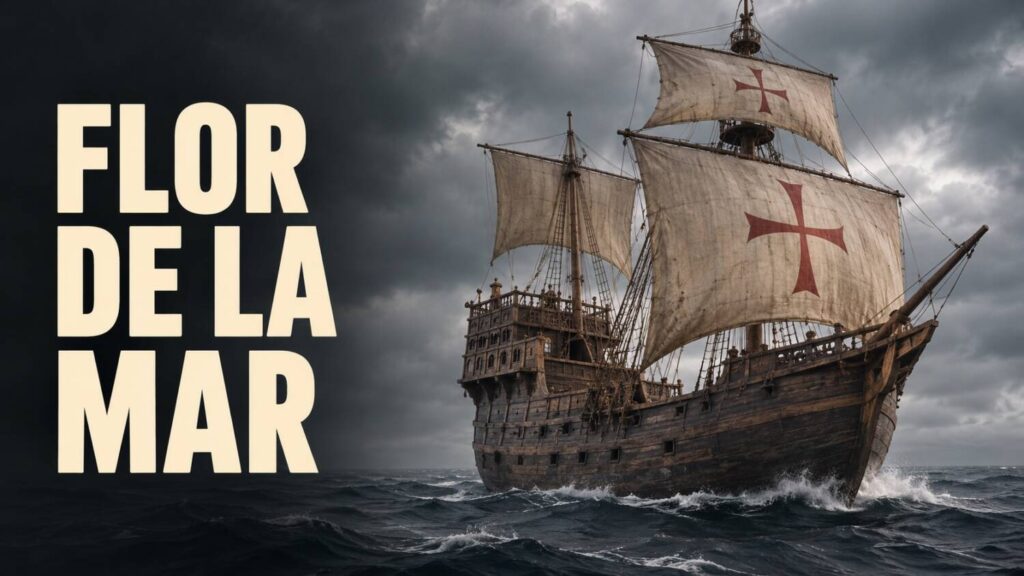
A gold-covered table appears in the account of what went down with the Flor de la Mar. So do jewellery and gold-plated palanquins. These are details from a sixteenth-century narrative about a wreck, and each has a different evidential value from a figure for the total treasure on board.
The voyage after Malacca
The ship was part of the Portuguese force that took Malacca in 1511, as recorded by Malaysia’s National Museum. Afonso de Albuquerque sailed on it after the conquest. The Commentaries compiled by his son describe the ship striking shoals on the return voyage and Albuquerque escaping to another vessel.
The account places the disaster off the Sumatran coast, in the vicinity of Aru. That is a historical description of a stretch of coast. A place-name in a voyage narrative can help narrow a search, but it gives no measured position for the hull. Later changes to shorelines and the use of different names in different accounts add to the uncertainty.
What the chronicle lists
In the 1880 English translation of the Commentaries, the account of the loss lists jewellery intended for King Manuel and objects taken from Malacca. It also records items reportedly saved, including a gold sword, a crown and a ruby ring sent by the king of Siam. The passage discusses losses involving the ship and an accompanying junk. It gives readers good reason to keep the lists and vessels straight.
In his letters to King Manuel, Albuquerque gives a different detail. Alongside a sword and ruby, he names a gold cup that was recovered broken and repaired. He also records the loss of much of the tin coinage made at Malacca. The letter and the later chronicle illuminate different parts of the cargo. Their disagreement over the gift is a reason to preserve the attribution for each item.
The narrative names objects and explains why some mattered to Albuquerque. It does not weigh the metals or itemise everything loaded onto the Flor de la Mar. A modern valuation would need those quantities, information about materials and a defensible way to price individual pieces. The chronicle supplies too few of those inputs.
What would identify the wreck
An identification would need a documented site and several clues that point to the same ship, such as the date of the hull, the construction and the context of distinctive objects. The sources available for this account do not establish a confirmed wreck site or recovered cargo. The gold-covered table belongs to the written record of the loss. An object found underwater would need its own chain of evidence.