City life can make a nature-centered spiritual practice feel out of reach: there may be little soil, no safe place to burn herbs, and nowhere to leave a jar beneath an open sky. But practitioners who identify as urban witches often approach those limits not as proof that a practice is impossible, but as an invitation to adapt it to the surroundings they actually have.
Start with what is available
One recurring idea in discussions among city practitioners is simple: use what you have rather than waiting for ideal conditions. A balcony roof that blocks direct moonlight need not rule out a personal moon-water ritual; one practitioner described catching the moon’s reflection in a jar instead. Someone without garden soil might combine a little swept-up household dust with potting soil. These are examples of individual spiritual approaches, not established claims about how magic works. Their practical value is that they make ritual possible within the limits of a home.
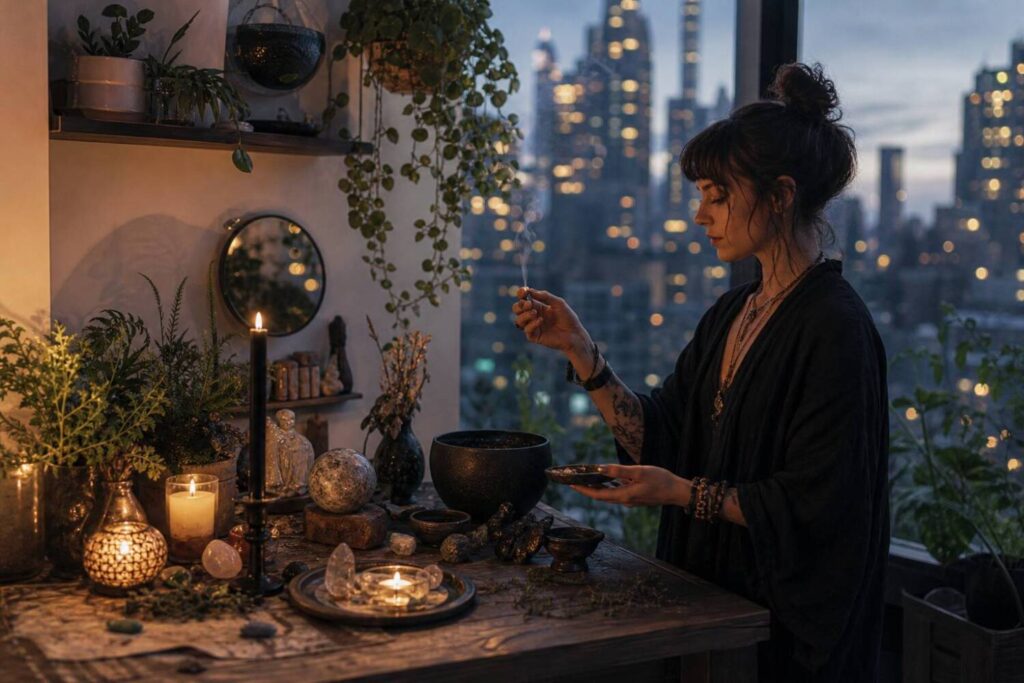
Other low-space practices mentioned by urban witches include teas or potions, sachets, sigils, meditation, and spiritual baths. A bath can mean pouring water over oneself rather than needing a bathtub. Houseplants or windowsill herbs can bring living greenery into an apartment, while a small container of potting soil can offer a place to tend plants or mark a personal ritual. For people who cannot easily reach a quiet park, a walk, a bench, or simply attentive observation from home may be more realistic than an elaborate outdoor ceremony.
Reconsider what counts as nature
Urban environments are not devoid of natural life. Weeds push through pavement, moss grows on walls, and birds and plants occupy ledges, roofs, and landscaped spaces. Practitioners describe noticing these small signs as a way to build attention and connection. A crowded city park may not feel like a forest, but it can still offer weather, trees, soil, and seasonal change. Botanical gardens, zoos, and tended public green spaces are other possible places to encounter plants and animals, where access is practical and permitted.
Some practitioners also reinterpret city infrastructure through their own spiritual frameworks. In one discussion, a person compared the movement of subway lines to flowing water, using the transit system as a symbol of motion and direction. Others described bridges, traffic lights, or familiar tools as carrying personal meaning through repeated use. A question about the “energy” of plastic on a lightpost or metal in a train points to a broader cultural idea: urban materials, too, can become part of a practitioner’s symbolic world.
Some witches understand this through animist beliefs, in which spirit or presence may be attributed not only to living things but also to objects and places. Others may treat a train, lamp, or household item as a metaphor, focus for attention, or meaningful ritual tool without making a claim about its literal consciousness. These are personal interpretations. They should not be presented as scientific findings or as beliefs shared by all witches.
Make safety and respect part of the practice
Apartment living can make fire rituals unsuitable. If burning anything feels unsafe or is prohibited by building rules, there is no need to force the practice: a sigil, spoken intention, visualization, or other non-burning approach may serve the same personal purpose. If someone chooses to burn a small item, they should first consider ventilation, fire risk, and the rules of their home, and use appropriate precautions. The discussion’s practical suggestions include a heat-safe vessel and a way to contain or extinguish a small flame; they are not a reason to burn materials where it is unsafe.
Likewise, a river may be spiritually significant without being an appropriate place to leave objects. One city resident specifically noted that local waterways were important and should not be disturbed. A practitioner can work with water symbolically at home, use tap water in a personal ritual, or contemplate a river without putting anything into it. Avoiding pollution, taking plants or soil from protected places, and respecting public spaces helps keep personal practice from imposing costs on others.
Keep cultural traditions distinct
“Witchcraft” is not one uniform tradition. Modern practitioners draw on different spiritual, cultural, and personal frameworks, and the label can mean different things in different communities. A discussion about African diasporic traditions and modern witchcraft illustrates why broad claims are risky: contributors emphasized that practitioners may distinguish witchcraft from their own inherited or community-specific traditions, and that popular portrayals of history can be misleading. A practical guide to urban practice should therefore avoid treating all traditions as interchangeable or reducing them to a single image drawn from popular culture.
Ultimately, urban witchcraft is less about reproducing an imagined wilderness setting than deciding how to make meaning in a particular place. A window, a houseplant, rain on pavement, a subway journey, or the moon reflected in glass can become part of a personal practice if the practitioner chooses. The city does not dictate what those things mean; attention, belief, safety, and respect shape how they are used.