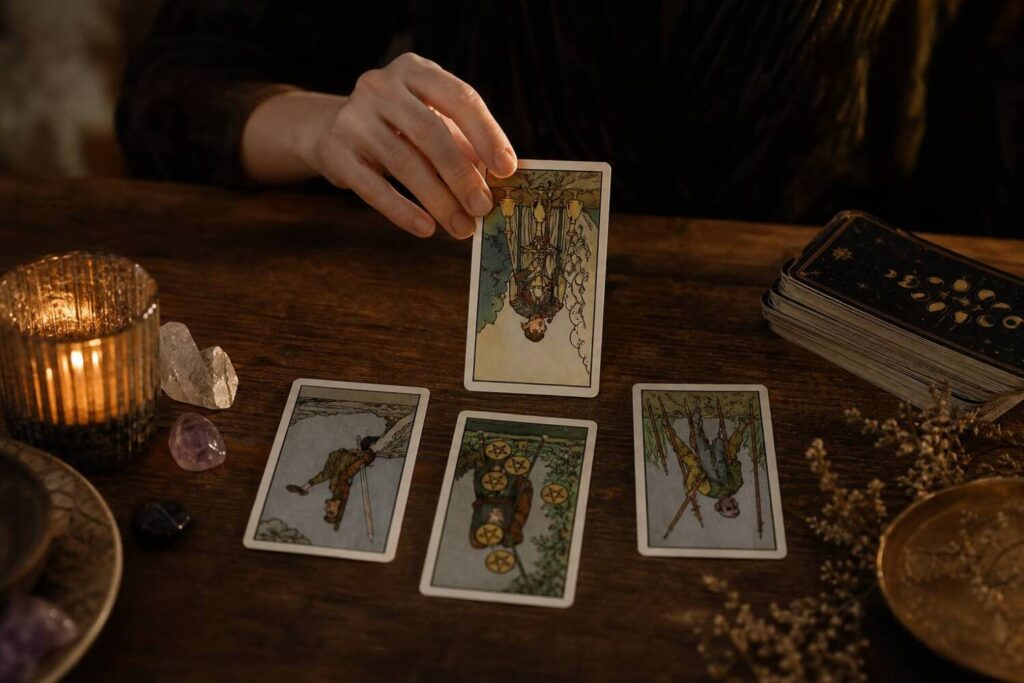
A reversed card is one that appears upside down in a spread. Readers who use reversals treat the orientation as another interpretive cue, but not necessarily as a sign that the card means the opposite of its upright meaning. It may suggest that the card’s energy is blocked, delayed, muted, excessive, lacking, or turned inward. The surrounding cards and the question help determine which reading fits.
Reversals are optional. Some readers find they add nuance; others feel the 78 upright cards, their positions in a spread, and the relationships between them already provide enough to interpret. There is no single approach every reader needs to follow.
Why readers include reversals
For readers who use them, reversals can help distinguish between different expressions of a card’s theme. A card might point to an energy that is present but difficult to access, operating privately rather than outwardly, or being expressed in excess. That can give a reading more detail without requiring a separate fixed meaning for every card.
Other readers prefer to keep every card upright. They may find reversals distracting, stressful, or unnecessarily complicated, or feel that context and the spread already reveal what is blocked or out of balance. Either choice can be a consistent reading practice.
Several ways to interpret a reversal
Rather than memorizing one rule, try treating these as possible lenses. Choose the interpretation that best fits the question, the card’s imagery, and the rest of the spread.
- Blocked or delayed: The card’s energy may be difficult to express, or its effects may be held up.
- Muted or lacking: The quality associated with the upright card may be present in a weaker form or missing from the situation.
- Excessive or misdirected: The energy may be overdone, turned into an unhelpful pattern, or expressed in a way that works against the person.
- Turned inward: The theme may be operating internally rather than being visible in a person’s actions or circumstances.
- Subverted or resisted: The card may point to resistance to its upright theme, or to a different angle on that theme, not simply its opposite.
Context matters. For example, the Devil reversed might suggest a wish to break free from an attachment or unhealthy pattern. In a different question or spread, it might point to wanting to indulge but feeling prevented from doing so. The card alone does not settle which interpretation applies.
Consider the surrounding cards, the position the card occupies, and the question being asked. If the meaning remains unclear, a clarifier or a question to the person receiving the reading can add context. Some readers also look closely at the reversed image itself: a detail or direction that is less noticeable upright may stand out when the card is turned.
Keep reversals from becoming automatic bad news
A reversal does not have to be read as negative. Treating every upside-down card as bad can flatten the interpretation and make a reading more alarming than the context supports. A reversal may describe an obstacle, a delay, an inward process, or an opportunity to notice how an energy is being used.
If reversals make readings feel confusing or distressing, it is reasonable to pause them or leave them out. You can also decide that an occasional reversed card is a prompt to look more closely, rather than a separate meaning you must immediately define. The useful question is not whether reversals are required, but whether they help you read with clarity.
Check the deck before you read
An upside-down card can result from the deck’s physical orientation, not just from the way it was shuffled. If the whole deck is facing the same way and the shuffle never changes the cards’ orientation, the deck may stay that way. A reader who then draws from it could see many reversals simply because of how the cards were set up.
Before a reading, check whether the cards are all upright or whether some are already reversed. If you use reversals, choose a shuffle that can change card orientation. One approach is to turn half the deck around during a shuffle; repeated shuffling can introduce new reversals and turn some previously reversed cards upright. A wash shuffle, mixing the cards face down on a surface, is another method readers use.
The aim is not to force a particular number of reversals. It is to make sure your handling of the deck matches your practice, so a run of reversed cards is not simply an unintended result of leaving the deck turned around. If you prefer upright-only readings, you can orient the cards consistently and shuffle in a way that maintains that choice.
A simple routine for daily practice
- Choose your approach: Decide whether you will read reversals, ignore them, or treat them as a cue to pay closer attention.
- Set the deck: Check the cards’ orientation before shuffling.
- Shuffle accordingly: If reading reversals, use a method that changes orientation; if not, keep the cards aligned upright.
- Read in context: Interpret any reversal through the question, its spread position, the image, and the surrounding cards.
- Notice what works: In a daily reading or journal, record how you interpreted the card and whether that approach made the reading clearer.