

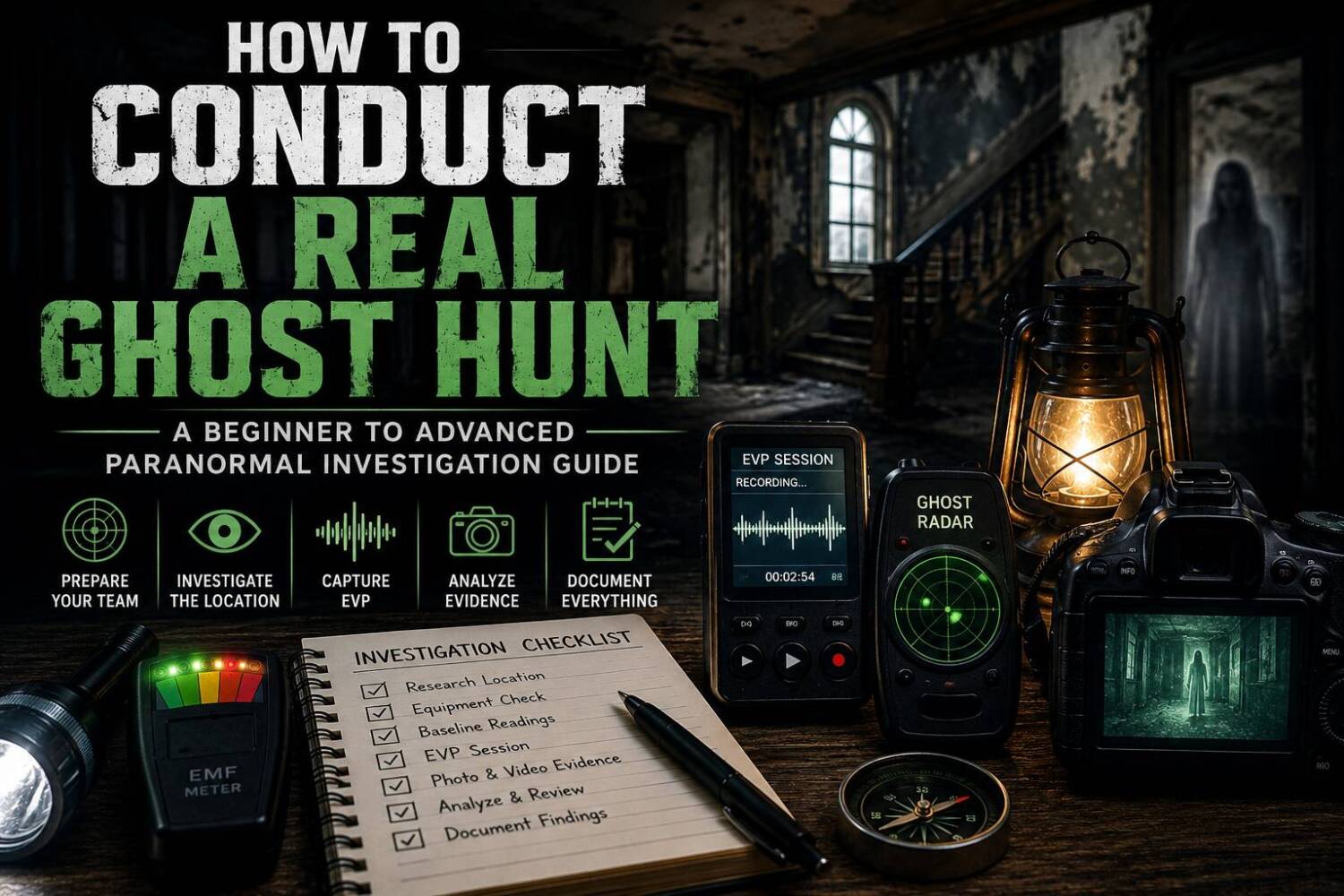

Ghost hunting is often misunderstood because television shows focus on dramatic reactions rather than structured investigation. In reality, experienced paranormal investigators spend most of their time documenting environments, eliminating ordinary explanations, analyzing audio and video evidence, and searching for repeatable patterns.
A proper ghost hunt combines skepticism, environmental awareness, historical research, and careful observation. The goal is not simply to prove that ghosts exist. The goal is to determine whether unusual experiences can be explained through ordinary causes or whether they remain unresolved after careful testing.
Step 1: Research the Location Before You Arrive
The strongest paranormal investigations begin long before any equipment is switched on.
Research:
- Property history
- Deaths, fires, or crimes connected to the location
- Witness reports
- Architectural changes
- Nearby railways, factories, or power lines
- Environmental hazards
- Local folklore and urban legends
Investigators should avoid reading highly detailed ghost stories immediately before entering a site because expectation and suggestion can strongly influence perception.
Step 2: Establish an Environmental Baseline
Many alleged hauntings are eventually linked to environmental conditions. Before beginning a paranormal session, investigators should map the environment carefully.
Check for:
- Drafts and cold airflow
- Loose floorboards and pipes
- Electromagnetic interference
- Nearby radio sources
- Animal activity
- Mold exposure
- Carbon monoxide risks
- Low-frequency vibration or infrasound
The Magnetic Field Map Generator can help investigators visualize environmental fluctuations and identify unusual electromagnetic hotspots inside a building.
The Ghost Radar can also be used to monitor unusual audio-energy patterns during baseline sweeps.
Step 3: Begin a Structured EVP Session
Electronic Voice Phenomena, known as EVP, remains one of the most common forms of paranormal investigation.
A proper EVP session should follow consistent rules:
- Choose a quiet room.
- Silence phones and electronics.
- Announce the start time clearly.
- Ask short, direct questions.
- Leave 10 to 15 seconds of silence between questions.
- Keep a written log of noises and interruptions.
- Avoid speaking over potential responses.
The Live EVP Dashboard provides real-time waveform and spectrogram monitoring during EVP sessions.
After recording, investigators can use the EVP Audio Lab to reduce background noise, isolate whispers, reverse audio, and analyze spectral anomalies.
If investigating video footage, the Video Whisper Detector can isolate faint voices hidden beneath ambient sound.
Step 4: Conduct Visual Documentation
Photographs and video footage are among the most controversial forms of paranormal evidence because ordinary effects are frequently mistaken for ghosts.
Common false positives include:
- Dust and insects
- Lens flare
- Motion blur
- Compression artifacts
- Infrared reflections
- Shadow distortion
- Pareidolia
Even so, careful visual analysis can reveal details missed during an investigation.
The Haunted Image Analyzer helps investigators examine low-light photographs using infrared-style filters, gamma correction, and image enhancement.
The Spirit Outline Detector uses edge-detection techniques inspired by SLS camera systems commonly associated with modern ghost hunting.
Step 5: Try Controlled Spirit Communication Experiments
Some paranormal investigators attempt direct communication using spirit boxes, white noise generators, or audio-frequency manipulation.
These methods remain highly controversial because the human brain naturally searches for meaningful words within static and random sound.
The Online Spirit Box & Binaural Beat Synthesizer can be used during controlled communication sessions or meditation-focused experiments.
Sessions should always be documented carefully and compared against environmental recordings to avoid contamination and confirmation bias.
Step 6: Look for Repeatable Patterns
Experienced investigators rarely treat a single strange event as strong evidence. Instead, they look for recurring patterns that appear across multiple sessions.
Track:
- Times when activity occurs
- Specific rooms connected to reports
- Temperature changes
- EMF fluctuations
- Audio anomalies
- Witness consistency
- Weather conditions
- Electronic interference
Repeatability is one of the most important principles in any serious investigation.
Step 7: Avoid Common Ghost Hunting Mistakes
Many investigations become unreliable because investigators unintentionally contaminate their own evidence.
Common mistakes include:
- Talking over EVP sessions
- Using overly suggestive language
- Investigating while exhausted or emotionally distressed
- Ignoring environmental explanations
- Reviewing evidence alone instead of using blind comparison
- Interpreting every anomaly as paranormal
The best investigators remain open-minded while actively trying to disprove their own assumptions.
When Evidence Becomes Interesting
Most ghost hunts produce ordinary explanations rather than dramatic supernatural encounters. However, certain combinations of evidence tend to attract serious attention from investigators:
- Multiple independent witnesses reporting the same event
- Repeated audio anomalies captured under controlled conditions
- Consistent activity centered around one location
- Environmental readings that correlate with witness reports
- Patterns that repeat over multiple investigations
Even then, paranormal evidence remains controversial and difficult to verify scientifically.
Ghost Hunting as Structured Investigation
The most valuable paranormal investigations are not the loudest or most dramatic. They are the ones conducted carefully, skeptically, and methodically.
Whether hauntings ultimately arise from environmental conditions, psychology, folklore, unknown natural phenomena, or something genuinely unexplained, a disciplined approach produces better evidence and more meaningful experiences.
Good ghost hunting is not about chasing fear. It is about investigating the unknown with curiosity, documentation, and critical thinking.