

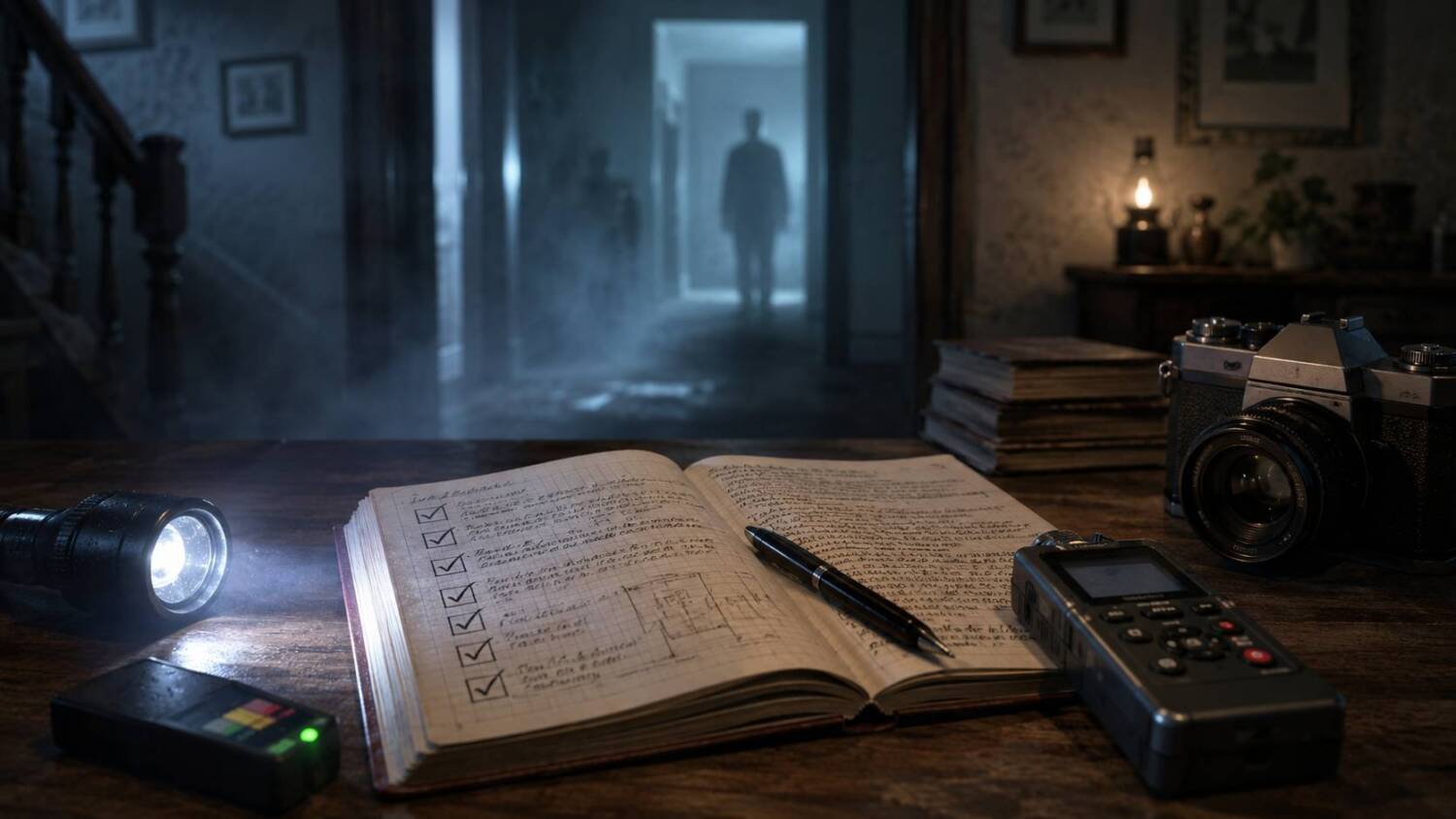

Most strange experiences arrive without a label. A figure in a doorway, an object that seems to move on its own, a dream that feels too solid, a bird leaving uncanny gifts, a video clip that looks wrong: the first question is rarely what happened? It is usually what kind of thing was that?
Identifying a paranormal experience is not the same as proving one. A good checklist does not force every eerie moment into a ghost story, but it also does not flatten every account into imagination. It gives the experience room to be examined: the setting, the timing, the witnesses, the physical evidence, the emotional atmosphere, and the ordinary explanations that should be considered first.
The following checklist is designed for anyone trying to make sense of an encounter. It can be used for hauntings, apparitions, childhood memories, haunted-object fears, animal omens, ritual aftermaths, strange footage, and those hard-to-name experiences that sit somewhere between folklore, spirit work, and high strangeness.
1. Write Down the Experience Before You Interpret It
The first step is to record the experience in plain detail before giving it a name. Do this as soon as possible, while the memory is still fresh. Separate what you directly observed from what you later concluded.
For example, I saw a tall woman-shaped figure in the archway is an observation. It was an angel, fairy, or extradimensional entity is an interpretation. Both may matter, but they should not be mixed too early.
Include the time, location, lighting, weather, sounds, smells, physical sensations, and your emotional state. Note whether you had just woken up, were falling asleep, were grieving, were anxious, had been meditating, were performing a ritual, or were in a place already associated with odd stories. These details do not invalidate the experience. They help identify the category it may belong to.
A useful record should answer five simple questions: What did you notice first? What changed in the environment? How long did it last? What did you do next? What remained afterward?
2. Check the Ordinary Explanations First
The most useful paranormal investigators begin with ordinary causes. That does not make them hostile to the unexplained. It keeps the investigation honest.
Objects can shift because of weak shelves, settling floors, pets, vibration, drafts, humidity, magnets, failing glue, loose hinges, or cheap mechanisms inside toys and dolls. A doll whose hair falls out or whose eyes suddenly move may feel terrifying in the moment, but age, glue breakdown, and mechanical degradation can produce effects that look far stranger than they are.
Video evidence needs the same caution. Security cameras compress movement, smear low-light footage, distort small animals, and create artifacts that look like cloaked shapes or vanishing figures. If dogs, cats, insects, branches, rain, headlights, or pixelation are present, review the clip frame by frame before assuming an entity is visible.
For personal sightings, consider sleep paralysis, hypnopompic and hypnagogic states, migraines, fever, medication effects, exhaustion, carbon monoxide risk, mold exposure, electrical faults, and chronic health symptoms. These explanations are not insults. They are safety checks. A suspected haunting is still worth investigating, but a gas leak or medical issue must be ruled out immediately.
3. Identify the Setting: Sleep, Ritual, Grief, Object, Animal, or Place
Paranormal experiences often cluster around certain settings. The setting can help narrow the type of encounter you may be dealing with.
Sleep and childhood experiences often blur dream, memory, astral imagery, spirit contact, and folklore. A child seeing a fairy-like being, a tall glowing figure, or a creature that seems drawn from imagination may later remember the event with startling clarity. The question is not simply whether it was a dream. Ask whether the experience had continuity, witnesses, physical effects, repeated patterns, or later confirmation from someone else.
Ritual experiences are shaped by intention. A crossroads disposal, cleansing bath, protection charm, or offering can make small disruptions feel significant. If something goes wrong during or after a ritual, examine whether the event changed the working itself or merely startled you out of focus.
Object experiences usually involve dolls, antiques, inherited items, second-hand finds, occult tools, or items sold as haunted. Ask whether the object has a documented history, whether activity began only after it arrived, and whether the same activity occurs when the object is moved, covered, cleansed, or removed.
Animal experiences often sit between natural intelligence and omen. Crows, for instance, are known for observation, memory, and pattern recognition. A crow leaving stones near a boundary may be a clever animal responding to visible objects, a relationship signal, or a personal omen depending on the wider pattern.
Place-based experiences involve recurring activity in a house, road, graveyard, workplace, or landscape. These are stronger when multiple people notice similar things independently.
4. Ask Whether There Were Witnesses or Independent Confirmation
A single experience can be meaningful, but independent confirmation strengthens the case. The best confirmation comes from someone who noticed the same thing without being prompted.
Ask witnesses to write their version separately. Do not tell them your interpretation first. Compare details afterward: location, appearance, direction of movement, timing, sound, emotional response, and physical effects. Matching details are useful. Differences are also useful because they show how perception may have shaped the event.
Childhood accounts sometimes include a strange extra layer: a sibling, parent, or friend who remembers part of the event differently, denies it later, or recalls an impossible detail. Treat that carefully. Memory can shift over time, especially around fear, sleep, family stress, and childhood imagination. Still, if another person remembers the same core event, the account becomes harder to dismiss as a private dream.
For hauntings, keep a shared log. If three people independently report knocks from the same wall, a cold patch in the same room, or recurring activity at the same hour, the pattern matters more than one dramatic night.
5. Look for Repetition, Escalation, and Pattern
One odd event may be coincidence. A pattern deserves closer attention.
Track when the activity happens. Does it follow a person, an object, a room, a date, a ritual, a stressful period, or a particular emotional state? Does it intensify when discussed? Does it stop when an item is removed? Does it happen around sleep, storms, anniversaries, grief, illness, arguments, or meditation?
Repetition can also clarify the category. Footsteps in one hallway suggest a place-based haunting. Bad dreams and pressure in bed suggest a sleep-related phenomenon or attachment fear. Repeated animal gifts suggest an animal relationship, offering pattern, or omen structure. Recurring visions during meditation may belong more to spirit work, energy perception, or altered states than to a classic ghost encounter.
Escalation matters too. A single cold spot is weak evidence. Cold spots followed by knocks, object movement, voices, shared sightings, and emotional disturbance form a stronger case. At the same time, escalation can also come from attention, fear, and expectation. The log helps separate activity from anxiety.
6. Study the Emotional Signature
People often remember how an encounter felt before they can explain what it was. Fear is common, but fear alone does not identify the source. A protective presence can frighten someone by appearing suddenly. A harmless natural event can feel sinister in the wrong atmosphere.
Instead of asking only whether the experience felt scary, ask what kind of emotional signature it carried. Did it feel watchful, playful, predatory, sad, protective, confused, familiar, mechanical, dreamlike, or intelligent? Did the feeling arrive before the event, during it, or only afterward?
Some accounts describe entities or presences that seem curious rather than hostile. Others feel oppressive from the beginning. Haunted-object fears often begin with nausea, dizziness, dread, or the sense of being watched. Ritual concerns may feel like incompletion, contamination, or a broken boundary. Animal omens may feel meaningful but not threatening.
The emotional signature is not proof, but it is part of the data. If several witnesses independently describe the same mood in the same place, that becomes a pattern worth noting.
7. Match the Experience to Folklore, but Do Not Let Folklore Take Over
Folklore gives language to the unknown. Fairies, changelings, angels, ghosts, shadow figures, attachments, tulpas, egregores, omens, cryptids, and extraterrestrial or interdimensional beings are all interpretive frames people use when an experience does not fit ordinary categories.
These frames can be useful. A childhood encounter with small beings may resemble fairy lore, alien abduction narratives, astral projection accounts, or dream visitation traditions. A tall glowing figure may be read as an angel, guardian, spirit, or nonhuman intelligence. A repeated animal offering may be understood through witchcraft, animism, or corvid behavior.
The danger is choosing the most exciting label too quickly. Once a label is chosen, every detail can be bent to fit it. A practical approach is to list three possible categories and test each one against the evidence.
Ask: What details support this interpretation? What details argue against it? What would I expect to happen next if this interpretation were true? What mundane explanation still fits? Which interpretation explains the most details with the fewest assumptions?
8. Examine Physical Evidence Without Overvaluing It
Physical evidence is useful, but it is rarely as simple as it appears. Photos, videos, object movement, scratches, temperature changes, strange gifts, damaged items, and audio recordings all need context.
For photos and video, preserve the original file. Do not rely only on screenshots or social media uploads, since compression can create false shapes and missing details. Note the device, lighting, weather, distance, and whether there were reflective surfaces, insects, pets, passing vehicles, or moving branches.
For objects, document placement with photos. Mark the position discreetly. Check whether anyone else has access. Look for tilted surfaces, airflow, loose fittings, pets, children, vibration from appliances, and natural decay.
For bodily marks, prioritize health and safety. Scratches, bruises, rashes, sleep injuries, allergic reactions, and skin conditions can look dramatic. If they recur, photograph them, note the timing, and consider medical advice before assuming a paranormal attack.
The goal is not to strip the mystery away. It is to protect the strongest evidence from weak assumptions.
9. Consider Whether the Experience Changed Anything
One of the most overlooked questions is what changed after the event. Some experiences are frightening but isolated. Others alter a home, a person, a relationship, or a spiritual practice.
Ask whether the encounter produced lasting effects. Did activity continue? Did your dreams change? Did a room feel different? Did animals react repeatedly? Did an object become a focus? Did the experience push you toward ritual, prayer, cleansing, research, avoidance, or a new belief system?
Not every meaningful experience is external. Some events function like omens, initiations, warnings, grief visitations, or symbolic breakthroughs. That does not make them less important. It simply means the experience may be identified by its impact as much as by its mechanics.
If the event left you calmer, clearer, or protected, it may belong to a different category than an encounter that leaves you drained, obsessed, fearful, or isolated. In paranormal identification, aftermath matters.
10. Use a Simple Classification Checklist
After documenting the experience, use this classification checklist to narrow the field.
- Likely ordinary cause: The event has a clear environmental, mechanical, medical, animal, technological, or psychological explanation.
- Unresolved anomaly: Ordinary causes are possible but incomplete, and the event lacks enough evidence for a stronger label.
- Place-based haunting: Activity repeats in a location, especially with independent witnesses or historical associations.
- Object-centered activity: Activity begins with, follows, or focuses on a particular item.
- Sleep or altered-state encounter: The event happens around sleep, meditation, trance, illness, or liminal consciousness.
- Folkloric or entity encounter: The experience matches recurring patterns from fairy lore, spirit lore, shadow figures, angels, cryptids, or nonhuman intelligence accounts.
- Animal omen or relationship: Animal behavior carries repeated symbolic meaning but may also be explained through intelligence, habit, or conditioning.
- Ritual response: The event occurs during or after magical, spiritual, cleansing, protection, or crossroads work.
- Grief or visitation experience: The event centers on a deceased person, anniversary, funeral period, dream message, familiar scent, or sense of presence.
- Evidence-led investigation: The strongest material is video, audio, photographs, physical marks, or measured environmental changes.
A single event can belong to more than one category. A childhood apparition may be both sleep-adjacent and folkloric. A haunted object may trigger place-based activity. A ritual concern may involve ordinary anxiety and meaningful symbolism. Classification is not a verdict. It is a map.
When to Get Help
Seek practical help immediately if the experience involves danger, illness, gas smells, electrical faults, threats, stalking, violence, self-harm fears, or a person losing touch with daily reality. Safety comes before spiritual interpretation.
For a suspected haunting, start with mundane checks: carbon monoxide detectors, wiring, locks, pests, plumbing, structural noises, and cameras. For intense fear or repeated sleep encounters, consider sleep quality, stress, medication changes, and medical support. For ritual or spiritual concerns, speak with a trusted practitioner, clergy member, elder, or grounded community member rather than someone who feeds panic.
A reliable helper should calm the situation, ask careful questions, and encourage documentation. Be cautious around anyone who instantly declares a demon, demands large payments, or tells you that you are powerless. Fear makes people easy to exploit.
A Balanced Way to Name the Unknown
The most honest answer to a strange experience is sometimes I do not know yet. That answer can feel unsatisfying, but it is often the beginning of a better investigation.
A paranormal checklist gives you a way to move slowly. Record before interpreting. Rule out danger. Look for witnesses. Study the pattern. Respect folklore without surrendering to it. Keep the evidence intact. Notice the emotional signature. Ask what changed afterward.
Some experiences will resolve into ordinary causes. Some will remain ambiguous. A few may deepen into the kind of mystery that changes how a person understands the world. The point is not to rush the unknown into a convenient box. The point is to give it a careful, respectful examination before deciding what name it deserves.