

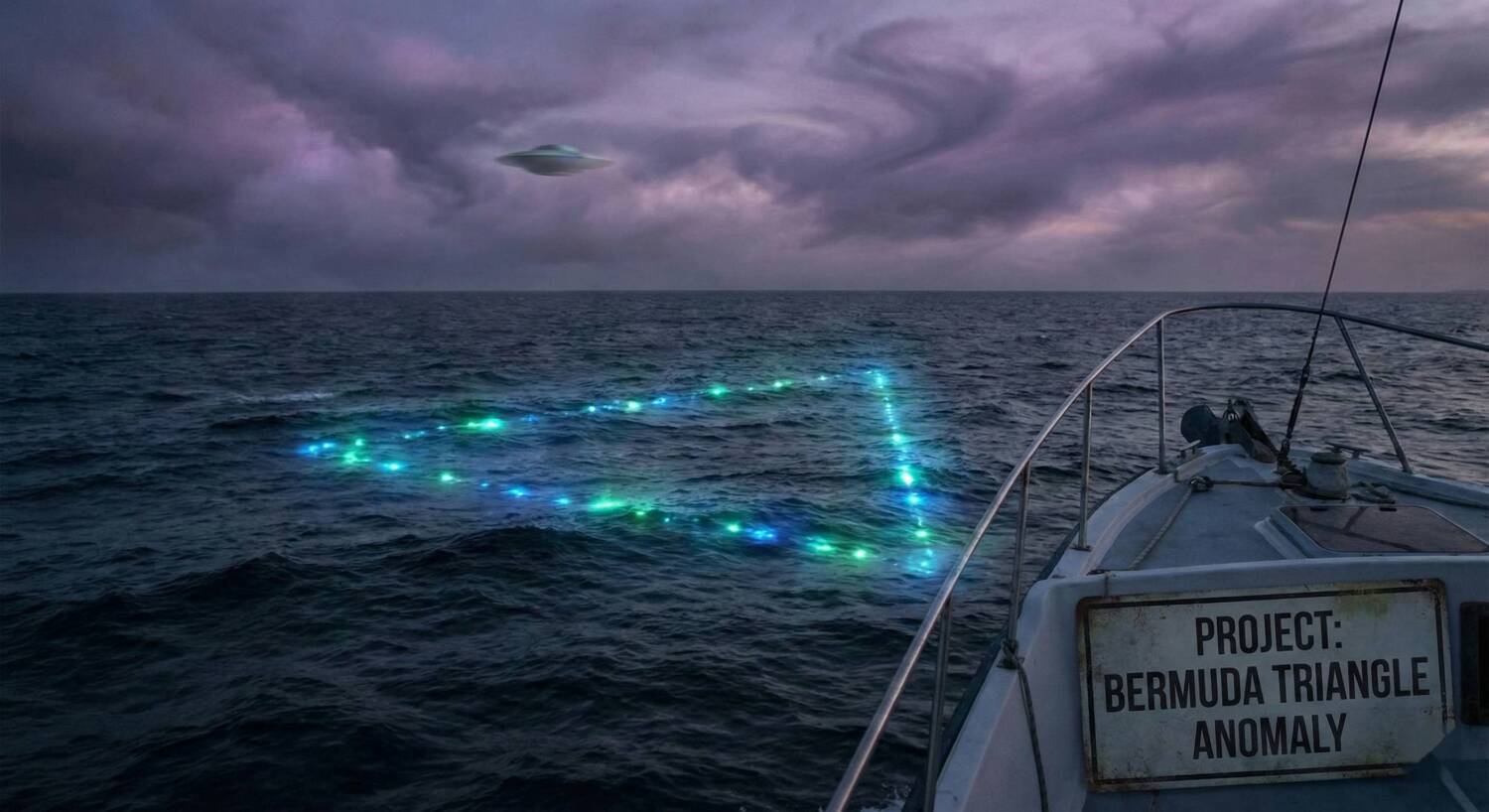
For decades, the Bermuda Triangle has captured imaginations as a zone of unexplained disappearances and eerie forces. Stretching roughly between Miami, Bermuda, and Puerto Rico, the area has been blamed for the vanishing of ships, aircraft, and crews without a trace. But in recent years, modern science has taken a closer look at this mysterious patch of the Atlantic. What researchers have discovered paints a picture far more grounded in natural explanations—though the mystery hasn’t entirely disappeared.
Modern ships, aircraft, and research institutions have spent years studying the waters of the Bermuda Triangle. The Bermuda Institute of Ocean Sciences (BIOS), for example, operates the RV Atlantic Explorer, a vessel that routinely conducts oceanographic research in and around the area. These missions measure water chemistry, current speeds, salinity, and temperature as part of long-term environmental studies.
While these expeditions were not launched to investigate paranormal events, their data has provided valuable insight into the natural forces that define the Triangle. Scientists have identified strong oceanic currents, unpredictable weather patterns, and areas of sudden turbulence that could explain many of the incidents once considered mysterious. Satellite imaging and underwater mapping have also revealed deep-sea trenches and sudden shifts in topography that might have contributed to the disappearance of ships before modern navigation systems existed.
The Search for Anomalies
Over the years, researchers have also investigated claims of magnetic disturbances or “compass malfunctions” often cited in Bermuda Triangle lore. However, detailed magnetic surveys have shown no unique or abnormal magnetic behavior in the region. The variations that do occur are consistent with those found in other parts of the world’s oceans and are well-understood by navigators today.
Some scientists have tested older hypotheses, such as methane gas eruptions from the seafloor that could reduce water density and cause ships to sink rapidly. Yet geological data has revealed no recent methane releases in the Triangle large enough to affect surface vessels. Similarly, no evidence of gravitational or electromagnetic anomalies has ever been confirmed by satellite or deep-sea measurements.
Natural Forces Behind the Myth
Researchers from organizations like NOAA and Lloyd’s of London have concluded that the Bermuda Triangle is no more dangerous than any other heavily traveled region of the Atlantic Ocean. The area’s high traffic volume, powerful Gulf Stream currents, and volatile weather likely account for most of its tragedies. Sudden tropical storms, water spouts, and rogue waves can appear without warning, even in modern times. Before GPS, radar, and satellite tracking, such hazards could easily lead to vessels vanishing without a trace.
In fact, many of the Triangle’s most famous cases occurred before the development of reliable long-distance communication or accurate navigation systems. As those technologies improved, reports of mysterious disappearances dropped dramatically. Today, the region sees thousands of ships and aircraft pass through every year without incident.
The Mystery That Remains
Despite the scientific consensus, the Bermuda Triangle continues to hold a strange allure. While modern research has debunked many supernatural claims, the idea of a part of the world’s oceans that seems to defy explanation still fascinates people. Some investigators have suggested that rare meteorological events—like sudden downdrafts or magnetic microbursts—might occasionally produce bizarre incidents that science has yet to fully understand.
For now, though, the most credible evidence suggests that the Bermuda Triangle’s mysteries are the result of nature’s unpredictable power and human vulnerability to it. The legend may never completely fade, but modern science has shown that even our most famous “haunted” seas are governed by forces we can understand—if we’re willing to look closely enough.
 Conspiracy
 The Bermuda Triangle