

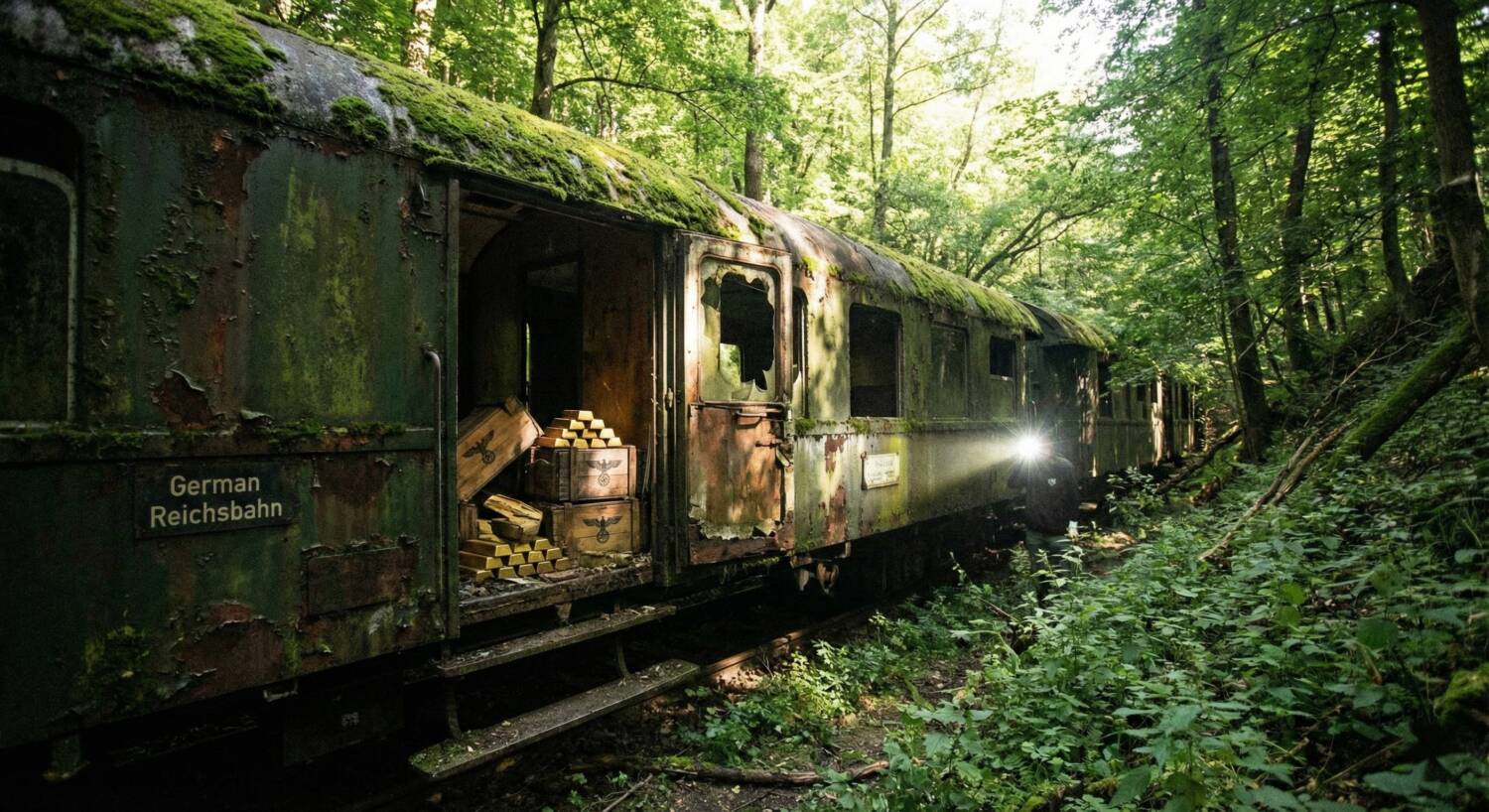
The legend of the Nazi gold train is one of the most famous treasure mysteries to come out of World War II. Though often treated as an age-old story, the tale we know today is surprisingly modern in its form. Here’s a detailed look at how the story began, how it spread, and why it still captures imaginations eighty years later.
In early 1945, as the Red Army advanced west into Nazi-occupied Europe, panic swept through the German command. The Third Reich had plundered immense quantities of gold, currency, art, and personal valuables from across the continent. Much of it was stored in Silesia, now southwestern Poland. Facing Soviet capture, Nazi officials began ordering these assets moved west toward central Germany, often by train. Several trains carrying valuables were indeed dispatched from the city of Breslau (now Wrocław), but none have ever been documented as disappearing under mysterious circumstances. The notion of a single train vanishing with tons of treasure likely grew from the confusion and destruction of those final weeks.
Post-War Whispers and Early Rumors
After the war ended, the Soviets occupied Lower Silesia, an area full of destroyed railways, sealed tunnels, and mines. Many of those tunnels belonged to the secret Nazi construction effort known as Project Riese, an underground complex spread through the Owl Mountains. Local stories soon emerged about German engineers sealing off tunnels and SS guards executing workers to hide something of great value before retreating. Polish settlers who moved into the area after the war repeated those accounts, giving birth to the first whispers of a hidden treasure train somewhere between Wrocław and Wałbrzych.
From Folklore to Printed Legend
The first written references to the Nazi gold train appeared in the 1970s in local Polish newspapers, where the tale was mentioned alongside other regional treasure rumors. By the 1980s, the legend had solidified into a more complete story: a heavily armored train left Breslau during the final weeks of the war carrying gold, art, and valuables. Somewhere near Ksiaz Castle or within the Project Riese tunnels, it was said to have vanished without a trace. The story merged with existing folklore about hidden Nazi tunnels and secret bunkers, embedding itself deeply in local culture.
Project Riese and the Perfect Setting for a Legend
Project Riese, meaning “Giant,” was a real Nazi underground construction project built between 1943 and 1945. The site’s exact purpose remains uncertain, with theories ranging from weapons production to an alternate government headquarters. Because it was abandoned and sealed off as the Soviets approached, it became a fertile ground for legends. The existence of so many uncharted tunnels convinced many that the Nazis could easily have hidden a treasure train there. To this day, parts of Riese remain unexplored, fueling speculation that something extraordinary might still lie beneath the Owl Mountains.
The Legend Reborn in the 1990s
After the fall of communism, Poland opened up to private exploration, and amateur treasure hunting boomed. During the 1990s, stories of the gold train resurfaced in books, television documentaries, and tabloid reports. Newly released archives confirmed that the Nazis had hidden valuables elsewhere in Europe, such as in Austria’s Lake Toplitz, which blurred the line between real history and myth. The idea that a similar treasure might be buried in Poland seemed entirely plausible to many.
The Global Frenzy of 2015
The legend reached global prominence in 2015 when two men, Piotr Koper and Andreas Richter, announced they had found the lost train near Wałbrzych. Their ground-penetrating radar scans showed what looked like a 100-meter-long object under an old railway embankment. The media seized the story, and even the Polish army became involved. For weeks, the world waited for confirmation of buried treasure. But when excavation began, no evidence of a train appeared. Experts later concluded that the radar images had been misinterpreted, and the supposed train-shaped anomaly was just a natural formation. Despite this, the excitement brought thousands of visitors to the area and firmly cemented the Nazi gold train as a modern legend.
The 2025 Revival
Interest in the story flared again in 2025 when a group calling themselves “Gold Train 2025” announced new findings near Wałbrzych. They claimed radar scans showed multiple freight wagons hidden in a tunnel and stated their data was “complete from the point of view of physics, mathematics and logic.” As with previous claims, no verifiable proof has been made public. Authorities have only allowed shallow surface exploration so far, leaving the matter unresolved. Historians continue to classify the gold train as an urban legend until physical evidence is uncovered.
Why the Legend Endures
Several factors explain the persistence of the Nazi gold train myth. Real Nazi treasure shipments did exist, and much of it remains unaccounted for. The tunnels of Project Riese are real, vast, and mysterious. The Soviet occupation of the region after the war was secretive, leaving room for speculation. And above all, the idea of a missing train full of gold captures the imagination in a way that few mysteries can. It combines elements of history, folklore, and adventure — the perfect ingredients for a story that refuses to fade.
Whether the gold train ever existed may never be proven, but the legend has already achieved its own kind of immortality. It continues to draw explorers, researchers, and dreamers to the mountains of Lower Silesia, searching not just for treasure, but for a glimpse of history’s most tantalizing ghost.
 Nazi Gold Train: The Allure of Hidden World War II Riches