

Among the earliest urban societies of the ancient world, the Indus Valley Civilization remains one of the most sophisticated and yet most mysterious. Flourishing between approximately 2600 and 1900 BCE, this civilization stretched across what is now Pakistan and northwest India, encompassing major cities such as Harappa, Mohenjo-Daro, and Dholavira. These cities were models of early urban planning, complete with complex drainage systems, standardized weights and measures, and evidence of trade networks that extended to Mesopotamia. Yet, one of the most enduring enigmas of this ancient society lies not in its architecture or trade, but in its writing, known as the Indus Valley Script.
A Script Without a Voice
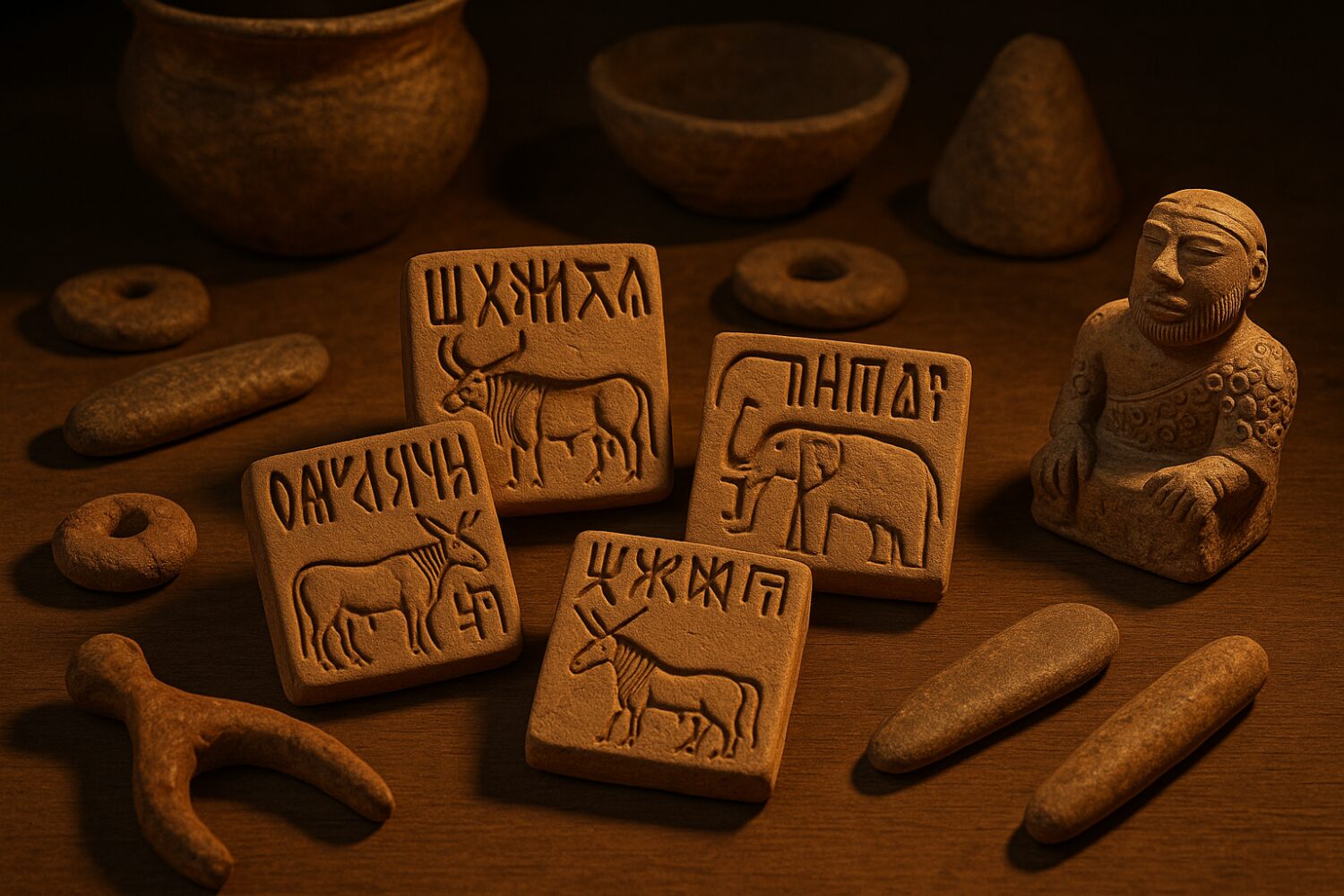
The Indus Valley Script appears on thousands of artifacts including seals, pottery shards, copper tablets, and small stone objects. These inscriptions often feature short sequences of symbols, typically between five and ten characters, accompanied by images of animals, mythological figures, or geometric patterns. The precision and consistency of these symbols suggest that they represented a standardized system of communication. However, despite over a century of study, no one has been able to read them. The civilization left behind no bilingual texts or longer inscriptions that could help decode the symbols, leaving linguists and archaeologists with little more than educated guesses.
Theories and Interpretations
Scholars have long debated whether the script represents a true written language or a proto-writing system used for administrative and ritual purposes. Some argue that the brevity of the inscriptions means they may not represent speech at all, but rather symbolic identifiers for merchants, families, or religious institutions. Others believe it encodes a spoken language, possibly an early form of Dravidian or Proto-Indo-Iranian. Computational linguists have even applied modern algorithms and artificial intelligence to analyze symbol frequencies and patterns, yet no clear linguistic structure has emerged.
Several researchers have pointed out recurring motifs and standardized sign sequences, suggesting grammatical regularity. Still, without a key for translation, such as the Rosetta Stone that unlocked Egyptian hieroglyphs, the Indus symbols remain silent. The possibility that the civilization’s language has no surviving descendants makes the task even more daunting.
The Meaning Behind the Symbols
The seals bearing these inscriptions often feature animals such as bulls, elephants, rhinoceroses, and unicorn-like creatures, leading to speculation about their cultural or religious significance. Some believe these animals were emblems of clans or deities. The frequent appearance of a seated human-like figure surrounded by animals has been interpreted by some as a proto-Shiva figure, linking the script’s iconography to early Hindu traditions. Yet, these interpretations remain speculative, built on parallels rather than proven connections.
The Enduring Mystery
One of the most compelling aspects of the Indus Valley Script is its resilience as an enigma. Despite the progress of modern archaeology and technology, it continues to resist interpretation, as if the civilization deliberately concealed its knowledge from future generations. Each new discovery, whether a seal or a fragment, adds a piece to the puzzle but never enough to reveal the full picture. It is a reminder that even the most advanced societies can vanish, leaving only tantalizing clues to their thoughts and beliefs.
Whether it represents an untranslatable language, a system of sacred symbols, or a lost code of trade and governance, the Indus Valley Script continues to inspire researchers and enthusiasts alike. It stands as one of humanity’s greatest unsolved linguistic mysteries, a testament to the depth and complexity of a civilization whose voice remains unheard yet deeply felt through its enduring silence.