

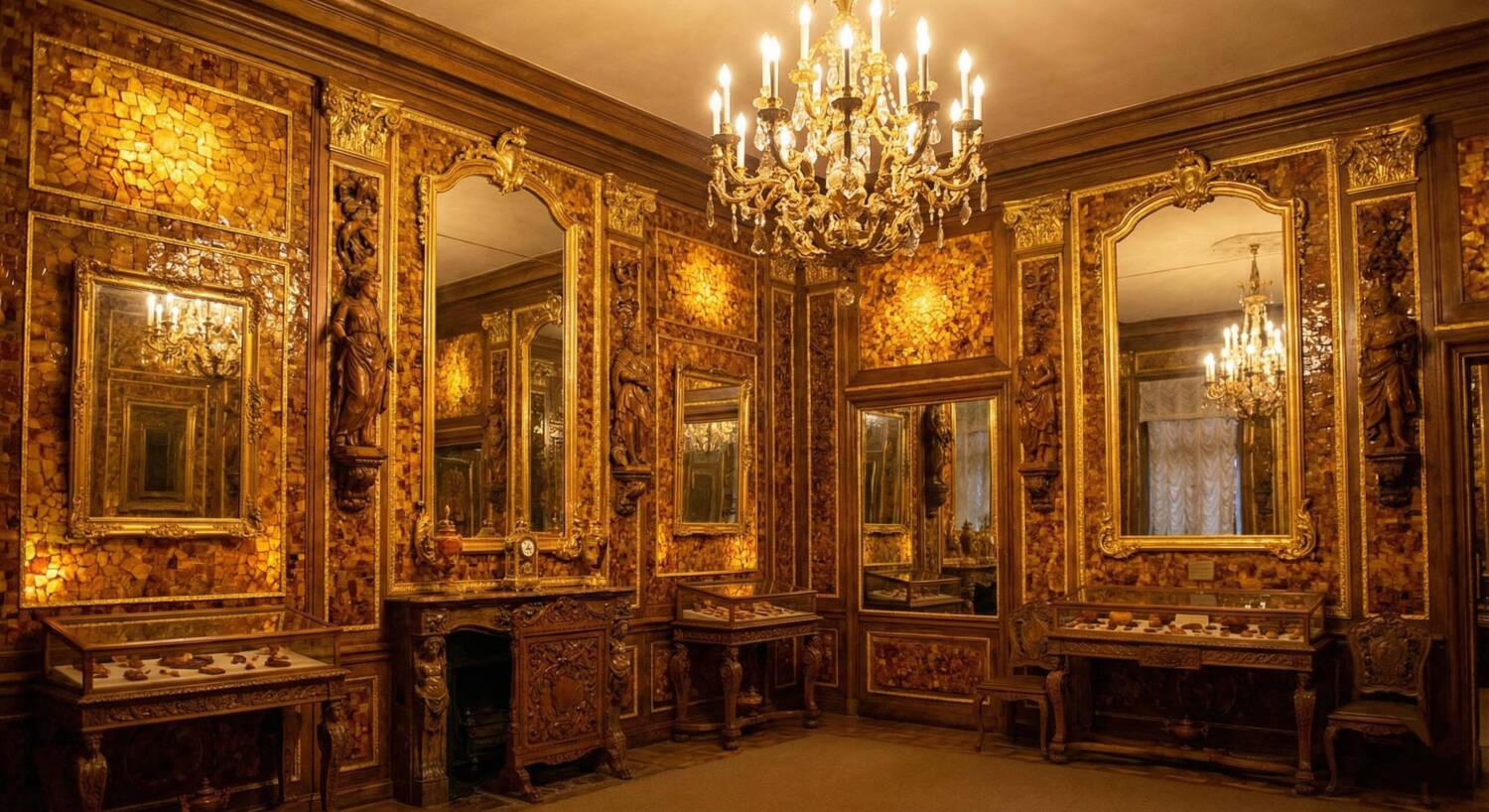

The Amber Room stands as one of history’s most legendary lost treasures, a breathtaking masterpiece that has captivated imaginations for generations. Crafted from over six tons of golden amber, intricate mirrors, and gilded wood, this opulent chamber was more than mere decorative art—it was a profound statement of imperial power, artistic brilliance, and Baroque extravagance. Its walls, shimmering with carved amber panels and gold leaf, were said to glow with a warm, ethereal light, earning it descriptions as “captured sunlight” and a wonder of the ancient world made real.
From its origins in 18th-century Prussia to its mysterious disappearance during World War II, the Amber Room’s story is woven with threads of diplomacy, war, and enduring intrigue. Today, despite a meticulous modern reconstruction, the fate of the original remains one of the world’s most perplexing unsolved mysteries, inspiring countless searches and theories. This article traces the room’s extraordinary journey, exploring its creation, its wartime vanishing, and the ongoing quest to uncover the truth behind its elusive fate.
A Gift Born of Royal Friendship
The Amber Room began its life in the early 18th century, commissioned by Frederick I of Prussia and designed by master sculptor Andreas Schlüter along with amber craftsman Gottfried Wolfram. The project quickly grew into an extravagant masterpiece of Baroque design, its walls lined with carved amber panels, gold leaf, and shimmering mirrors.
In 1716, Prussia’s King Frederick William I presented the Amber Room to Tsar Peter the Great of Russia as a diplomatic gift, cementing an alliance between the two nations. The gift was a sensation—a treasure so breathtaking that it was said to glow like captured sunlight. Over the following decades, Russian craftsmen expanded and enhanced the chamber, finally installing it in the Catherine Palace near St. Petersburg, where it became a centerpiece of imperial splendor.
By the mid-18th century, the Amber Room covered roughly 55 square meters and contained over six tons of amber. Visitors described it as radiant, almost ethereal, its golden walls glowing softly in candlelight. For nearly two centuries, it symbolized the wealth and culture of the Russian Empire.
The War That Swallowed a Masterpiece
The Amber Room’s fate changed forever in 1941 when Nazi Germany launched Operation Barbarossa and invaded the Soviet Union. As German troops swept through Russia, curators at the Catherine Palace attempted to hide the priceless chamber, but the amber had become too brittle to move safely. Within days, a German art unit dismantled the panels, packed them into crates, and transported them to Königsberg (modern-day Kaliningrad), where they reassembled the room inside the city’s castle museum.
For a brief time, the Amber Room was on display once again—this time under Nazi control. But as the war turned against Germany, Königsberg was heavily bombed by the Allies. In 1944, the castle suffered severe damage, and by the time Soviet troops reached the city in 1945, the Amber Room had disappeared entirely.
Vanished Without a Trace
No one has ever conclusively proven what happened next. Some historians believe the Amber Room was destroyed in the bombing raids or the fires that followed. Others think it was hidden in a secret bunker, mine, or even aboard a ship that sank while fleeing the advancing Soviet army.
Over the years, dozens of expeditions have searched for the lost panels. Reports of amber fragments, coded Nazi records, and secret underground chambers have fueled new leads, but none have yielded solid proof. One persistent theory suggests that portions of the room were smuggled into Germany or Poland and may still lie hidden in forgotten tunnels or vaults.
Adding to the mystery, several individuals who claimed to possess knowledge of the Amber Room’s location reportedly died under strange or sudden circumstances, deepening its aura of intrigue.
The Search and the Replica
Despite the decades of speculation, the true fate of the Amber Room remains unknown. In 2003, after years of meticulous research, Russian craftsmen completed a full reconstruction of the chamber in the Catherine Palace. Using original photographs, blueprints, and surviving records, they recreated the glowing amber walls that once captivated the world.
The replica stands today as both a triumph of restoration and a monument to loss—a symbol of cultural beauty torn apart by the chaos of war. Yet the mystery persists. Treasure hunters, historians, and adventurers continue to search, convinced that somewhere beneath layers of earth and secrecy, the real Amber Room still exists, waiting to be found.