
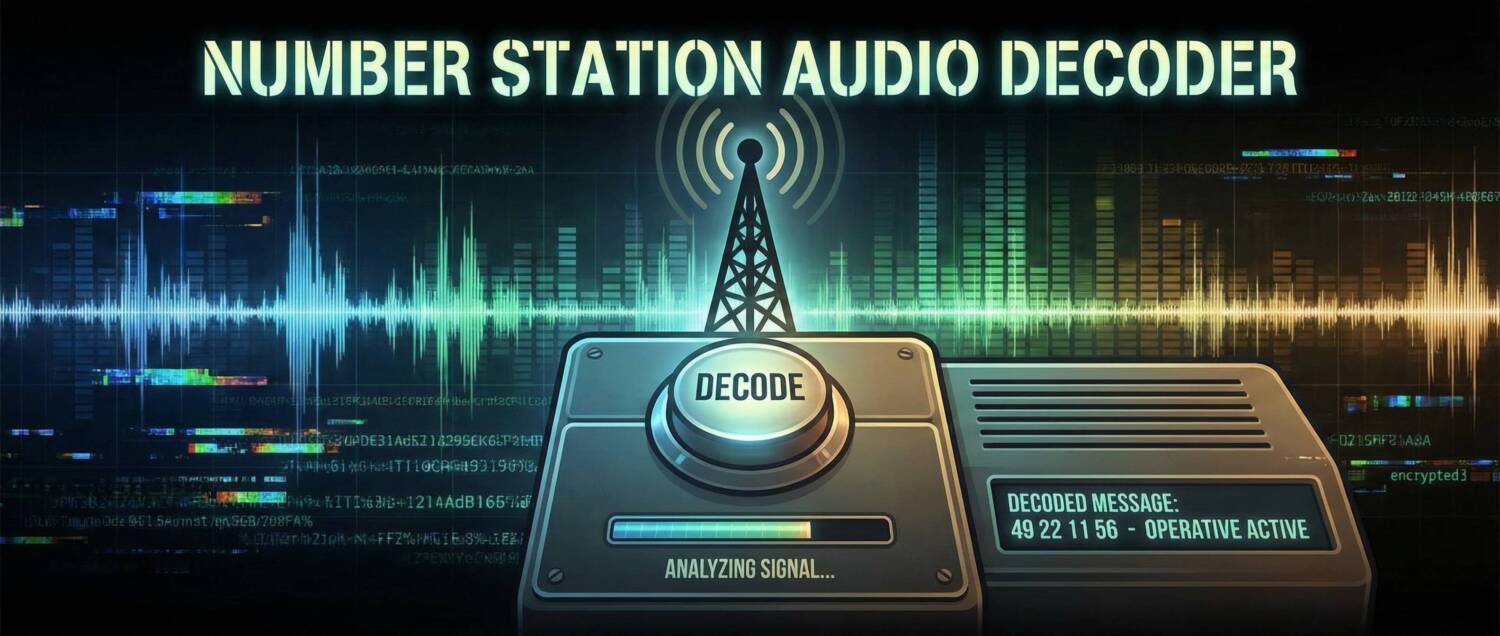

Uncover the secrets hidden in the static of shortwave radio with this specialized digital forensic tool. The Number Station Decoder is designed for both the audio analysis and cryptographic breakdown of intercepted spy transmissions. Whether you are investigating famous broadcasts like The Buzzer or analyzing a local anomaly, this tool provides the spectral visualization and decryption algorithms needed to translate ghost signals into readable intelligence.
The Cold War Never Ended on the Airwaves
For decades, amateur radio enthusiasts have tuned into mysterious broadcasts known as Number Stations. These stations transmit streams of numbers, letters, or tones, believed to be coded instructions for spies operating in foreign territories. While the technology of the world has moved on, these analog ghosts continue to broadcast. This tool transforms your browser into a listening post capable of analyzing these signals.
How to Use the Station Decoder
This tool is divided into two primary operational sectors: Signal Analysis and the Decryption Lab.
Step 1: Analyze the Audio If you have a recording of a transmission, upload it to the Signal Analysis tab. The tool generates a real-time spectrogram, visualizing the frequency bursts. This allows you to see the structure of the signal, making it easier to distinguish between background noise and data patterns. Use this visual feed to help transcribe the audio into a sequence of numbers or letters.
Step 2: Decrypt the Message Once you have your transcription, switch to the Decryption Lab. Enter your ciphertext into the input field. From here, you can apply various spycraft algorithms to attempt to reveal the plaintext message.
Available Decryption Modules
The Decryption Lab comes equipped with standard algorithms used in espionage and classic cryptography:
- A1Z26: A simple substitution cipher where A equals 1, B equals 2, and so on. This is commonly used to convert raw number streams into letters.
- Atbash: An ancient substitution cipher that reverses the alphabet. A becomes Z, B becomes Y.
- Caesar Shift: A rotation cipher often used for basic obfuscation. You can adjust the shift value to cycle through all 26 possible rotations.
- OTP (One-Time Pad) / Mod 10: The holy grail of spycraft. This module performs a digit-by-digit subtraction of a key from your ciphertext using modulo 10 arithmetic. If you possess the correct key, this method is mathematically unbreakable.
- Formatting Tools: Quickly group your text into blocks of five characters or strip whitespace to prepare the data for processing.