

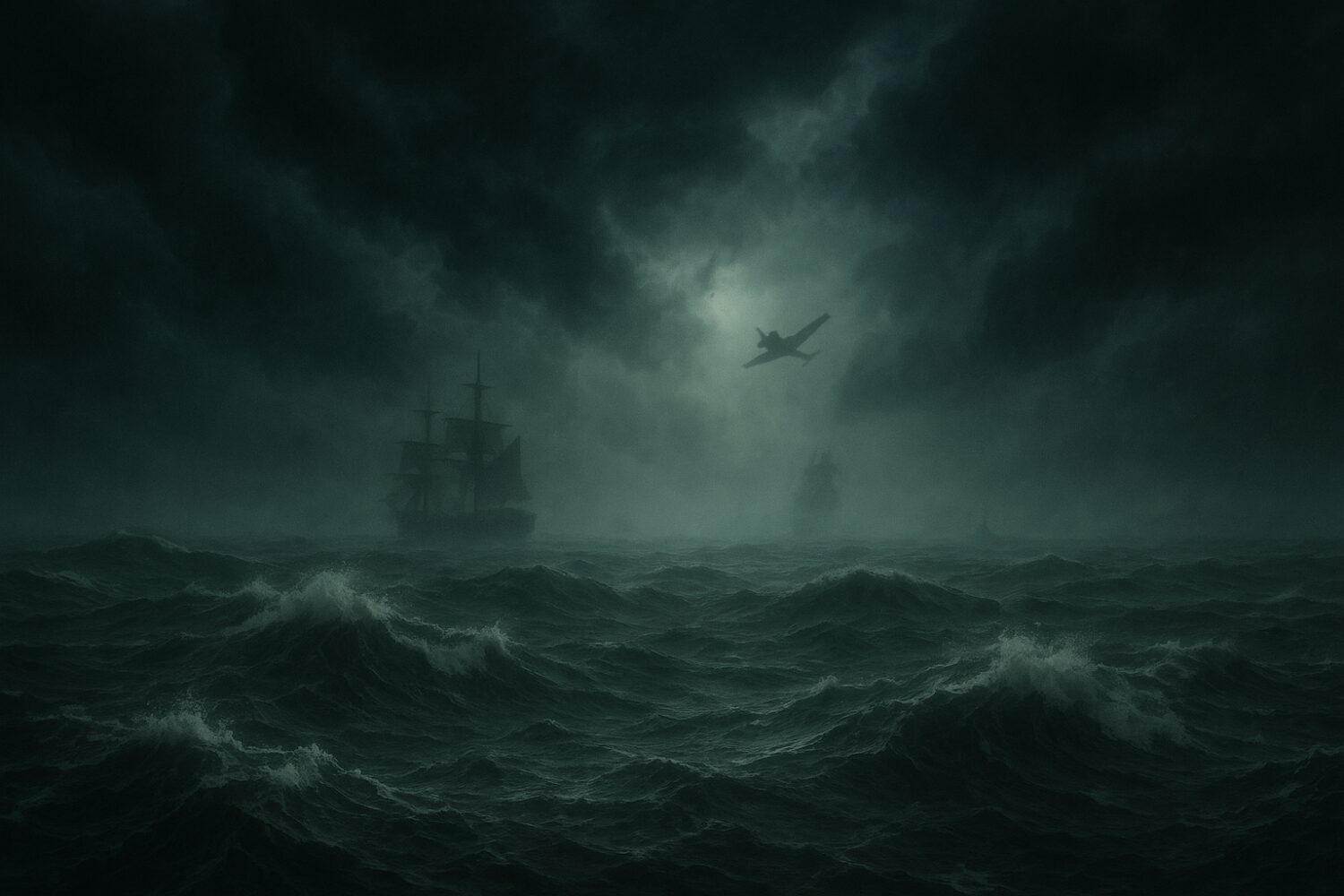
Few mysteries capture the imagination quite like the disappearance of Flight 19, a squadron of five U.S. Navy torpedo bombers that vanished without a trace on December 5, 1945. This single event is often credited with igniting the modern legend of the Bermuda Triangle, the fabled region of the Atlantic where ships and planes are said to vanish under unexplained circumstances.
Flight 19 took off from the U.S. Naval Air Station in Fort Lauderdale, Florida, for a routine training exercise known as “Navigation Problem No. 1.” The mission involved a series of overwater navigation legs designed to train pilots in open-sea flying and orientation. The squadron consisted of five Grumman TBM Avenger bombers, carrying a total of 14 men.
About 90 minutes into the flight, something went wrong. Flight leader Lt. Charles C. Taylor radioed that his compasses were malfunctioning and that he was unsure of his position. His voice, recorded in the logs of nearby radio stations, sounded increasingly anxious as he reported, “We are not sure where we are… the ocean looks strange.”
The Final Communications
Despite attempts by ground control to guide the squadron back to land, Taylor’s conflicting navigation reports suggested the group was flying deeper out to sea. The radio transcripts reveal a growing sense of confusion and urgency. At one point, Taylor insisted they were over the Florida Keys, a conclusion that baffled controllers who were tracking the flight’s likely position far to the east. This critical navigational error meant the squadron was turning away from safety, heading into the vast, open Atlantic as fuel supplies dwindled.
As daylight faded and storm conditions reportedly worsened, radio contact grew weaker and more fragmented. Controllers at Fort Lauderdale and other stations strained to hear the increasingly faint transmissions through the static. They repeatedly instructed Taylor to switch to an emergency radio frequency or to simply turn west, but compliance was inconsistent, and the signals suggested the pilots could no longer reliably determine which direction was west.
The last confirmed transmission from Flight 19 occurred around 7:04 p.m. when Taylor’s voice, crackling with interference, reportedly said, “All planes close up tight… we’ll have to ditch unless landfall.” This order to prepare for a water landing indicated a final, grim acceptance that they were lost over the ocean. Moments later, a broken, final signal was intercepted, though its content was indecipherable.
Then, silence. The five planes and their 14 crewmen vanished into the gathering darkness and were never seen again.
In one of the most chilling twists of the story, a Martin PBM Mariner flying boat was dispatched to search for Flight 19 later that evening. Within 20 minutes of takeoff, it too disappeared from radar, along with its 13-man crew. A nearby tanker reported seeing an explosion over the ocean, but no wreckage or survivors were ever recovered. The total loss: 27 men and six aircraft.
Theories and Explanations
Official Navy investigations initially concluded that the planes ran out of fuel and ditched in the sea, but the final report listed the cause as “unknown.” Over time, this lack of closure fed countless theories. Some suggest that compass malfunctions caused the pilots to become disoriented, possibly flying into bad weather. Others believe the planes may have fallen victim to rogue waves or magnetic anomalies. Paranormal enthusiasts, meanwhile, point to alien abductions or interdimensional portals as explanations for the squadron’s total disappearance.
Flight 19 remains one of the most haunting and influential mysteries of the 20th century. Despite multiple searches and advancements in sonar technology, no confirmed wreckage has ever been found. Its story continues to define the legend of the Bermuda Triangle and serves as a chilling reminder of how vast and unforgiving the ocean can be.
 The Bermuda Triangle