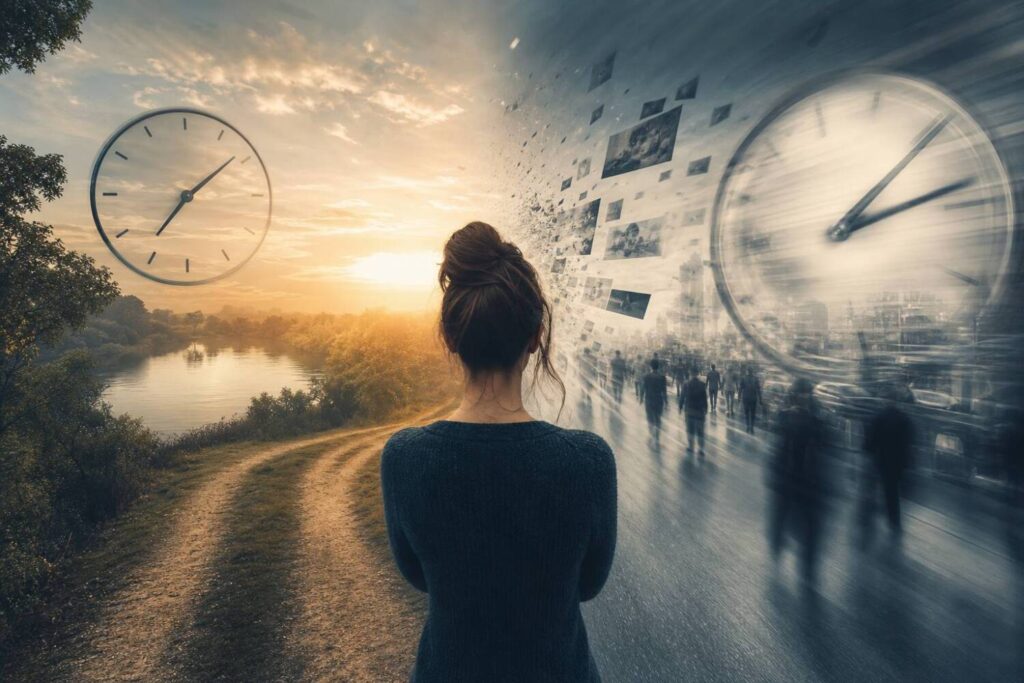
It was Sunday, and then, almost without noticing the days in between, it was Thursday. For one person describing the feeling online, weeks had seemed longer before 2020; now even the approach of another month came as a surprise. Others described the same disorientation in smaller rituals: bringing the garbage bins in, only to feel it was time to put them out again.
The feeling can be unsettling. If an hour once seemed substantial and a year now feels as though it has slipped past, it is natural to wonder what has changed. Several familiar features of attention and memory offer ways to understand the experience, without assuming that everyone experiences time in the same way.
Time in the moment and time in memory
There is a difference between how long an experience feels while it is happening and how long that period seems when remembered. A busy afternoon can pass quickly because attention is occupied. Looking back, though, a period filled with distinctive events may leave more memories to sort through than one made up of similar days.
The reverse can happen, too. An uneventful hour may feel slow while someone waits for it to end, yet the week containing it may leave few distinct landmarks in memory. That difference helps explain why a person might feel both bored in the moment and startled by how quickly the month has disappeared.
These are ways of describing patterns in perception, not a precise clock for the mind. A difficult or memorable experience does not always make a period feel longer, and people can remember the same stretch of life differently.
Why routine can make months blur
Routine gives daily life structure, but repetition can also make one day harder to distinguish from another in retrospect. When work, meals, errands and evenings follow a familiar sequence, there may be fewer obvious markers separating one week from the next.
Novelty can provide those markers. A new place, a change in schedule or an unfamiliar task may stand out when someone looks back. That does not mean every new experience feels slow while it is happening, or that a full calendar guarantees a satisfying sense of time. The point is that the remembered shape of a month depends partly on what makes its days distinguishable.
One commenter in the online discussions suggested that shared events can also anchor personal memories. When those landmarks are missing or disrupted, it may be harder to place experiences in time. That is a useful way to think about the feeling, though it is not proof of a single cause.
Does a year get shorter as we age?
A common explanation is proportional: to a five-year-old, one year represents a fifth of their life so far; to a 20-year-old, it represents a twentieth. The arithmetic is straightforward, and it offers an intuitive way to picture why a year might seem smaller against a longer lifetime.
But the calculation does not establish exactly how a year will feel. People do not necessarily judge duration by dividing it by their age, and getting older does not guarantee that every year will seem faster than the last. Changes in routine, responsibilities, attention and memorable experiences may also matter.
There is room for disagreement even within a family. In one discussion, a commenter said her husband was repeatedly astonished by how quickly their young children were growing, while the same years felt long to her. Their different impressions are a reminder that a shared calendar is not the same thing as a shared sense of time.
What attention, and phones, may change
Several people in the discussions pointed to phones: a moment of boredom becomes a few minutes of scrolling, then more time has passed than expected. An absorbing activity can draw attention away from the clock, making its passage less noticeable until the activity stops.
That is not a complete explanation for everyone. One person who felt the weeks racing by said they used their phone relatively little and did not use social media. Another described time still feeling faster than expected after more than a week without a phone, television, books or other entertainment.
Rather than treating smartphones as the sole cause, it may be more useful to ask where attention goes during an ordinary day. Screens can occupy it, but so can work, worry, chores and other familiar demands.
Why the pandemic remains a landmark
For people who locate the change around 2020, the pandemic offers a particularly striking break in the story of their lives. Ordinary routines were disrupted, and for some people days involved fewer outings or familiar social events. Looking back across that interruption, the distance between “before” and “now” can feel difficult to account for.
That does not mean the pandemic had one universal effect on time perception. A disrupted period might feel slow while being lived and compressed in memory afterward; another person might remember it very differently. Nor do the online accounts establish that the pandemic itself caused a lasting change for everyone who now feels time moving quickly.
A feeling of acceleration is not evidence that clocks have changed
Some online posters speculate that physical time is speeding up or that an outside force has altered it. Those claims go beyond the experience being reported. A strong feeling that weeks are passing unusually fast is real as an experience, but it does not, by itself, demonstrate a change in physical time.
Attention, routine and memory offer ways to examine the feeling without dismissing it. Someone who wants to notice the shape of their days might try recording small events or introducing an occasional change of routine, not as a guaranteed way to slow life down, but as a way to make its details easier to recall.
Often the unease arrives through an ordinary landmark: the bins are back at the curb, the children are older, or it is Thursday when Sunday still feels close. The clock may be familiar; what surprises us is how little of the journey between those moments we can readily bring to mind.