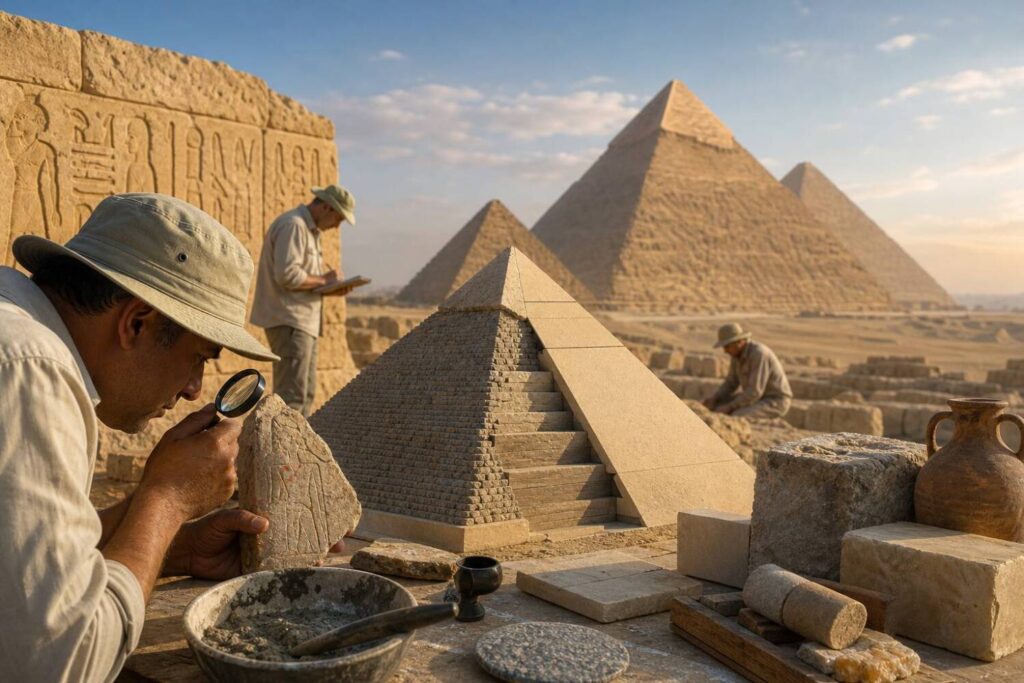
The age of the Egyptian pyramids is not established by a single inscription or document. It rests on several kinds of evidence that can be compared: records associated with a ruler’s reign, inscriptions and marks on the monuments, the materials and construction around them, and the sequence of pyramid-building forms. Each clue has limits. The case becomes persuasive when different clues point in the same direction.
For the Great Pyramid at Giza, the Diary of Merer is an important documentary clue. The account records the transport of Tura limestone to Giza during the reign of Khufu. That connects organized work at Giza with Khufu’s time, but it does not, by itself, prove that every transported block went into the pyramid: the limestone could have been used for other projects. The distinction matters. A record of activity in the right place and period is relevant evidence, not a complete construction log.
Other evidence adds to the picture. Khufu’s name has been found written on the backs of casing stones, while mortar exposed behind missing casing stones has been dated to dynastic Egypt. These findings support the attribution of the monument to the period associated with Khufu. As with the diary, their force comes from how they fit together with the wider evidence, not from treating any one clue as conclusive on its own.
What the Wadi al-Jarf records do, and do not, show
The Wadi al-Jarf papyri are discussed in connection with the Diary of Merer and the transport of stone to Giza. The record offers a concrete glimpse of logistical work during Khufu’s reign: limestone was being moved to the Giza site. It helps replace vague speculation with evidence of people and materials involved in large-scale building activity.
But the record has a defined scope. The available account does not establish that it describes every stage of construction, identify every worker, or provide a complete explanation of how the pyramid was built. Nor does evidence that stone was transported to Giza alone identify its exact final use. Responsible interpretation keeps those limits visible rather than asking a fragmentary record to answer questions it cannot settle.
Construction history is also visible in the pyramids themselves
The monuments can be considered as part of a broader architectural sequence. The discussion of Egyptian pyramids points to the Step Pyramid, the Meidum Pyramid, the Red Pyramid and the Giza pyramids as examples of changing design and construction. Comparisons among them have been used to argue for development over time, rather than the appearance of fully perfected pyramid-building without earlier stages.
This sequence is useful background, but it should not be mistaken for a precise calendar on its own. Architectural resemblance and change help archaeologists interpret relationships among monuments; records and physical evidence help anchor those interpretations in particular periods. The strongest account draws on both.
Labor, beer and the limits of the evidence
Claims that workers were paid in beer appear in the discussion, but the material provided here does not include the underlying document or enough detail to verify the claim independently. It is therefore not sound to present that statement as proof of how all pyramid workers were compensated. Likewise, the evidence summarized here does not establish a complete account of the workforce or, by itself, settle every question about labor conditions. A specific claim about payment should be distinguished from broader conclusions about who built the pyramids.
The discussion also refers to skeletal remains reported in connection with the Osiris Shaft and disputes over how those remains were described publicly. That is a separate archaeological question. The material provided does not identify those remains as pyramid workers, so they cannot responsibly be used as evidence about the pyramid labor force. Finding human remains at a site, and establishing who those people were or what work they did, are different steps.
What the evidence supports
The most defensible conclusion is cumulative: the Diary of Merer links limestone transport to Giza during Khufu’s reign; Khufu’s name on casing stones and the dating of exposed mortar add physical support; and the sequence of pyramid forms provides wider architectural context. Together, these lines of evidence support the established attribution of the Giza pyramids to ancient Egyptian construction in the period indicated by the records. They do not answer every question about building methods or labor, and claims that go beyond the available evidence should remain qualified.
That is not a weakness in archaeological reasoning. It is how historical conclusions are tested: individual clues are assessed for what they show, their limits are acknowledged, and confidence grows when independent evidence converges. An unanswered question is not proof of an alternative chronology; it is a reason to keep investigating.