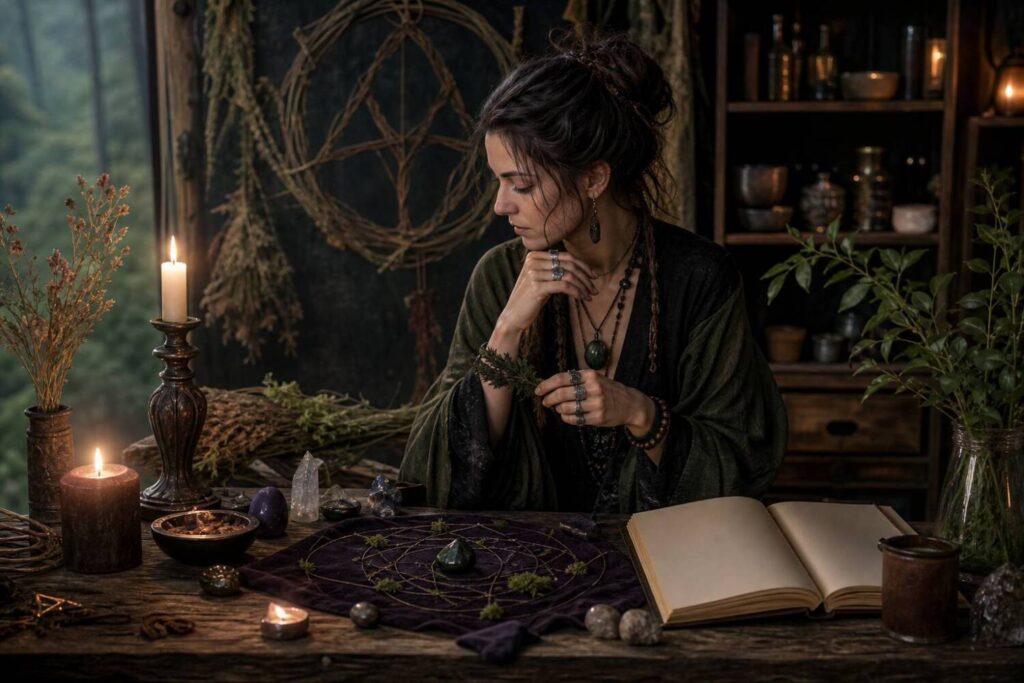
Must a witch cast spells? The answer depends on whom you ask, and, often, on what they mean by “spell.” In discussions among practitioners, some describe spell work as the defining feature of witchcraft. Others emphasize intention, nature, symbolism, spiritual practice, or study, and may not cast spells regularly, or at all. The disagreement is not just about technique. It reflects different ideas of what makes a practice witchcraft in the first place.
One useful starting point is that there is no single definition shared by everyone in these discussions. Some people use “witchcraft” to mean an active craft involving magic or spells. Others understand it more broadly, as a practice that can include ritual, energy work, personal reflection, or relationships with the natural world. Still others distinguish witchcraft from a nature-centered or spiritual identity, suggesting that someone drawn to those aspects might prefer a different label. Those are competing perspectives, not a settled test of who may call themselves a witch.
What counts as a spell?
Some of the disagreement comes down to how narrowly people define spell work. For one practitioner, a spell may mean a deliberate, clearly marked magical act: gather materials, speak an intention, and expect a particular result. Under that definition, setting a personal goal or spending time in nature may not count as spellcasting.
Other practitioners describe spell work more broadly. In one discussion, commenters suggested that it might include everyday acts such as stirring health into tea, cleansing a home, or influencing the direction of smoke. These examples show why a person can say they do not cast spells while someone else, using a broader definition, might describe some of their actions as spell work. The boundary is partly a matter of practice and partly a matter of vocabulary.
That difference matters for people who are drawn to witchcraft but uneasy with the popular image of dramatic spells that instantly change someone’s life. A practitioner may not believe that a ritual can simply make an outcome happen. They may still find meaning in using words, objects, or repeated actions to focus attention and clarify what they intend to do.
Intention-setting and the work that follows
One recurring distinction is between magic as a substitute for action and magic as a companion to action. In a discussion about putting energy into the world and then working toward a goal, commenters described spells as tools that can support material effort, not replace it. A ritual might help someone focus, build confidence, or reinforce a commitment, while the person still has to take practical steps toward the desired outcome.
This approach can make intention-setting feel close to spell work without making the two identical for everyone. Someone might name a goal, speak an affirmation, or mark a moment with a ritual, but understand the central work as their own choices afterward. Others may see those actions as spells in a broad sense; the practitioner may simply call them ways of living more intentionally.
Some commenters also describe ritual as a way to support personal change: strengthening a belief, staying attentive to a goal, or approaching life with greater care. These accounts explain what a practice can mean to the person doing it. They do not establish that spells reliably produce external effects. In the source discussions, practitioners disagree about belief, spirits, intention, and why a spell might succeed or fail. Some attribute outcomes to a spirit or to the elements of a spell; others point to intent or to the person’s own actions. There is no shared explanation in the discussion.
Nature, symbolism, and spirituality
Connection with nature, spiritual exploration, and symbolism can be important parts of a practitioner’s life without being understood as spellcasting. One person who questioned whether spell work was necessary described being drawn to nature, spirituality, and symbolism while remaining uncertain about the idea that people can shape reality through spells. That uncertainty did not erase their sense that witchcraft resonated with them; it was part of an ongoing effort to understand their own practice.
Other commenters drew a sharper distinction. They suggested that a nature-focused spiritual life without spell work might fit better under another label, such as Paganism or Druidry. These suggestions are examples of how participants negotiate categories, not definitive rules. Some people may use overlapping identities; others may find one term more accurate than another. The discussion itself also included the view that witchcraft need not be inherently spiritual, and that practitioners’ religious or spiritual beliefs vary.
Symbolism can also matter even when someone does not expect a supernatural result. A ritual, phrase, or object may help make an intention tangible or give a personal goal a deliberate beginning. For some, that is part of witchcraft; for others, it may be spiritual or reflective practice without being magic. The same outward action can carry different meanings depending on the person’s understanding of it.
Why study and patience enter the conversation
People new to witchcraft may arrive hoping for an immediate way to change difficult circumstances. One widely discussed post cautioned against expecting a quick fix and encouraged people to learn, read, and give the practice time. Its underlying point was not that every practitioner must follow one curriculum, but that a craft can involve learning rather than simply performing a spell and waiting for a result.
A commenter compared learning witchcraft to learning a language: knowing a few phrases is not the same as feeling able to speak it, and gaining skill does not mean mastering it. Another described practice as something that develops gradually. These comparisons frame witchcraft as an activity requiring experience and reflection, rather than a label earned through one dramatic act. They also help explain why some practitioners resist reducing the craft to a collection of ingredients or spells.
At the same time, study does not settle the definitional debate. Some participants argue that spell work is central to witchcraft, even if it is not done constantly. Others think a very narrow definition of a spell leaves out ordinary or subtle forms of practice. Still others are comfortable with a practice centered on nature or spirituality and may choose another name for it. Learning can help a person decide what they believe and do, but it does not make every practitioner agree on a single boundary.
A practice, a label, and room for disagreement
For someone exploring witchcraft without spellcasting, the most useful question may be less “Am I allowed to use this label?” than “What do I actually practice, and what do I mean by it?” A person can consider whether they use ritual, whether they understand intention-setting as magic, what role nature or spirituality plays, and whether they want to develop skills they associate with a craft. They can also remain uncertain while they learn.
Some practitioners will say that witchcraft requires spell work in some form. Others will include a wider range of activities, or see spells as only one part of a larger practice. That disagreement is real, and it need not be disguised as consensus. What the discussions make clear is that “spellcasting,” “intention,” “ritual,” and “witchcraft” do not mean exactly the same thing to everyone.
Witchcraft without conventional spellcasting may therefore be a meaningful description for some people and an inaccurate one for others, depending on their definitions. Nature connection, symbolism, spiritual exploration, study, and deliberate action can all be part of how people approach the craft, but no single account in these discussions speaks for everyone. The label is contested; the practice is personal; and, for many practitioners, understanding what they do takes time.